Family
Unspoken rules of the modern dating world
Exploring the Nuances of Modern Dating, Navigating Unwritten Rules and Expectations In today's dating landscape, a blend of tradition, technology, and evolving social dynamics shapes the unspoken guidelines that govern our romantic interactions. While explicit advice on dating is readily available, it's the subtle, unspoken rules that truly influence our behavior when it comes to seeking and maintaining relationships. These unwritten standards impact how we present ourselves, communicate our desires, handle conflicts, and navigate vulnerability.
By Actual Bit12 months ago in Confessions
Whispering Walls
Most people don’t pay attention to walls. They walk past them as if they’re blank things—silent, unmoving, unimportant. But I’ve always believed walls remember what we forget. Maybe that belief began the summer I returned to my childhood home to clear it out after my mother passed. Or maybe it began long before, back when I was a kid and the house seemed to hum with a life of its own. I just didn’t understand the language back then. When I unlocked the front door after all those years, the smell hit me first—old paper, dried lavender, and something faintly metallic, like rain that never arrived. Dust floated through the hallway as if it had been waiting for me specifically. The light was muted. Still. Expectant. I set my bags down and closed the door behind me. That was when I heard it. A whisper—soft, like fabric brushing against fabric. At first, I thought it was my imagination. Grief makes strange shapes out of silence. But then it came again, this time from the left wall near the old coat hooks. A long, slow exhale. My chest tightened. I remembered that sound. My mother used to say, “Every house has its own breath, beta. Listen closely and you’ll hear what it’s trying to tell you.” I used to laugh it off as one of her poetic oddities. But standing there, surrounded by dust and memories, the house really did sound as if it were breathing. I turned on the hallway light. The wallpaper, once a cheerful pattern of vines and tiny blue birds, had faded into a muted ghost of itself. The walls looked tired. But something about them felt… watchful. I spent the first day sorting boxes, opening drawers, stacking old books into piles that made no emotional sense. Grief rearranges logic like that. The house groaned sometimes—old wood settling, I told myself—but every so often, I heard the faintest murmur from somewhere deeper inside. By evening, I was exhausted. I sat on the floor of the living room, surrounded by photographs and yellowed envelopes. That was when I found a letter in my mother’s handwriting, tucked behind a frame. It read simply: “If you’re reading this, listen to the walls. They kept more than you ever knew.” The words unsettled me. My mother wasn’t cryptic in life; she was warm, clear, and straightforward. But this… this felt intentional. I held the paper to my chest and let my eyes drift closed. The whisper came again. Only this time, it wasn’t an accidental brush of sound. It was a voice. Faint. Raspy. But unmistakably human. I froze. It came from the far wall—my father’s old study. He had died when I was eight, too young to understand anything except the weight of sudden absence. My memories of him were scattered, like loose tiles that never quite fit the floor. The whisper deepened—soft syllables forming the echo of a language I couldn’t quite place. Urdu, maybe. Or the leftover breath of a lullaby spoken through time. Against every instinct, I walked toward the sound. The study door resisted at first. When it finally gave way, the stale air felt colder than the rest of the house. My father’s desk stood where it always had, covered in dust thick enough to record the history of the room. And on the back wall—the one I’d scribbled on as a child—something caught my eye. A faint shimmer… like a patch where the paint had been worn thin. I placed my palm on it. A warmth pulsed beneath the surface, as if the wall had a heartbeat. My breath caught in my throat. Then came the whisper again—clearer this time. I couldn’t understand the words, but I knew the feeling behind them. It wasn’t fear. It wasn’t sorrow. It was longing. Like the house itself missed the people who once filled it. I pressed my ear to the wall. The warmth spread—or maybe my own pulse was racing too fast. For a moment, I thought I felt movement, like shifting vibrations beneath layers of plaster. And then… A memory surged. Not a thought. Not an image. A sensation. My father’s voice—deep, patient—reading to me. His hand resting on the small of my back. The rhythm of his breath syncing with mine. Things I had forgotten long before. I stepped back, shaking. It wasn’t the wall speaking. It was me. Or the parts of me the house had held in its bones. My knees weakened, and I sank to the dusty floor. The whispering faded, replaced by a steady, comforting quiet. I stayed there until the moon cast silver lines across the floorboards. When I finally stood, something inside me had shifted. The grief was still there, heavy and real, but it wasn’t hollow anymore. It was connected—woven with the lives that had shaped me. For the next three days, I moved slowly through each room, touching the walls, listening to the muted murmurs of old laughter, arguments, songs, and silence. Every house, I realized, keeps its own archive—etched into drywall, soaked into timber, pressed into wallpaper seams. Not supernatural. Just human. The way memories cling to spaces long after we leave them. On the last morning, before locking the door for the final time, I stood in the hallway where I first heard the whisper. I ran my fingers along the faded vines of the wallpaper. A soft warmth rose beneath my hand. Not a whisper. Just a feeling. A quiet, gentle acknowledgment. When I stepped outside and pulled the door shut, I whispered back: “Thank you.” And for the first time since my mother’s passing, I felt the world exhale with me.
By Jhon smith12 months ago in Confessions
She Taught Me How to Love Myself Again
I never thought silence could be this loud. A deeply emotional story about motherhood, identity, and rediscovery. From sleepless nights and teenage storms to the quiet joy of letting go, this story explores how one mother learned to love herself again through her daughter's eyes.There's a kind of silence only mothers know - the one that follows after the crying stops, after the rooms grow quiet, after the years of chaos give way to a strange, aching peace.
By noor ul amin12 months ago in Confessions
The Last Café Before Midnight. AI-Generated.
Rain didn’t usually scare anyone in the city. But that night, it seemed heavier—like the sky was trying to wash away something it couldn’t name. The streetlights blurred into long yellow streaks, and the wind carried the smell of wet asphalt and loneliness.
By shakir hamid12 months ago in Confessions
dearest virgil,. Top Story - December 2025. Content Warning.
how are you, my consummate friend? now that we are in the same state again for the first time in years, it feels as though we couldn't be further apart. have you managed to escape your hell? i fear i have only managed to postpone my own.
By kp12 months ago in Confessions
“I Didn’t Realize I Was Losing Myself Until It Was Too Late
I Didn’t Realize I Was Losing Myself Until It Was Too Late BY: Khan I used to believe that losing yourself was a dramatic event—something loud, obvious, impossible to miss. I thought it happened in a single moment, like a crack in a mirror. But the truth is quieter. Sometimes you don’t notice it happening at all. Sometimes it feels like nothing. Just small choices, tiny compromises, little silences… until one day you wake up and the person staring back at you isn’t you anymore. For me, it started with a simple desire: to be liked. I was always the kind of person who valued peace over confrontation. I blended into groups, adjusted my opinions depending on who I sat beside, and softened my voice so much that even I could barely hear myself. It didn’t feel like a big deal back then—it felt like survival, like a shortcut to acceptance. When people praised me for being “easy” or “chill,” it felt like love. So I kept giving them what they wanted. The first real shift happened when I met Arham. He was confident in ways I wasn’t. He knew what he wanted, what he believed, and where he belonged. I admired it. Maybe I also envied it. Slowly, without realizing, I began to orbit around his personality. His preferences became mine. His routines shaped my days. If he liked a certain movie, I loved it. If he disliked someone, I avoided them. If he thought my dream of becoming a writer was “cute but unrealistic,” I laughed and agreed—even though that dream had kept me alive for years. At first, it felt like partnership. Later, it became submission. But the strangest part? I didn’t notice I was disappearing. I thought this was what love looked like—adapting, compromising, bending. I didn’t understand that bending too much turns you into a shape you can’t even recognize. My friends did try to warn me. “Ubaid, you’re quieter these days.” “You don’t hang out anymore.” “You changed.” But I brushed everything off. I told myself they didn’t understand. I told myself love required sacrifice. I told myself I was happy. The lie was comfortable. Until it wasn’t. The breaking point arrived on a night that seemed ordinary. We were at a small gathering—just friends, music, laughter. Someone mentioned a writing competition and encouraged me to join. It was harmless, just a suggestion. But Arham scoffed loudly, right in front of everyone. “She won’t do it,” he said. “She drops things halfway. She’s not built for that kind of commitment.” People laughed. I smiled too. What else could I do? But something inside me cracked—quietly, invisibly. That laugh tasted bitter, like swallowing a version of myself that still wanted to fight back. Later that night, when everyone had left, I asked him gently, “Why did you say that?” He shrugged. “Because it’s true.” It wasn’t the insult that hurt the most. It was the realization that he believed it… and maybe I did too. I had let him define me for so long that his definition became my truth. That night, I wrote for the first time in months. My hands trembled; the words came out jagged, wounded. But they were mine. And they reminded me of a version of myself I had abandoned. In the days that followed, I tried to reclaim small pieces of me. I started reading again. I reconnected with old friends. I said “no” to things that didn’t feel right. But the more I found myself, the more I lost him. He didn’t like the new—actually, the original—me. He accused me of changing, of being distant, of becoming “difficult.” But I wasn’t difficult; I was simply alive again. I was breathing in a way that felt honest. And then came the moment I will never forget. We were sitting in a café. He looked at me, frustrated, confused, almost angry, and said, “I liked you better before.” It was such a simple sentence… and it broke me. Because the “before” he was talking about wasn’t me. It was the watered-down version of myself I had created to keep him comfortable. And suddenly, everything made sense: I didn’t lose him. I had lost myself. I walked away that day—quietly, without drama. It hurt, yes. But the freedom hurt less than the cage I had built around myself. Healing was not immediate. It wasn’t magical. Some days I felt powerful; others I felt empty. Rediscovery is slow. But each day I chose myself, even when it was hard. I realized something important along the way: losing yourself doesn’t happen in a single moment, but finding yourself does. It happens the moment you decide you deserve to exist fully—unfiltered, unapologetic, unedited. Today, I’m still learning how to take up space. How to speak without fear. How to follow my dreams without waiting for someone’s permission. I’m still healing, but I’m finally home—in my own skin, in my own truth. And maybe that’s the real lesson: you don’t notice you’re lost until the world becomes too quiet, too controlled, too small. But once you hear your own voice again, even faintly, you realize it was never too late to return. I didn’t realize I was losing myself until I finally found me.
By Khan 12 months ago in Confessions
My Mother-In-Law’s Final Confession: The Secret Son She Hid For 25 Years
My Mother-In-Law’s Last Words Unlocked a Secret That Changed My Marriage Forever The Silence and the Last Breath Grief has a specific kind of quietness. It’s not just the absence of noise; it’s a heavy, insulating silence that wraps around a room, making even a whisper feel like a shout. That was the atmosphere in the hospital room the night Amelia, my mother-in-law, passed away. She had been battling a relentless illness for nearly a year, and we all knew this was the end. My husband, David, held her hand, his face a mask of controlled devastation. I stood beside him, trying to be the steady rock she had always been to me.
By The Insight Ledger 12 months ago in Confessions
My Wife’s Accident Wasn’t an Accident
Grief makes time lose its shape. Days feel like one long blur, and nights stretch until they feel endless. After my wife’s accident, I lived in that fog — half awake, half ruined, trying to convince myself that life would make sense again someday. Everyone told me the same thing. “It was an accident.” “She was unlucky.” “It was nobody’s fault.” And for a while, I believed them. I wanted to believe them, because believing anything else meant opening a door I wasn’t ready to open. But the truth has a strange habit. It doesn’t knock. It waits. Then it steps forward when you least expect it. My wife, Alina, was the kind of person who never moved through the world quietly. She lit up rooms, interrupted silences, and had a way of pulling people out of their shells. Losing someone like her is not just losing a person — it’s losing the color from your life. The night she died, I was told it happened fast. A car, a blind turn, a rainy road. Standard tragedy. But three months later, something small cracked the story open. A box. A plain cardboard box left on our doorstep with no name, no address, no return label. Inside it was a single object — my wife’s phone, the one the police told me was “too damaged to recover.” Except it wasn’t damaged at all. It was perfectly intact, fully functional, and turned off. My hands shook as I powered it on. The moment the screen lit up, it buzzed — a cluster of missed calls and messages from the night she died. All of them came from the same contact: “Don’t Let Him Find Out.” No name. Just that. The messages themselves were worse. “He knows.” “Don’t go home.” “I’m on my way. Stay where you are.” The timestamps were within minutes of the accident. Every hair on my body rose at once. I didn’t understand any of it yet — only that someone, somewhere, knew something the official report didn’t mention. I went straight to her best friend, Sana. She looked at the phone and froze as if she’d seen a ghost. “Where did you get this?” she whispered. I told her. She didn’t believe me. “No one was supposed to see these.” That one sentence felt like someone pushed ice into my chest. I asked her who the messages were from. She said she didn’t know. Her voice trembled enough to prove she was lying. Over the next few days, Sana avoided me. So did my brother-in-law. So did three of Alina’s coworkers. Everyone close to her suddenly had a reason not to talk about that night. That’s when fear changed shape. It wasn’t fear of the accident anymore — it was fear of the meaning behind it. Something was being kept from me. Carefully. Intentionally. My next step was the hospital. I asked for the surveillance footage around the ER entrance that night. The receptionist hesitated but eventually agreed. In the video, an ambulance arrives. Paramedics rush Alina inside. But a few seconds later, another figure steps out of the ambulance. A man. He wasn’t wearing a uniform. He wasn’t staff. He looked around nervously, pulled up his hood, and left almost immediately. My heart hammered against my ribs. Alina wasn’t alone when she was brought in. Someone had been with her. Someone the hospital never mentioned. I paused the footage again and again, looking at his face. He stayed just long enough for the camera to catch the shape of his jaw, the angle of his shoulders. He looked familiar. Too familiar. But my mind refused to believe it. I took the footage to my wife’s brother. When he saw it, his face drained of color. “You need to stop,” he said quietly. “Let this go.” I pressed him harder than I ever had. Finally, with tears in his eyes, he gave in. “She wasn’t supposed to be on that road,” he said. “She was going to meet someone. Someone who called her that night.” I asked him who. For a long moment he didn’t speak. Then he said the last thing I ever expected to hear. “She was coming to meet you.” My stomach flipped. “That’s impossible,” I said. “I didn’t call her.” He shook his head. “You didn’t. But someone using your name did.” It felt like the floor fell away under me. That stranger in the video… That familiar face… The warnings on her phone… The silence from everyone around me… Everything pointed to one terrifying possibility — someone had impersonated me, lured her out, and made sure I never knew the real reason she was on that road. I went home and opened her phone again. This time, I checked the deleted call logs. One entry had been wiped clean — but the digital footprint remained. A number disguised under my contact. A fake version of me. The final message she received moments before the crash was short: “Come alone. No one can know.” My hands went numb. My wife wasn’t running from danger — she was running toward what she thought was me. She had trusted the voice she believed belonged to her husband. And someone used that trust to lead her into darkness. I don’t know who the man in the hospital video was. I don’t know who left the phone on my doorstep. I don’t know why the people closest to her stayed silent. Maybe they were afraid. Maybe they were protecting me. Or maybe they knew the truth was something no one should carry. But I do know one thing now — my wife’s accident wasn’t an accident. It was a message. And whoever sent it is still out there, waiting for me to understand what the message really means.
By The Insight Ledger 12 months ago in Confessions
The Phone Call I Was Never Supposed to Hear
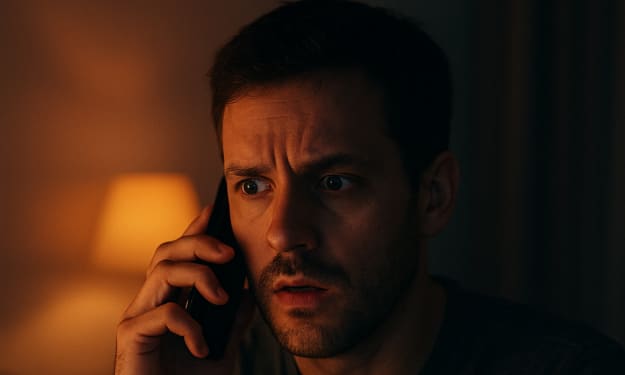
Some stories don’t begin with dramatic thunder or flashing danger. Some start quietly—like a phone ringing at a time it shouldn’t. Mine began on an ordinary Thursday night, with my wife asleep next to me and my phone vibrating against the nightstand. I wasn’t even supposed to hear it. If I hadn’t gotten up for a glass of water, if I hadn’t grabbed my phone to check the time, if I hadn’t accidentally swiped the screen instead of tapping it, I would’ve never heard the voice that changed everything. Life has a cruel sense of timing like that. When the call opened, I didn’t even know it was active. The screen was dark, the room silent. And then I heard a voice—low, unfamiliar, and too close. A man’s voice. He said my wife’s name. Slowly. Intimately. As if he had said it a thousand times before. I froze. I remember the exact way his tone shifted from confident to concerned. “Are you listening? … Hello?” I ended the call so fast the phone nearly slipped from my hand. My heart hammered against my ribs. I stared at the screen praying it was a glitch, a wrong number, a dream. Anything but what it sounded like. Before I could think, a message appeared. “Call me back when he’s asleep.” The room suddenly felt too small. Too dark. Too dangerous. My wife turned slightly in her sleep, a soft breath escaping her lips. She had no idea I was standing three feet away from her, shaking, staring at a message that could tear a marriage apart. I didn’t reply. I didn’t sleep. I sat in the living room with the phone on the table, staring at it like it might explode. Every minute felt like an hour. Every thought felt like poison. I tried to convince myself it was a mistake. A wrong number. A misunderstanding. But inside, something colder whispered: You already know the truth. At 7 a.m., when she woke up, she smiled at me like every morning—soft, warm, trusting. I couldn’t even form a full smile back. The message felt like a stain between us. As she made breakfast, her phone buzzed on the counter. Normally, I never touched it. Never even looked. But that day wasn’t normal. A new message popped up: Same name. Same number. Same man. My stomach twisted. I didn’t open it. I didn’t need to. The truth was already cracking through the surface. She saw me looking. Just for a second. And that one second changed her expression—like a cloud crossing the sun. A tiny flicker of fear. I had known her for ten years and had never seen that expression before. She grabbed the phone too quickly. “You okay?” she asked. I lied. “Yeah.” We ate in silence. For two days, I carried the secret like a burning coal in my chest. I watched her laugh, talk, move around the house like nothing was wrong. She even kissed me goodnight. I felt like a stranger living beside someone who had become a mystery overnight. But secrets don’t sit quietly. They scratch. They claw. They demand attention. On the third night, curiosity twisted into anger, and anger twisted into something worse: resolve. If she wasn’t going to tell me the truth, I would find it myself. She slept early. The room was dim. Her breathing was slow and steady. And when her phone lit up with another notification, I reached for it. My hands shook. There is something terrifying about crossing a boundary you never imagined crossing. But I crossed it anyway. I opened the message. “He doesn’t know anything. Don’t panic.” My chest tightened. Another message arrived a minute later. “You’re still coming tomorrow, right?” That was it. The quiet broke. My pulse roared in my ears. The room felt wrong. The air felt heavy. I placed her phone back and walked straight out of the bedroom before I said something irreversible. I sat in the living room again—just like the first night—and waited for morning. Maybe I wanted answers. Maybe I wanted courage. Maybe I wanted the truth to hurt less when it arrived. It didn’t. When she walked out for breakfast, I didn’t let her pretend. I didn’t pretend either. “We need to talk,” I said. Her face drained of color. For the first time in years, she looked at me like a stranger—trying to guess what I knew. She didn’t deny it. She didn’t lie. She just broke. The story that spilled out of her wasn’t the one I expected. It wasn’t an affair. It wasn’t romance. It wasn’t even emotional betrayal. It was fear. Real fear. She told me the calls were from a man who had been blackmailing her for weeks—someone who had stolen old pictures of her from before we met. Pictures she never intended anyone to see. Pictures from a past she had buried because it filled her with shame. She paid him once. He demanded more. She tried ignoring him. He threatened her. She panicked. She hid it from me because she felt guilty… and because she thought I’d see her differently. I didn’t believe her immediately. Trust doesn’t heal in a single conversation. But I looked at the messages again, the wording, the timing, the tone. Something about it aligned with fear more than romance. So I did the one thing grief, anger, and suspicion had blinded me to: I listened. I asked for the full story. By the time she finished, she wasn’t crying anymore. She just looked exhausted—as if carrying the secret had drained every last drop of strength from her. We contacted the police. Collected the messages. Reported the number. They confirmed similar cases. Same tactics. Same pressure. Same psychological traps. In the end, the truth wasn’t beautiful. It wasn’t clean. It wasn’t even easy to forgive. But it was real. And sometimes the truth—even a painful one—is better than the lies we imagine in its place. Today, the number doesn’t call anymore. The man doesn’t message. The threat is gone. But that night—the accidental call, the voice, the message that was never meant for my ears—that moment still lives in my memory like a blade with two edges. One edge cut me open. The other saved us both.
By AngelFace12 months ago in Confessions
He Died Five Years Ago… Then I Got a Message From His Number
Grief is a strange thing. People say it fades, softens, turns into something manageable over time. Maybe that’s true for some. For me, it never disappeared. It just learned to stay quiet… until the night my phone lit up with a message from a number that should have stayed silent forever. It was a little after 11 p.m. My apartment was dark, the kind of darkness that makes every sound feel louder. I had just turned off the TV and was heading to bed when my phone buzzed. I remember thinking it was probably a bank alert or a late-night promotional message. But when I picked it up, the name on the screen stopped me cold. “Daniel.” My brother. My best friend. The person I lost in an accident five years ago. At first, I didn’t breathe. I didn’t move. The room didn’t feel real anymore. The screen showed a single message. “Are you awake?” My heart pounded so hard that for a moment, I thought I might black out. My hands started shaking. I told myself it had to be a scam, a glitch, a recycled number gone to someone new. Anything except what my heart was terrified to hope for. I opened the message thread. Everything was the same as it had been on the night he died — the last message I had sent him, the one he never saw: “Text me when you get home.” He never made it home. A drunk driver hit his car just three streets away from his apartment. He was gone before the ambulance even arrived. And now, five years later, here was his name glowing on my screen, asking if I was awake. Every instinct said not to reply, but grief doesn’t follow logic. Grief follows longing. I typed three words that barely made it through my trembling fingers. “Who is this?” The reply came almost instantly. “It’s me.” I stepped back from the phone as if it had bitten me. A cold ripple ran through my chest. People don’t come back. Numbers don’t send messages from the other side. So who was playing with me? And why? I stared at the screen, trying to decide whether to block it or call it, when another message arrived. “I’m sorry I left like that.” My throat tightened. Daniel used to say that during small arguments, after late-night talks, whenever he felt guilty about something trivial. It was his way of smoothing things over. Seeing those words again felt like reopening a wound that never fully closed. I typed slowly, choosing every word carefully. “This isn’t funny. Who are you?” Again, the response came without delay. “Check the box under my bed.” My breath froze. There was only one person on earth who knew about that box. Five years ago, after Daniel’s funeral, I cleaned out his apartment. I found that old wooden crate under his bed — filled with movie tickets, childhood pictures, and small things he collected over the years. Before I left, I locked it and kept the key in my drawer. I hadn’t opened it since. But now someone — somehow — was telling me to. I grabbed my jacket, took my car keys, and drove across the city. I don’t remember the road. I don’t remember the traffic lights. I only remember the panic pulsing inside my chest as I unlocked my old storage unit where I kept the crate. The wooden box looked exactly the same. Dusty. Unmoved. Untouched. I unlocked it and opened the lid. Everything was still there — the movie ticket from our last cinema trip, a letter he wrote to himself when he was 15, the watch our father gave him. But on the top, where nothing had ever been placed before, lay a folded note. A note I had never seen. My hands went cold as I picked it up. The handwriting was his. I recognized the curve of the letters, the way he always slanted the “y.” The note read: “If you’re reading this, I didn’t make it home. I’m sorry. Please don’t carry the things I never said.” I sat down on the cold concrete floor. My breath came out uneven and shaky. Daniel had always been strangely intuitive. He would joke about writing “just in case” letters, but I never took him seriously. I didn’t know how long I sat there before my phone buzzed again. “You found it.” A chill crawled across my skin. I typed, “How did you know about the note? When did you write it?” Then I waited. One minute. Two minutes. Ten. Nothing. Finally, the three dots appeared — the typing bubble. Then nothing. Then it appeared again. Then stopped again. It felt like someone was struggling to say something. At last, a message came through. “Let it go.” That was the final text. The number stopped responding after that. When I tried calling it, a robotic voice said the number was not in service. I reported the incident to the phone company. They told me the number had been inactive for years, not reassigned to anyone, and technically couldn’t have sent a message at all. But it did. I still don’t know who—or what—contacted me that night. Maybe someone hacked something they shouldn’t have. Maybe someone wanted to hurt me. Or maybe grief plays tricks sharp enough to cut straight through reality. But the note was real. His handwriting was real. And whatever happened, it led me to the one message my brother never got to say while he was alive: let it go. Since that night, something in me feels different. The grief is still there, but it no longer claws at me the way it used to. It sits quietly, like a memory instead of a wound. Sometimes I still open my phone at night and look at the last message thread. It hasn’t changed. The final text remains: “Let it go.” And for the first time in five years… I finally think I can.
By AngelFace12 months ago in Confessions
How to Love a Partner With a Different Past
All relationships are a combination of two emotional worlds and loving one partner and having a different history will take time, understanding, and compassion. They might have been influenced by their past in how they perceive their beliefs, wounds and expectations differently than the way that you are. Rather than being scared by these differences, it is possible to embrace them to make the connections even stronger. Love is made more purposeful when you recognize and respect the distinct experiences that made your partner who he or she is today. It becomes non-passive and highly conscious and is not based on assumption but empathy.
By Hayley Kiyoko12 months ago in Confessions