Childhood
I Wanted to be a Marine Biologist
I Wanted to Be a Marine Biologist My father has a sister, Debbie. I called her “Aunt Debbie.” Debbie is honestly the nicest person I am blood related to besides my Uncle Bill. Debbie lived in Anderson, Indiana. In her bathroom, her toilet seat covers, shower covers, soap dispensers, and whatever the fuck else you can put in a bathroom were covered in a fish design. I found it so fascinating, the colors, the shapes, and sizes these creatures could come in. I found it beautiful at such a young age. Now, my aunt’s fish addiction went past the bathroom walls. Fish decorations flooded the house—might I add her house was really well furnished for Anderson in the early 2000s—but besides that, she had one betta fish. Honestly forgot the name.
By mark cunninghamabout a year ago in Confessions
Tattoos for Tots
In the grand carnival of our perpetually progressing society, every day brings fresh opportunities to cast aside dusty traditions and dance wildly into the realm of innovation. Among the array of societal taboos ripe for reconsideration, one surprisingly persists—our arbitrary denial of tattoos to children. Yes, my good friends, the absurdity must cease; it's high time we acknowledge the autonomy and self-expression of our youngest citizens by letting them ink their hearts onto their sleeves—literally.
By Conrad Hannonabout a year ago in Confessions
Confessions of a Neurodivergent Black Girl: Shame. Content Warning.
"Can't you do anything right?" Shame permeates me like the sound of a church bell in the streets. It moves through my body like a snake, wrapping itself around my heart and my brain. Then it squeezes.
By Rissabout a year ago in Confessions
"The 5 Seconds That Broke Me — and Then Built Me Again”
It was just five seconds. Five seconds of silence after the call ended. Five seconds that shattered my world. I still remember the vibration in my pocket. I was walking home after a tiring shift, lost in thought, wondering if life would ever become more than just survival. The call came from my brother. I picked it up with a tired, “Hello?” There was silence. Then a breath. Then: “Bhai… Ammi… gone.” Click. No explanations. No chance to ask how. No time to even scream. Just silence. The kind that doesn’t echo. The kind that deafens. I dropped to my knees in the middle of the sidewalk. The world around me kept moving, but I was frozen. People passed. Cars honked. A child laughed in the distance. But inside me, everything had stopped. She was my world. My reason. My late-night dua. The voice that would still whisper, “Beta, did you eat?” no matter how far away I was. And now she was gone. That night, I didn't cry. I couldn't. I sat in my room, staring at the wall. My phone buzzed — condolences, texts, calls — I didn't reply. I couldn’t. Something inside me had shut down. My heart felt like it had been unplugged from life. Around 3 a.m., I heard the Adhan for Fajr from the mosque nearby. I hadn’t prayed in months. Life had pulled me so far from Allah that I didn’t even recognize myself anymore. But that Adhan—it didn’t feel like a call. It felt like a whisper to a soul that had been buried. With slow, robotic movements, I made wudhu. Water hit my face like lightning—cold, painful, but awakening. I laid out the dusty prayer mat from under my bed. It still smelled like home. I stood for salah. And as I said, "Allahu Akbar", the dam broke. I cried through the entire prayer. Not tears of ritual or guilt. But the kind of crying that empties you. The kind where your chest convulses, and you can’t breathe, and you whisper, "Ya Allah, I’m broken. I don’t know what to do." For the first time in years, I spoke to Allah like He was right there. Because He was. That moment didn’t bring my mother back. It didn’t erase the pain. But it gave me something I hadn’t felt in years: clarity. The next few weeks weren’t easy. I’d break down without warning. I’d wake up hoping it was all a dream. But one thing stayed constant: I started talking to Allah every day. Not always in formal dua, but in whispered thoughts, in journal entries, in the silent moments of prayer. I started listening to the Qur’an again—Surah Duha became my lifeline. > “And surely your Lord is going to give you, and you will be satisfied…” (Surah Duha, 93:5) That one verse made me believe again. That maybe this loss was not the end, but a turning point. I began praying all five times. Not because I was perfect, but because I needed Him like oxygen. I volunteered at a nearby shelter. I found comfort in serving others the way my mother used to. Slowly, pain turned into purpose. And I realized something: I had built a life that looked successful but was hollow inside. My mother’s passing forced me to confront the void. And it was only in that brokenness that I found the space for Allah to rebuild me. People say time heals. I disagree. It wasn’t time. It was sujood. It was that moment in the night when I cried like a child and whispered, “Ya Allah, I have nothing left but You.” And that was enough. Today, I still miss her. I still have days where I fall apart. But I also have days where I smile for no reason—because I know she’s with her Rabb, and I’m on a path back to mine. All of it began in those five seconds. The five seconds that broke me… and then built me again.
By TrueVocalabout a year ago in Confessions
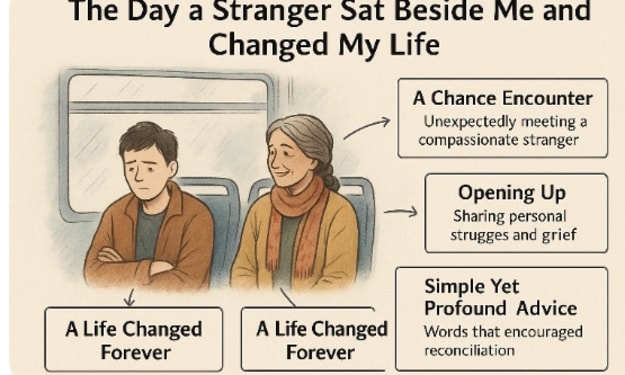
: “The Day a Stranger Sat Beside Me and Changed My Life”
I wasn’t supposed to be on that bus. My car had broken down two days earlier, and everything since had been a blur of borrowed rides, rescheduled shifts, and growing panic. I was already skating on thin ice at work, and one more delay could cost me my job. To top it off, rent was due, my savings were gone, and my sister hadn’t spoken to me since the funeral.
By Izazkhanabout a year ago in Confessions
A Light That Burned in the Dark
There was a time when Nathan didn’t know how to breathe. He wasn’t choking, not in the physical sense. But every morning felt like drowning inside a glass room, suffocating without water, without a cause, without a way out. People around him would casually say, “It’s just a phase,” as if agony was temporary like a passing flu, or a scratched record you could replace. But Nathan knew otherwise. Inside him, there was a silence deafening, persistent that crushed every budding thought before it could bloom into hope.
By Ashraf about a year ago in Confessions
Behind Smiles
Behind Smiles You see her every day. She's the kind of person who makes others feel lighter just by entering the room. Her smile is radiant, her laugh contagious. She remembers birthdays, sends late-night encouragement messages to friends, and cracks jokes even during tense meetings. Everyone calls her "sunshine." She's the one people lean on when things go wrong. Her name is Ayesha. She's twenty-six, working at a fast-paced digital agency, always dressed in vibrant colors, always humming some old Bollywood tune. If you didn’t know better, you’d say she’s the happiest person alive. But no one sees her after the lights go out. No one sees her come home to an empty apartment, place her phone face-down, and curl up on the corner of her bed, hugging a pillow that smells like memories. No one sees the moments where she stares blankly at the ceiling, eyes open, heart heavy, wondering what it’s like to live without pretending. No one hears the silence she drowns in every night — the silence she tries to fill with noise all day long. Ayesha wasn’t always this way. There was a time she dreamed freely — of writing books, traveling solo, laughing with her mother over tea on rainy evenings. But life had other plans. Her mother passed away suddenly when Ayesha was nineteen. A year later, her elder brother moved abroad, never to return. Her father stopped speaking to her after she refused an arranged marriage, saying she had "shamed" the family. So, Ayesha became her own home. Her own family. Her own comfort. She wore her smile like armor. She began journaling daily. Page after page of affirmations, goals, gratitude — but also pain. The kind of pain too raw to share. One page read: > “Everyone thinks I’m healing. But sometimes, I think I’ve just gotten better at hiding.” Work became her escape. So did social media. Her Instagram bloomed with golden hour shots, captions about self-love, coffee aesthetics, and book recommendations. People followed her for “positivity.” They never saw the drafts folder full of unsent goodbyes. Until one Thursday, everything collapsed. Ayesha didn’t get out of bed. Her limbs wouldn’t move. Her chest felt like it had caved in. Her mind — numb. Her phone kept buzzing: meetings, reminders, voice notes. She ignored them all. By evening, a close colleague who lived nearby grew concerned and came over. When she didn’t respond, he got the landlord to unlock the door. There she was. Not hurt. Not unconscious. Just sitting by the window, her face pale, her eyes swollen from crying. On the mirror in her bedroom, written in lipstick, were the words: “I’m tired of pretending.” She was taken to the hospital. Diagnosed with severe emotional exhaustion and clinical depression. The doctor called it an “internal breakdown” — the kind no one sees until it’s too late. And the people around her? Shocked. “I never knew…” “She was always so happy…” “She checked on me last week!” That’s the thing about people like Ayesha. They give so much light, hoping others don’t see their darkness. Weeks passed. Slowly, she began to speak. In therapy, at first. Then to herself in the mirror. Then finally, to the world. She posted on Instagram — no filter, no caption aesthetics: > “To those who think smiles mean strength: they don’t. I smiled to survive. I smiled to distract. I smiled so no one would ask if I was okay. But I wasn’t. And if you're reading this, and you’re tired too — please, speak up. Pretending will kill you in silence.” The post went viral. Messages poured in. Not of pity — but resonance. “I feel seen.” “This is my story too.” “You just saved me.” Ayesha changed that day. She didn’t become weak. She became real. Now, she laughs — but not to hide. She cries — without shame. And when someone says, “You seem so positive,” she smiles softly and says, “Sometimes. But not always. And that’s okay.” She leads mental health workshops at work now. She talks about the importance of checking in on “the strong ones.” She listens more. Speaks slower. Pauses often. And sometimes, when she looks at the mirror, she still sees that old version of herself — the girl who smiled to survive. But now, she reaches out — and comforts her. Because behind the brightest smiles are often the quietest screams. And Ayesha? She’s done hiding.
By TrueVocalabout a year ago in Confessions
She Was My Best Friend for 20 Years — Until I Found Out the Truth About Her Past
When a Stranger Becomes Your Person We met in college, in one of those large, echoing lecture halls where nobody really knows anyone unless they make the effort. Emily chose the seat next to me because every other seat had been taken. I remember she smiled like she already knew a secret about me. It was disarming. She borrowed a pen, cracked a joke about the professor’s monotone voice, and by the end of class, I knew I wanted her to be part of my life.
By Izazkhanabout a year ago in Confessions