Childhood
When You Outgrow Your Coping Mechanisms
At some point in your healing, you look around and realize you’re not in survival mode anymore. The alarms have stopped ringing. The ground beneath you is steadier. The chaos has quieted—but you’re still flinching. You’re still over-explaining. You’re still waiting for the other shoe to drop.
By Irfan Aliabout a year ago in Confessions
How I Learned to Be Gentle with My Mind
For most of my life, my mind was a battlefield. It wasn’t loud or chaotic in a way that anyone else could hear, but inside, the noise was constant. The judgments, the overthinking, the quiet self-criticism disguised as “motivation.” I didn’t know it back then, but I had built a home inside my head that was anything but kind.
By Irfan Aliabout a year ago in Confessions
The Blue Door
It was a time when the world seemed much bigger, and yet everything I truly needed was contained within a single neighborhood block. I was ten years old, and my universe revolved around a cracked sidewalk, the buzz of cicadas, and the whispers of wind through sycamore trees.
By nawab sagarabout a year ago in Confessions
Don’t Be Afraid
Because sometimes the monsters are real—but so is love. The fever started just after midnight. You were too hot, too pale. Your small body trembled under the blanket, though your forehead burned like fire. I heard you whimper in your sleep. A sound that shattered something soft inside me.
By Angela Davidabout a year ago in Confessions
Why I Ghosted My Best Friend
I never imagined I’d be the kind of person to ghost someone—especially not someone I once called my best friend. Yet, somewhere between unread messages and avoided phone calls, that’s exactly what happened. I ghosted my best friend. It wasn’t a decision made in anger or spite. It wasn’t even really a decision at all—it was more like a slow fade, a retreat into silence that I didn’t know how to reverse. And as much as I regret the way things ended, the experience taught me more about myself, my boundaries, and the complicated dynamics of adult friendships than I ever expected.
By Muhammad Asimabout a year ago in Confessions
The Name That Wasn’t Mine – But Followed Me for Years
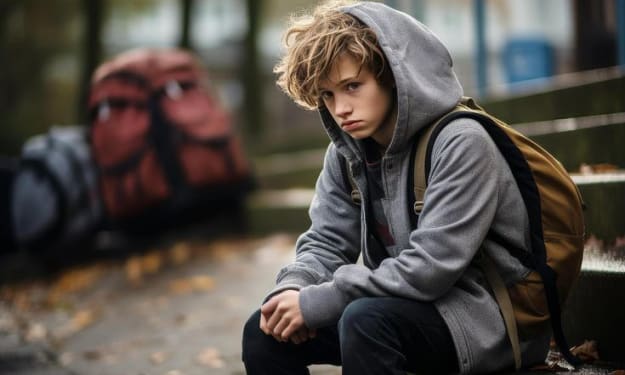
🔹 The Beginning of It All These days, it feels like a trend—students who are quiet or not very mischievous are often the ones picked on. They become easy targets. Today, I’m sharing a personal story—one that brought me pain, isolation, and left behind a scar I still carry. It started back in Grade 6, during the winter session. My older brother had kindly bought me a new school jacket. Since I wasn’t with him at the time, he chose the size randomly. When I tried it at home, it was a little big, but not in an awkward way. My mother, understanding our financial situation, said: > “It’s good. When you grow up a bit, it will fit you perfectly. Buying a smaller size now would only mean buying another one next year. We can’t afford that.” So, I wore the jacket with pride, even if it wasn’t a perfect fit. At first, nobody noticed. 🔹 The Day Everything Changed One day in class, something unexpected happened. The teacher asked me to stand and answer a question. But instead of calling me by my name, he looked at me and made a joke. He called me a funny nickname based on my jacket — a name I still can’t write because it hurts too much. The entire class laughed. I froze. That moment? It shattered something inside me. Even today, I hold deep respect for that teacher. But whenever I remember that moment, it burns inside. A teacher—a figure meant to support, to uplift—was the first to laugh at me in front of the whole class. He probably thought it was a lighthearted joke. But for me, it became a painful identity I never asked for.
By Zain ul abidin about a year ago in Confessions
The Things I Never Said Out Loud — Until Now
I don’t remember the first time I stayed quiet when I wanted to speak. Maybe it was at five years old when I heard my parents fight through the wall, and I sat in bed with my hands over my ears, wondering if it was my fault.
By nawab sagarabout a year ago in Confessions
Voices from Gaza: Life in a War Zone
Voices from Gaza: Life in a War Zone The sound of drones overhead has become as familiar as the call to prayer in Gaza. For many who live there, especially children, war is not an occasional event — it is a background noise, an uninvited guest in every home, every conversation, every dream. Behind every statistic, every news headline, there is a human being. A child who didn’t sleep. A mother who buried her son. A student who writes poetry by candlelight because the electricity is out again. These are the voices from Gaza — voices that demand to be heard not as numbers, but as people.
By Nazim Aliabout a year ago in Confessions
I Found His Toy Under the Couch. I Sat There for Hours.
I Found His Toy Under the Couch. I Sat There for Hours. It was supposed to be a normal Sunday afternoon. The kind where laundry hums in the background, the scent of coffee lingers in the air, and the house feels almost too quiet—comfortably so. But then I knelt to fetch the remote I’d dropped, and my hand touched something small and familiar beneath the couch. It was the red dinosaur. Not just any dinosaur—his dinosaur. The one with a bite mark on the tail and a missing eye. The one that roared when you pressed its belly, though now the sound was faint and glitchy. I hadn’t seen it in months. Maybe a year. Maybe longer. Time does that. It folds in on itself when grief becomes part of your every breath. I didn’t mean to sit down, not really. But I did. Right there on the floor, legs crossed like I was eight again. I turned the toy over in my hands, tracing its plastic ridges, feeling every scratch, every chip in the paint, and every memory flood in like water through a broken dam. --- He had named the dinosaur “Chompy.” Not very original, but endearingly him. He’d carried it everywhere—to the park, to preschool, even to bed, despite my protests that it was too hard and would hurt his face. He never cared. Chompy was his buddy. His partner in crime. The one who helped him roar at imaginary monsters and pretend the kitchen was a jungle. I remember the day we bought it—he was three, and the toy aisle was a battlefield of indecision. But when he saw Chompy, he grabbed it with both arms like he’d found treasure. He didn't even glance at the others. "This one," he had said, face serious. “He’s mine.” And he was. --- When he got sick, Chompy came with us to every doctor appointment. Every hospital stay. Every night spent in sterile white rooms under too-bright lights and too-quiet hallways. When the nurses couldn’t get him to sleep, they brought warm blankets, but only Chompy worked. It was during those months I began to understand the cruel shape of time. How it stretches endlessly when you’re waiting for results, yet sprints past you when you want more of it. We tried everything—treatments, diets, prayers, even silence, which we somehow hoped would change fate. But it didn’t. He was five when the world dimmed. Five. Too young to understand why he was hurting. Old enough to know he wouldn’t be going home. --- The house hasn’t been the same since. I boxed up most of his toys, gave away clothes, rearranged furniture like somehow shifting the layout would make the emptiness feel different. But some things stayed untouched—like the red dinosaur, which I assumed had been packed away, lost, or maybe taken by some quiet mercy of time. But it was here. Just under the couch. Waiting. Like he had hidden it for me. As I sat on the floor, the light through the window shifted from gold to blue, casting long shadows across the carpet. The hum of the fridge was the only sound. I pressed Chompy’s belly and heard the weak mechanical roar—a scratchy echo of a little boy's laugh. That’s when I broke. Not the kind of sobbing that you can wipe away with a tissue and a shaky breath. The kind that twists in your chest, guttural and silent, because you’re afraid if you make a sound, the walls might collapse with you. I sat there for hours. Holding that toy like it could bring him back. Like maybe, if I closed my eyes hard enough, I’d hear tiny footsteps down the hall, or his voice asking for juice or for me to read the dinosaur book again. But there was only the ticking clock, and the ache in my chest, and the weight of something I didn’t know I had buried so deep. --- They say grief gets lighter. That’s not true. You just get stronger, or better at pretending you’re okay. You learn to carry it like a stone in your pocket—small, but always there. Today, that stone felt like a boulder again. All because of a toy under the couch. Funny how grief doesn’t always come with anniversaries or birthdays. Sometimes it comes with dust and silence, plastic teeth, and a missing eye. And when it does, all you can do is sit with it. And remember.
By Azmat Roman ✨about a year ago in Confessions