Childhood
The Silence I Inherited
In the country where I currently live, the world often feels upside down. Every day brings a fresh dose of absurdity. People drive recklessly, drunk and unaware of consequences. Laws seem like mere suggestions, and the streets are filled with chaos. I don’t engage with much of it—I stay away. I have learned to withdraw, to protect my peace by limiting my contact with others.
By Saeed Ullah about a year ago in Confessions
The Last Orange She Peeled for me
I hadn’t spoken to my mother in three years. Not since the night everything fell apart—when the weight of years and unspoken words cracked the fragile glass between us. The fight itself was stupid, if I’m honest. Something about who I loved, how I lived, and how much of that didn’t match the picture she had carried in her head since I was a child. I remember her words, sharp as broken porcelain: “If that’s who you are, then you’re no longer my daughter.” I had never felt so cold while standing in the middle of a kitchen. I looked at her for a long time, waiting for her to take it back. But she didn’t. Her lips were tight. Her hands clenched. Her face was the same as it had been when I was seven and spilled juice on the carpet, but this wasn’t juice. This was me. I walked out that night with just a bag and my silence. And silence became our only language after that. Holidays passed. Birthdays came and went. Her name would flash on my screen sometimes, a message or a call, but I wouldn’t answer. There were voicemails, but I never listened to them. I told myself she didn’t deserve to be heard if she couldn’t accept me. But every time I walked past the citrus section in a grocery store, something pulled at me. Oranges. Always oranges. You see, when I was little, she used to peel them for me. She had this way of doing it—slow, careful, elegant. She never tore the peel. She’d get it off in a single, perfect spiral like it was some secret art passed down through generations. She’d split the slices for me, remove every bit of the white thread. No seeds, no mess, just sweetness and safety in my small hands. Those memories refused to fade, no matter how much distance I put between us. Then, one quiet Tuesday morning, my uncle called. The kind of call that makes your throat tighten before you even say hello. “She fell,” he said. “Out in the garden. Hit her head. She’s stable now. But... she asked for you.” I didn’t know how to feel. Anger flared up first. Then confusion. Then guilt. So much guilt. Three years of silence. Three years of her reaching out and me pretending I didn’t see. I booked the flight anyway. When I saw her in the hospital, she looked small. Not the towering woman of my childhood or the fire-breathing dragon from that night—but something gentler. Defeated, maybe. Or just tired. She didn’t speak. Just looked at me and gave the smallest, almost imperceptible nod. I didn’t know what to say. Where do you start after three years of absence? There are no scripts for this. No perfect lines. So I said nothing. I just sat beside her and took out the thing I brought: two oranges. I placed one on her table, unwrapped in a paper towel. Her eyes flicked toward it. I handed it to her gently. Her fingers trembled, but they remembered. She began peeling. Not in a single spiral, this time. Her grip wasn’t strong enough. The peel broke in chunks, jagged and wet. Juice ran down her hand and onto the towel. She winced slightly. But she didn’t stop. She peeled the entire orange and pulled it apart, slice by slice. She picked up one and held it out to me. Just like when I was small. No words. Just orange. I took it. I bit into it. It was sour at first, then sweet. Familiar. Alive. And just like that, my eyes stung. That orange did what three years of stubbornness couldn’t. It broke me. Forgiveness wasn’t something we said. It wasn’t “I’m sorry” or “I forgive you.” It was a broken peel. A shaky hand. A quiet offering of fruit between a mother and her daughter. She passed away two days later in her sleep. Peacefully. Quietly. Just like she had peeled that orange. I cleaned out her apartment with my uncle. It smelled faintly of citrus. There was a bowl of fruit on the table, two oranges left. I wrapped them carefully and took them home. At her funeral, I told no one what happened in the hospital. It felt too sacred. Too small and powerful to share. Now, I peel oranges for my daughter. I never get the peel off in one piece. It breaks every time. I smile and hand her a slice, sticky juice running down my fingers. One day she asked, “Why do you always buy oranges, Mama?” I told her, “Because someone I loved once peeled one for me.” Forgiveness is not always dramatic. Sometimes, it is soft. Sometimes, it is slow. Sometimes, it is silent. And sometimes, it’s shaped like orange slices.
By Muhammad Kaleemullahabout a year ago in Confessions
How to Create a Life You Love
What if your dream life isn’t waiting to be found—but quietly asking to be built? Every morning, millions of people wake up, brush their teeth, scroll their phones, drink coffee, and dive into a life they never consciously chose. Somewhere along the way, routine replaced purpose. But what if this very moment—right now—was your opportunity to press reset?
By USAMA KHANabout a year ago in Confessions
"The Shadow Looks Back"
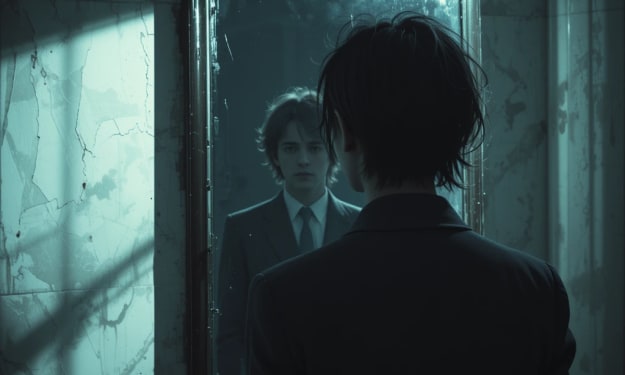
A psychological tale of confronting your deepest fears to find your truest self. 1.The Unsettling Reflection Emily had always been fascinated by mirrors. She loved staring at her reflection, admiring her features, and making funny faces to see how they would look. But one day, while getting ready for bed, Emily noticed something strange in the mirror. At first, she thought it was just a trick of the light, but as she looked closer, she realized that there was a figure standing just behind her.
By M.Changerabout a year ago in Confessions
The Day I Stopped Apologizing for My Anxiety
It happened after another draining day at work, a day tangled in nervous energy. I kept hearing myself say, “Sorry I’m so anxious,” and “Sorry if I’m a bother.” My cheeks were hot with embarrassment every time a flush of panic crept in. That afternoon, after excusing my shivers and silence for what felt like the tenth time, I caught my reflection in the bathroom mirror. My eyes looked tired, old even, weighed down by invisible baggage. At that moment, I felt a swell of anger and stubborn hope rise—the realization that I deserved more than a cycle of apologies for simply being me.
By Wilson Igbasiabout a year ago in Confessions
The Greedy Thug and the Wise Villager
Once upon a time, in a peaceful little village nestled among green hills and whispering forests, people lived a simple life. They were known for their honesty, hospitality, and pure-hearted generosity. The village had little in the way of wealth, but it was full of kindness. In the center of this village lived an old man - wise, soft-spoken, and observant. His words carried weight, though they were rarely acted on. Most of the villagers admired him, but few truly understood the depth of his wisdom.
By Echoes of Lifeabout a year ago in Confessions
Confessions of a Former Alcoholic Part 1 . Top Story - August 2025.
In the country I live in, absurd events occur almost daily, and people live in a state of lawlessness. People are almost always drunk and driving. I don't like this situation in my country, and I stay away from almost everyone.
By TheNaethabout a year ago in Confessions
The Envelope That Changed Everything
It was another rain-soaked gray morning. I was under a bakery awning, holding out for the rain to slow down, sipping on cheap coffee, scrolling my phone like everyone around me. The street was numb wet and tired and crammed with silent frustration from people trying to get somewhere. One of those mornings when no one really looks up.
By Abdullah Khanabout a year ago in Confessions
"The Day I Learned to Let Go of the Past"
I'll never forget the day I realized that I was holding onto things that no longer served me. I was going through a difficult time in my life, struggling to cope with the loss of a loved one and the end of a long-term relationship. I felt lost and alone, like I was drifting through life without a sense of direction.
By M.Changerabout a year ago in Confessions
The Silent Mind
In a discovery that could reshape neuroscience, artificial intelligence, and even philosophy, scientists at the Global Institute for Cognitive Research (GICR) have found compelling evidence of a new form of thinking — one that occurs entirely without language, mental images, or any recognizable internal monologue. The research, released earlier this week in the journal Cognitive Frontiers, introduces the concept of “pure cognition,” a previously unidentified mental process that may underlie many of our most intuitive thoughts and decisions. For centuries, human thinking has been closely tied to language. From Descartes’ “I think, therefore I am” to modern-day understandings of inner speech and visualization, we’ve assumed that thought is shaped by words or sensory-based imagery. But this new study suggests there’s more going on beneath the surface. Dr. Elena Voigt, lead neuroscientist at GICR and head of the six-year research project, describes the breakthrough as “a glimpse into the mind’s silent engine.” “We’ve long believed that language is necessary for abstract reasoning,” Voigt explained. “But what we found is a layer of thought that appears to happen faster, deeper, and entirely without language. It’s like the brain is running calculations or forming judgments in complete silence.” The study involved over 200 participants across varied linguistic, cultural, and neurological backgrounds. Using high-resolution fMRI, machine learning models, and a battery of cognitive tasks designed to bypass verbalization, researchers monitored how the brain responded to complex decision-making scenarios. Participants were asked to make snap judgments about morality, logic puzzles, or aesthetic preferences while being discouraged from using inner speech or imagery. What emerged was a consistent neural pattern — brief bursts of activity in regions not typically associated with linguistic processing, but rather with integration and synthesis, particularly in the precuneus, anterior cingulate cortex, and parts of the default mode network. These bursts occurred milliseconds before subjects could consciously explain their decision. “It was like watching the brain arrive at an answer before the person could tell you why,” said Dr. Anil Rajan, a co-author of the study. “The thinking was happening, but it wasn’t being ‘heard’ in the traditional sense.” Perhaps most striking is the implication that much of our decision-making — from snap judgments about people to momentary creative insights — may originate from this silent, pre-verbal cognitive layer. And while it doesn’t replace language-based thought, it appears to form a foundation upon which more conscious reasoning builds. The discovery has sparked interest — and debate — beyond neuroscience. AI developers, for instance, are paying close attention. If machines could be trained to model this kind of non-symbolic, intuitive processing, it could advance human-like artificial intelligence in unexpected ways. “We’ve been teaching AI to think like humans through language and logic,” said Dr. Mei Tanaka, an AI ethicist not affiliated with the study. “But what if we’re missing the most powerful part — the part that doesn’t speak? That changes everything.” However, not all experts are convinced. Some argue that the “pure cognition” observed could still be a product of unconscious verbalization or subliminal imagery not easily captured by current technology. Others worry that framing this as a new kind of thought may be premature without clearer definitions. Dr. Voigt is cautious but optimistic. “We don’t claim to have all the answers,” she said. “But we’ve opened a door. And behind that door, we see a kind of mental activity that’s been overlooked because it doesn’t speak in words. It just knows.” The implications of the research are vast. Education could one day be redesigned to foster intuitive learning pathways. Therapies might tap into this silent processing to bypass trauma-linked language. Even meditation practices may gain scientific grounding, as studies into non-verbal awareness align with ancient traditions of “thoughtless” presence. As the boundaries of the mind expand, one thing becomes clear: thinking doesn’t always sound like a voice in your head. Sometimes, the most profound thoughts are the ones that arrive without a word.
By Rizwan about a year ago in Confessions
Whispers of Winter
The children had once ruled the hill as kings and queens of winter. Laughter echoed through the cold air, snowballs flew like comets, and sleds carved winding trails down the icy slopes. Among them were Sam, Elsie, and little Kip — inseparable companions who shared their joys with a small, curious red fox they named Ember.
By Solene Hartabout a year ago in Confessions