Childhood
The Risk of Serving Kings: A Timeless Lesson from Sheikh Saadi
The Advice of Sheikh Saadi: A Tale of Wisdom, Temptation, and Consequence BY:Khan Long ago, in a time when people turned to the wise for guidance before making any life-changing decision, a poor man approached the great Persian scholar and poet, Sheikh Saadi. This man was burdened with poverty, his children were many, and his means of livelihood were almost nonexistent. Hunger gnawed at him and despair filled his heart. “Respected Sheikh,” the man said with a trembling voice, “I can no longer endure this life of want. My children are hungry, my wife suffers with me, and I have no trade or income to provide for them. Many times I have thought of abandoning this place to seek a better fortune elsewhere, but then I fear the taunts of people. They will accuse me of being heartless—of leaving my family behind in hardship just to ease my own burden. I beg you, guide me. You are known for wisdom in both worldly and spiritual matters. Please recommend me for service under a king. Perhaps in a royal court, I may find relief.” Sheikh Saadi looked at him with a calm and piercing gaze. He answered: “Serving a king is like standing on the edge of a sharp blade. There are two sides to such service: the hope of wealth and the risk of your very life. Wise men say it is never wise to put your life in danger merely for the hope of provision. Be content with simple bread and peace.” But the man grew restless. “O Sheikh, that is not the answer I seek! You do not understand my pain. If I serve the king honestly, without betrayal or deceit, why should I ever face harm from him?” To this, Sheikh Saadi narrated a parable: “One day, a fox was seen running frantically through the forest. People stopped her and asked, ‘What danger drives you so swiftly?’ The fox replied, ‘I have heard that the lions are conscripting animals for labor.’ The people laughed. ‘But you are no kin of the lion. Why should you fear?’ The fox sighed and said, ‘What if my enemies, out of jealousy, claim that I am the lion’s cub? Who then will save me from such an accusation?’ Do you not see, my friend? Even if you remain faithful and honest in your duties, jealous rivals may accuse you falsely. And in the presence of a powerful king, who will dare to defend you? For fear of their own safety, even loyal companions fall silent. Thus, it is better to endure poverty with dignity than to expose yourself to peril in the court of kings.” The poor man, however, became angry. He felt Sheikh Saadi had dismissed his suffering. Persistently, he begged again for a position. Finally, to quiet him, Sheikh Saadi recommended him to royal service. In time, the man rose through the ranks of the court. His diligence and intelligence earned him promotions. From a poor beggar, he became a respected officer. Soon, he was counted among the trusted companions of the king himself. His household prospered, and his children no longer went hungry. He felt proud that he had defied Sheikh Saadi’s caution and carved out success for himself. Years later, Sheikh Saadi traveled for the pilgrimage to Mecca. Upon his return, he happened to see the same man again—but this time in rags, broken and destitute. His face bore the scars of betrayal and hardship. Saadi was astonished. “What has happened to you?” asked the Sheikh. “How did fortune turn against you so harshly?” The man sighed heavily and spoke with bitterness. “Your words were true, Sheikh. My jealous rivals accused me of treachery against the king. Though I was innocent, the king ordered an investigation. None of my friends, none of my companions in court, dared to defend me. Their silence condemned me. The same people who once bowed before me now trample me under their feet. When I held power, they praised me. But when I fell, they abandoned me. Thus, I lost not only my position but also my honor.” Sheikh Saadi shook his head gently. “Did I not tell you? Serving kings is like living in a river—every step is threatened by drowning. If a man does not have the strength to endure a second sting, why should he place his hand again in the nest of a scorpion? Wisdom is given so that men may learn from experience. The wise profit from advice, while the foolish insist on learning only through suffering. And often, that suffering leaves scars too deep to heal.” The man lowered his head in silence. He now understood the weight of those words he had once ignored. --- Moral of the Story This timeless parable reminds us of a profound truth: not all opportunities are worth the risk they bring. The allure of wealth and position may dazzle us, but they often come with hidden dangers—jealous rivals, fragile loyalties, and the cruelty of power. It is better to live humbly and in peace than to gamble one’s life and honor in the treacherous court of kings. Sheikh Saadi’s wisdom, centuries old, still speaks to us today: true wealth lies not in riches or positions, but in contentment, integrity, and the courage to live simply.
By Khan about a year ago in Confessions
Something I need to tell you
Dear Aunt, I am sending this as an email because I need a clear place to say what I have been carrying for a long time. I will use “Aunt” here because that is what you are, even though, for many months, you have not acted like someone who cares gently for us. I will still show you respect in this message, because respect is all I can offer if nothing else remains. I know you may not answer. I know it may be ignored. Still, I need to be honest.
By Zidaneabout a year ago in Confessions
Gudia’s Prayer: A Child’s Hope for Her Friend Guddu
Gudia’s Prayer BY:Khan I am Gudia. Right now, I am sitting in the long, silent corridor of a hospital. The floor beneath me is cold, and so is the air around me. It feels like the whole world has fallen asleep, except for me and the sound of my own thoughts. I know my mother must be worried at home. I never returned last night, and she must be pacing, waiting, maybe even crying. In the morning, when I finally go home, she will scold me, perhaps even beat me with the corner of her dupatta the way she does when she is angry. And I will take it silently, because I know she is worried out of love. But how can I leave? How can I go home when Guddu is lying here in this hospital, fighting for his life? Maybe you don’t know who Guddu is. How would you? Let me tell you. Guddu is not just a friend—he is my secret-keeper, my laughter, my world. He is the one who buys me small pieces of roasted corn from the street, who treats me to a kulfi when the heat becomes unbearable, who listens to me when no one else does. But let me tell you how we first became friends. One afternoon, my mother sent me to the market to buy vegetables. On the way, I saw Guddu sitting outside his house, selling candies. I wanted one so badly. I asked him, “Please give me a candy. I’ll bring the money tomorrow.” He didn’t ask questions, didn’t frown. He just smiled and handed me a candy without taking a single coin. That was the beginning. After that day, we were always together. Our neighborhood is dirty, filled with garbage dumps at every corner. The air often smells of rotting food, and stray dogs fight over scraps in the alleys. But somehow, in that ugliness, our friendship blossomed. Guddu and I would sit near the railway crossing, right by the old iron gate where trains would thunder past. He would count the coins he earned from selling candies, his small hands moving carefully as if every coin was a treasure. And I would chatter endlessly—about my school, my mother, my dreams. He would listen, smile, and sometimes laugh out loud. Life was simple, even if the world around us wasn’t. But then came the day everything changed. We were walking home together, chatting as usual, when we came across one of those garbage piles. We tried to walk carefully, stepping around it, but in the blink of an eye, something sharp hidden inside the trash pierced Guddu’s foot. He winced in pain. Blood began to flow from the wound, staining the dust beneath his feet. I quickly tore a strip from my dupatta and pressed it against his foot to stop the bleeding. Guddu tried to laugh it off, pretending it was nothing, but I could see the pain in his eyes. After that day, he was never the same. He started falling sick more often. His laughter faded, his energy drained. His mother took him to the hospital, and then came the words that no child should ever hear: “He has AIDS.” At first, I didn’t understand what that meant. All I knew was that the doctors whispered as if they carried bad news, and people began to look at Guddu differently, as if he was carrying a shadow that could spread. But I knew only one thing: Guddu was my friend. And friends don’t leave each other behind. Now I sit here on the cold floor of the hospital corridor, praying with all my heart. I press my hands together tightly, whispering every prayer I know. “Please, God. Don’t take Guddu away. Please don’t let him die.” Tears burn my eyes, but I don’t let them fall. I believe that if I keep praying hard enough, if I keep believing, then maybe a miracle will happen. Maybe Guddu will open his eyes tomorrow, smile at me, and say, “See, Gudia? I told you I won’t leave you.” I believe in that hope. I must. Because what is friendship without hope? Dear children, if you are reading my story, I want to ask you something. Please whisper a prayer with me. Say it softly, in your heart: “Gudia’s Guddu will live. He will not die.” Because when many hearts pray together, miracles can happen. I know life is cruel sometimes. Our world is full of dirt, pain, and poverty. Children like Guddu and me are often forgotten. But in the middle of all this, love still exists—love in the form of friendship, kindness, and loyalty. That is why I believe Guddu’s story will not end here. Yes, maybe the doctors have given up. Maybe the neighbors whisper that his days are numbered. But I believe differently. I believe that prayer is stronger than fear, and friendship is stronger than disease. So I sit here through the night, on the cold hospital floor, waiting for dawn. The world sleeps, but I stay awake. Because somewhere in that room, on that hospital bed, my best friend is fighting for his life. And I will not leave him alone. Not tonight. Not ever.
By Khan about a year ago in Confessions
The Council of Selves
Ras had always been a dreamer. At seventeen, she'd fall asleep with notebooks full of plans scattered across her bed—sketches of the art gallery she'd own, acceptance letters to prestigious universities she'd attend, wedding invitations with blanks where her future husband's name would go. She dreamed in vivid detail of the woman she'd become: successful, polished, surrounded by the life she'd carefully orchestrated.
By Parsley Rose about a year ago in Confessions
The Things We Do in the Dark. Content Warning.
October 12th I saw him again today. It’s stupid, really. The way my body reacts. A full-system reboot from a thirty-second interaction in a coffee line. It’s not even about the words. It’s about the space between them.
By Chahatabout a year ago in Confessions
The Prize Hunter and the Junkyard Trick
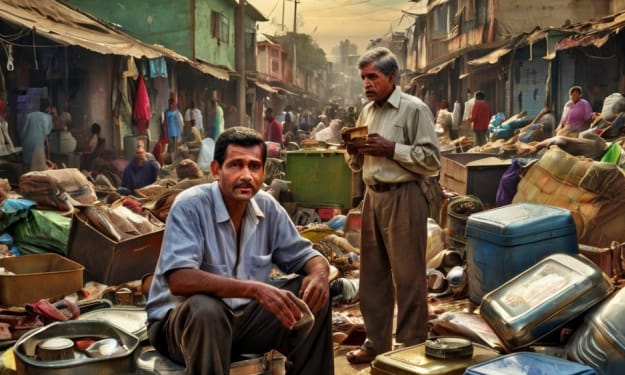
The Prize Hunter and the Junkyard Lesson BY:Khan Bashir Ahmed Bhatti, my old friend, has an unusual obsession. He is always chasing after prize schemes. Over the years, he has won several items through lucky draws—small and big prizes alike. A washing machine, a motorcycle, household appliances—he has collected them all, free of cost. The secret of his winnings lies not in luck alone but in his peculiar habit. He never throws away wrappers. Soap wrappers, tea packets, biscuit covers—even empty cigarette packs—he hoards them all in his house like a treasure trove. Whenever a company announces prizes through a lucky draw, he is the first one to pull out a stack of wrappers, scribble his name, ID card number, and mobile phone on them, and drop them into the entry boxes. Most people buy the products just to participate in the scheme, but my friend never spends a dime. He scavenges wrappers from wherever he can find them—at shops, in trash heaps, or even in the junkyard. For him, every wrapper is a lottery ticket, and the more entries he sends, the better his chances of winning. And indeed, his tactic often pays off. The companies, of course, are not blind to this trickery. They know many participants send in wrappers without purchasing the products. But since a wrapper carries no proof of whether it was bought or found, they are forced to honor the winner. A currency note works the same way: whether earned through hard work or picked up from the street, it holds its value everywhere. Similarly, a wrapper is valid as long as it isn’t torn or soiled. Still, some companies have become smarter. They now mark new products with a golden star, insisting that only star-marked wrappers qualify for the draw. Others insert coupons inside the packaging, forcing customers to purchase the item to participate. These innovations have reduced the tricks of people like my friend, but his passion remains undimmed. One pleasant afternoon, with cool breezes sweeping the city, my friend and I were strolling down a busy street. As we neared the bazaar, rows of junk shops came into view. On one side of the road stood two warehouses, and on the other, three more yards buzzing with business. Pushcart vendors were weighing scrap paper, bottles, and broken goods while the junk dealers, dressed in shabby clothes, sat lazily on their chairs, paying cash and recording tallies. Among the piles of junk, my friend’s sharp eyes caught sight of something—a shiny, almost brand-new tea tin lying on top of a mound of scrap. Its retail price would have been around 190 rupees. To him, it wasn’t just an empty container—it was a golden ticket. Without hesitation, he stepped forward, picked it up, and examined it with delight. But his small act didn’t go unnoticed. The junk dealer, sitting nearby, shouted in a harsh tone, “Uncle, please put that back. It’s not yours.” The words struck like a whip. My friend froze. All eyes turned toward him. The other junk dealers, sensing a moment of drama, began staring, eager to watch him squirm. The tin itself was worthless, but his mistake was in picking it up without permission. The dealer’s voice had exposed him, and embarrassment is heavier than any burden. For a moment, my friend looked shaken, but being clever and quick-witted, he recovered instantly. Saving face was now more important than saving the tin. He beckoned the junk dealer over with a mysterious smile. Curious, the man walked up. I, too, drew closer, wondering what trick my friend would pull this time. Holding the tea tin, my friend pointed at the printed word “Supreme.” “What does this say?” he asked. The dealer, who was literate enough, replied, “It says Supreme.” “Good,” said my friend. “Now tell me, if you remove the letters ‘Sup,’ what remains?” “Then it becomes ‘reme’—or rather ‘reme,’” the dealer answered hesitantly. “And if we add the letter K before it, what word do we get?” The dealer thought for a second. “That would make it ‘Kreme’—or ‘Cream.’” My friend leaned in dramatically. “Exactly. And cream sounds like ‘Kareem.’ Tell me, Kareem and Raheem—what are these names?” The dealer chuckled. “Kareem was my father’s name. Raheem was my uncle’s.” “Wrong!” my friend declared firmly. “No ordinary human is named Kareem or Raheem on their own. These are sacred names—attributes of Allah Himself. That is why our parents always prefix them with ‘Abdul,’ making them Abdul Kareem, Abdul Raheem. Without ‘Abdul,’ they belong only to God.” The dealer scratched his back nervously. “Yes… yes, you are right. My father’s real name was Abdul Kareem, and my uncle was Abdul Raheem.” My friend pounced on the moment. “So you see, this word on the tin—‘Supreme’—contains the sacred letters that form the word Kareem. And here you are, letting it lie in the dirt among scrap and filth. Do you realize what a grave sin that is? Words connected to the divine should be kept in a clean, elevated place, not tossed onto a junk heap.” The dealer’s eyes widened. He folded his hands apologetically. “You are absolutely right. I have made a big mistake. Please, take this tin and place it somewhere respectful. I don’t want to be guilty of disrespect again.” My friend nodded gravely. “Good. Learn from this. Never let sacred words fall into dishonor again.” He shook the dealer’s hand, tucked the tin under his arm, and walked away with me. Once we were at a distance, I turned to him and asked, half amused, half amazed, “What was that all about? You turned a scolding into a sermon and walked away with the prize.” He grinned slyly. “If I had simply put the tin back, I would have lost face. The dealer wanted to embarrass me, but I outsmarted him. And besides,” he winked, “I didn’t lie. Respect for sacred words is indeed our duty.” I couldn’t help but laugh. That was my friend—always cunning, always ready with a trick, and forever chasing prizes, even if it meant turning a junkyard lesson into a theological debate.
By Khan about a year ago in Confessions
A House Divided: When a Father’s Betrayal Shattered a Family
A House Divided BY:Khan Khalid Mahmood Ashraf’s life took a turn the day his wife, Bushra, fell seriously ill. For years, she had been the heart of their home — the mother of five daughters and two sons, the anchor of a bustling household. But this time, when she was admitted to the hospital after her third heart attack, the doctors shook their heads grimly. “Pray for her recovery,” they told the family, “the rest is in God’s hands.” For three long months, Bushra lay in the hospital bed, her children constantly at her side, whispering prayers into the sterile air. Ashraf, however, was not as steadfast. Behind the façade of worry, he had already begun weaving a new plan for himself. Believing Bushra would not survive, he secretly married Salma, a distant relative — a divorced woman with a daughter from her previous marriage. He justified his decision by telling himself that his children needed a mother. But fate had other plans. Bushra survived. By what the family called nothing short of a miracle, she was discharged from the hospital and returned home. The children’s prayers had been answered. Yet, her recovery shattered Ashraf’s secret dreams. He had imagined welcoming a new bride into the house, but Bushra’s unexpected return meant his plans fell apart. From then on, peace left the home. Ashraf, a man with a weakness for women, found himself frustrated. Small arguments with Bushra turned into daily battles. The children, already traumatized by their mother’s illness, grew weary of their parents’ endless fights. One evening, when Bushra’s married daughters and their husbands came to visit, they confronted Ashraf. Why did he keep fighting with their mother? At first, he resisted, but then he blurted out the truth. “I want to divide this house into two parts,” he declared coldly. “Bushra will live in one part with her children. And Salma, my wife, will live in the other part with her daughter. I married Salma because I thought Bushra would not survive. I did this for the children, to give them another mother. And I gave shelter to a helpless woman. Now Bushra is standing in my way.” The room fell silent. His daughters and sons were stunned. They could neither oppose their father openly nor ignore the pain of their mother. His betrayal had already taken root, and there was no turning back. Tensions escalated until tragedy struck. Ashraf’s younger son, unable to bear the humiliation and family turmoil, consumed poison and ended his life. The loss devastated Bushra, who collapsed into a coma after her son’s funeral. A year later, she too passed away, unable to recover from her grief. The family home, once filled with love and laughter, became a place of sorrow. Yet Ashraf, hardened and obstinate, remained unchanged. He brought Salma openly into the house, dividing it as he had always wanted. But his eldest son, Javed, could no longer focus on his studies. Dropping out of school, he began driving a pickup truck to provide for his younger sisters. The burden of responsibility fell squarely on his young shoulders. Ashraf, unsympathetic, had further plans. One day, he summoned Javed and delivered an ultimatum: “If you want to stay in this house, you must marry Salma’s younger sister. If you refuse, you will be thrown out and cut off from my inheritance. Decide wisely.” Javed was horrified. To him, Salma was the reason his mother and brother were gone, the root of his family’s destruction. The thought of marrying her sister was unbearable. But Ashraf’s authority was ironclad. Resistance meant losing everything. For months, Javed stalled, avoiding his father’s demand. But eventually, under relentless pressure, he surrendered. With his sisters’ futures in mind, he reluctantly married Salma’s younger sister. His sacrifice was silent, but it tore at his soul. Life moved on. Javed devoted himself to supporting his sisters and caring for his new wife. Surprisingly, she turned out to be kind-hearted, and though he never loved the circumstances, he treated her with respect. In time, she too became a partner in his struggles. But Ashraf’s selfishness did not end there. With Salma by his side, he continued to control the family. Javed, however, grew stronger. He worked tirelessly, saving every rupee he could. Finally, he convinced his wife to demand that Ashraf transfer the house into Javed’s name. Desperate to appease them, Ashraf agreed. The day the papers were signed, Javed wasted no time. He tore down the dividing wall of the house. With tears streaming down his face, he remembered his mother and brother. The family wept together, grieving the home that had once been whole. A short while later, Javed sold the house. He gathered his sisters and wife and moved to the city, determined to build a new life away from his father’s shadow. Ashraf begged him not to go. “My job is here. My life is here. Don’t leave me alone,” he pleaded. But Javed’s heart had hardened. “When you were strong, you thought only of yourself,” he told his father. “Now that you are weak, you expect us to care for you? You must learn what helplessness feels like.” And so, Ashraf was left behind, an old man surrounded by silence. Even Salma eventually left to live with her daughter and son-in-law in the city. Ashraf, once proud and domineering, now faced the twilight of his life alone, haunted by the ruins of the family he himself had destroyed.
By Khan about a year ago in Confessions
The Phone That Stole My Sister’s Life
The Phone That Stole My Sister’s Life BY:Khan Kiran woke Noor one morning with a scolding she meant as affection. “Kiran, get up — it’s morning. You stay up on your phone all night and then pretend you don’t hear the alarm. What do people even talk about on the phone all night? It’s nonsense, a waste of time.” Noor rubbed her eyes, used to Kiran’s teasing. They were only two daughters at home now; their father had died and their mother worked long hours cleaning houses to make ends meet. Kiran was restless by nature. She called late-night phone chatter “time-pass” and said it made people foolish. Noor worried about her sister — she prayed after each of the five daily prayers for Kiran’s safety. Noor kept the house in order and watched the bills while Kiran joked about romance and rebellion. “If only you had a boyfriend,” Kiran said one morning, “you’d be awake talking to him all night, whispering love vows. Life would be so much sweeter.” Noor only shook her head and asked her to eat breakfast. Two days later Kiran told Noor she would go out to celebrate a friend’s birthday and stay overnight. Noor’s eyes filled with tears. “If you don’t come back at night, I don’t want you to go at all,” she said bluntly. Kiran pushed back fiercely. “I’m not a child. This is my life and I’ll live it how I want. Please stop interfering.” Noor’s fear was not pious prudery; it was a sister’s worry. Their mother was ill and needed care. They had no brothers, no one else to rely on. Noor tried to reason, to remind Kiran that the world could be cruel, that strangers who praised could later hurt. “Once a woman’s honor is lost, it’s very hard to recover,” Noor murmured, prayers mixing with heartbreak. “If you go, be careful. Protect yourself.” Kiran laughed it off — till the night she met Samir. Samir was everything Noor had warned about: charming, well-dressed, used to winning trust and then vanishing. He was the kind of young man who courted girls on their phones, spent hours on flattery and promises, then discarded them when he was done. To Kiran, desperate for affection and excited by the secrecy, his attention felt like validation. At a five-star hotel where Kiran thought she was going to celebrate a friend’s birthday, Samir waited and smiled when she arrived. He wrapped her hand in his and whispered declarations. “You belong to me,” he told her, and Kiran, under the spell of sudden romance, believed him. They ate, they laughed, and later they left for a room where the storm outside seemed to make everything cinematic. Samir’s words were like a promise made to a gullible heart: “I’ll never leave you.” Kiran believed that, too. What happened that night was not spoken of in explicit detail, but it was enough. Samir took advantage of Kiran’s trust. He used her vulnerability and treated her like an amusement, then vanished when morning came. He left her ashamed and alone. He disconnected his number, and Kiran’s calls went unanswered. The texts stopped. It was the pattern of a predator: connect, consume, disappear. Kiran returned home with downcast eyes and a wounded conscience. Noor saw the shame in her sister’s face, but it was only when Kiran’s health began to fail that the full tragedy unfolded. Weeks after that night, Kiran grew weak and pale. She fell ill and when she was taken to the hospital, doctors discovered a pregnancy — and, shockingly, they found the baby had already died inside her. Emergency surgery was required. The surgeons warned Noor that Kiran’s life might be at risk. Noor prayed until her voice broke. She begged God to spare her sister. In the operating room, Kiran spoke with halting sincerity. “Forgive me,” she said to Noor. “This is my punishment. I ignored you. I thought I knew better. I was wrong. I am so sorry.” After hours of waiting, the surgeon emerged with the worst possible news: Kiran had not survived. The life that had caused so much grief, the girl who had been reckless and bold, who wanted to seize her freedom, was gone. Noor collapsed, grief swallowing her like an ocean. People murmured around her; she kept repeating only one thought, a single bitter, futile question: “If only she had not had a phone. If only she had listened.” The tragedy of Kiran and Noor is not just a private sorrow; it is a portrait of how social media and instant, intimate connections can be manipulated. Kiran trusted a voice on the phone and the warm glow of attention. Samir used that access to take advantage of her. Their story shows how easy it is for predators to present themselves as lovers, friends, or saviors online and then disappear when there are consequences. This is also a plea to families to talk — honestly, without shame — about risks and boundaries. Noor’s warnings were rooted in love, not control. Her sister’s defiance sprang from loneliness and a hunger for belonging. Social media, with its flattering comments and private chats, can make lies feel like truth. It can isolate the young from the protection of those who care, and it can turn a private betrayal into a catastrophe. Noor stayed behind to care for their mother, carrying the weight of loss and the bitter lesson that came too late. She became quieter, more protective of the people around her. She spoke up at neighbors’ gatherings about caution and compassion, asking families to watch their children’s late-night habits and to help rather than scold. She asked communities to teach young people how to spot false affection, how to value their bodies and choices, and how to seek help before a secret becomes a tragedy. Kiran’s story is a warning and a grief at once: the promise of connection can be a trap when it replaces real human anchors. Phones and social apps are tools — they can bring good, but in the wrong hands they can put lives at risk. Noor’s prayer did not save her sister, but her voice can still save others: speak to your loved ones, keep lines of trust open, and remember that no glowing screen is worth a human life.
By Khan about a year ago in Confessions
The Silent Widow: A Village Heiress Who Sacrificed Her Life for Others
The Untold Tale of a Village Heiress BY:Khan In the heart of a vast village during the days of the British Raj lived Raisa Khalid Ahmed, a man of immense wealth and influence. His presence commanded respect; he owned nearly half the agricultural lands of the village and two lush orchards filled with trees heavy with fruits of every season. God had blessed him with fortune, land, and prestige. Yet, despite these worldly blessings, there was a void in his life—he had no son to inherit his legacy. The village spread far and wide, its fields blooming with crops of every variety. His land alone was enough to sustain his entire family’s needs. But those were times when education, especially English education, was frowned upon by the Muslim community, more so in rural areas. Schools did not exist for boys, let alone for girls. Girls were usually taught only to recite the Quran and perform prayers. Medical facilities were equally absent—no clinics, no hospitals. Women rarely traveled to the city for treatment, for there were no proper roads, no transport. A patient often perished on the way in a bullock cart before reaching any doctor. Ahmed Sahib lived with his wife and daughters, holding tightly to the traditions of his time. He was blessed with six daughters, though tragedy struck early—four of them died in childhood. Only two survived: the elder, aged fifteen, and the younger, just nine years old. Like most men of his generation, Ahmed Sahib believed that educating girls was unnecessary. Instead, he prepared them for domestic life and looked for suitable matches when they came of age. When proposals began arriving, suitors often expressed preference for the younger daughter, but since she was too young, the proposals were politely declined. Eventually, an excellent match was found for the elder daughter. She was married into a respectable family, leaving the younger still a child at home. Not long after, another proposal came—this time for the younger daughter. It was from a wealthy family in the same village. The patriarch of that household had passed away, leaving behind vast lands and a young widow raising their only son. The boy, just fifteen, was studying in a prestigious school in the city. His mother wished for him to be married in name only, with the actual wedding delayed until he grew older. Given the wealth and honor of the family, Ahmed Sahib accepted the match, and the two children were bound together in a simple marriage contract. For a while, life went on peacefully. But fate had other plans. When the girl turned eleven, tragedy struck. Her young husband, still studying in the city, fell gravely ill and passed away. The shock reverberated through both families. The boy’s mother, devastated by the loss of her only child, soon followed him to the grave. At the very same time, Ahmed Sahib’s wife gave birth to another baby girl. Their home, once full of anticipation, was suddenly drowned in sorrow. Amid this chaos, the eleven-year-old widow could not even comprehend what had befallen her. When her bangles were broken and she was forced into white garments, she resisted in tears, screaming that she would not give up her colorful clothes or her beloved ornaments. She was too young to understand widowhood but old enough to feel its cruelty. Her mother too shared in her grief, breaking her own bangles in mourning. Life in the household grew somber. The younger sister, as she grew older, was married into a highly educated and prestigious family. Her father-in-law was a barrister trained in London, and her husband held a prominent government position. After Ahmed Sahib’s death, she took her widowed sister into her home. The young widow never remarried, for in their family, second marriages were considered improper. Instead, she devoted herself entirely to raising her sister’s children. Though she had been deprived of the joys of her own marriage, she poured her love and affection into her nieces and nephews. They grew up calling her “Ammi,” treating her with the same respect and love as their real mother. Her wealth remained intact, but she never sought luxury. Instead, she embraced a life of service and sacrifice. Her existence became a testament to quiet resilience—the story of a woman denied her own happiness yet giving boundless love to others. She lived a long life, reaching nearly ninety years of age. In 1975, she finally departed from this world. She was laid to rest from her sister’s home, the same home where she had spent decades nurturing generations that were not her own. Her story is not one of romance or grandeur, but of sacrifice, endurance, and silent strength. In an era when girls were seldom given choices, she bore the weight of her fate with dignity. While the world saw her as a wealthy heiress, in truth, she was a woman whose greatest legacy was not land or riches but the love she left behind in the hearts of those who called her “mother.” May God grant her eternal peace and the highest place in His mercy. Amen.
By Khan about a year ago in Confessions
The Hidden Pain Behind Early School Years
“The average high school kid today has the same level of anxiety as the average psychiatric patient in the 1950s.”)” - Scott Stossel, My Age of Anxiety: Fear, Hope, Dread, and the Search for Peace of Mind
By Gabriela Trofin-Tatárabout a year ago in Confessions
The New Time
Introduction This is a five year old post from my Seven Days In blog with my thoughts on getting older and why time might seem to go much faster, also with a couple of books that you might like to sample, which also touch on the nature of time.
By Mike Singleton 💜 Mikeydred about a year ago in Confessions