
Success Is Boring
Why Repetition and Routine Build Real Winners
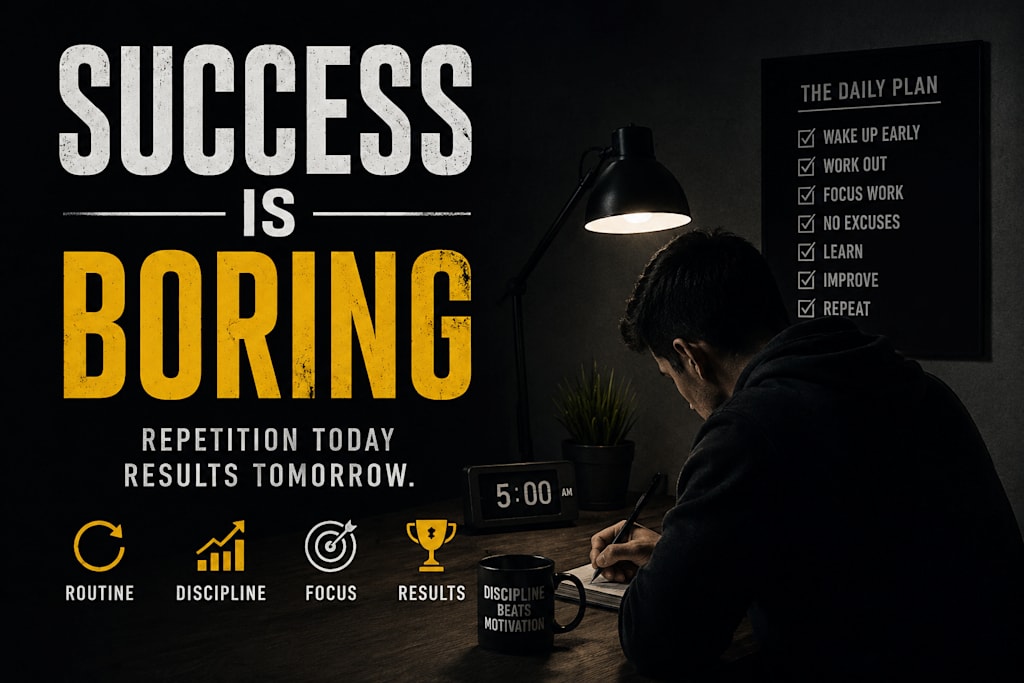
Success is often imagined as exciting, glamorous, and filled with breakthrough moments. Social media feeds are packed with highlight reels—big wins, overnight transformations, and dramatic success stories. But behind every “overnight success” is something far less exciting: repetition, routine, and consistency.
The truth is simple and uncomfortable—success is boring.
Not because it lacks value, but because it demands doing the same things over and over again, long before results show up. The sooner you accept this, the sooner you align yourself with how real progress actually works.
The Myth of Exciting Success
We are conditioned to believe that success should feel thrilling. Movies, books, and online content all reinforce the idea that success is a dramatic journey filled with constant action and visible progress.
In reality, success looks more like this:
Waking up early—even when you don’t feel like it
Practicing the same skill every day
Repeating tasks that feel mundane
Making slow, incremental improvements
There are no fireworks in the daily grind. No applause. No instant validation. And that’s exactly why most people quit.
They’re not failing because they lack talent. They’re failing because they get bored.
Why Boring Works
The human brain craves novelty. It seeks excitement, change, and quick rewards. Routine, on the other hand, feels predictable and unstimulating. But ironically, it’s this very predictability that creates mastery.
Repetition strengthens neural pathways. It turns effort into habit and habit into automatic behavior. Over time, what once required discipline becomes second nature.
Think about it:
Athletes train the same movements thousands of times
Writers sit down daily, even without inspiration
Entrepreneurs handle repetitive tasks before scaling
The magic isn’t in doing something extraordinary once. It’s in doing something ordinary consistently.
The Hidden Power of Routine
Routine eliminates decision fatigue. When your actions are pre-decided, you spend less energy debating and more energy executing.
Instead of asking:
“Should I work out today?”
“Do I feel like writing?”
Routine answers for you:
“This is what I do.”
That shift—from choice to identity—is powerful. It removes excuses and builds momentum.
A structured routine also creates stability. Even when motivation drops, your system keeps you moving forward. And in the long run, systems always outperform motivation.
Discipline Over Motivation
Motivation is unreliable. It comes and goes, often influenced by mood, environment, or external validation.
Discipline, however, is steady.
If you rely on motivation, you’ll only act when you feel inspired. If you rely on discipline, you’ll act regardless of how you feel.
That’s where the “boring” part comes in. Discipline requires:
Showing up when you don’t want to
Doing the work when it feels repetitive
Staying consistent without immediate rewards
It’s not exciting—but it’s effective.
The Plateau Phase: Where Most People Quit
One of the most frustrating parts of any journey is the plateau—the period where effort doesn’t seem to produce visible results.
You’re working hard, staying consistent, but nothing seems to change.
This is where boredom intensifies.
Many people interpret this phase as failure. In reality, it’s a necessary stage of growth. Progress is often happening beneath the surface, invisible until it reaches a tipping point.
Those who succeed are the ones who push through the plateau.
They keep going—not because it’s exciting, but because they understand the process.
Mastery Is Repetition
There is no shortcut to mastery.
Whether it’s learning a skill, building a business, or improving your mindset, mastery comes from repetition.
Doing something once gives you exposure.
Doing it ten times builds familiarity.
Doing it a thousand times builds excellence.
This repetition is not glamorous. It doesn’t feel like progress every day. But over time, it compounds into something powerful.
Small actions, repeated consistently, create massive results.
The Role of Patience
We live in a fast-paced world where everything is expected instantly—results, growth, and success.
But real success doesn’t operate on short timelines.
It requires patience.
Patience means:
Trusting the process
Accepting slow progress
Staying committed without immediate rewards
This is difficult because patience feels passive. It feels like nothing is happening.
But in reality, patience is active persistence. It’s continuing to work, even when results are delayed.
Boredom Is a Test
Boredom isn’t the enemy—it’s a filter.
It separates those who are serious from those who are not.
Anyone can start something when it’s exciting. Few can continue when it becomes repetitive.
When the novelty fades, you’re left with a choice:
Quit and chase something new
Stay and build something meaningful
Most people choose the first option. That’s why true success is rare.
Building a System That Works
If success depends on repetition, then your goal shouldn’t be to stay motivated—it should be to build a system.
A good system:
Removes unnecessary decisions
Creates structure
Encourages consistency
For example:
Set a fixed time for your work
Break tasks into manageable steps
Track progress regularly
Systems make boring work easier to sustain. They turn discipline into routine and routine into results.
The Compound Effect
The most powerful aspect of boring work is compounding.
Each small effort may seem insignificant on its own, but over time, they add up.
One workout won’t change your body
One article won’t build a career
One day of effort won’t transform your life
But repeated consistently:
Workouts build strength
Writing builds authority
Daily effort builds success
Compounding is slow at first. Almost invisible. But eventually, it accelerates.
And when it does, it looks like sudden success—when in reality, it’s the result of long-term consistency.
Redefining Success
To embrace the “boring” nature of success, you need to redefine what success means.
Instead of focusing only on outcomes, focus on actions.
Success is not just:
Getting results
Achieving milestones
It’s also:
Showing up daily
Staying consistent
Following your system
When you shift your focus from outcomes to process, the journey becomes more sustainable.
Embracing the Process
The key to long-term success is not avoiding boredom—it’s learning to embrace it.
Instead of seeing repetition as a burden, see it as progress.
Instead of chasing excitement, build consistency.
Instead of waiting for motivation, rely on discipline.
Because in the end, success isn’t built in moments of excitement. It’s built in quiet, repetitive actions that no one sees.
Final Thoughts
Success is not glamorous. It’s not always exciting. And it’s definitely not fast.
It’s slow. It’s repetitive. And yes—it’s boring.
But that’s exactly why it works.
While others chase shortcuts and quick wins, those who embrace the boring process quietly build something lasting.
So the next time your work feels repetitive or unexciting, don’t see it as a sign to quit.
See it as proof that you’re on the right path.
Because real success doesn’t come from doing extraordinary things once.
It comes from doing ordinary things—again and again—until they become extraordinary.
About the Creator
Enjoyed the story? Support the Creator.
Subscribe for free to receive all their stories in your feed.
Comments
There are no comments for this story
Be the first to respond and start the conversation.