
Public Speaking Made Simple
Turn fear into confidence step by step
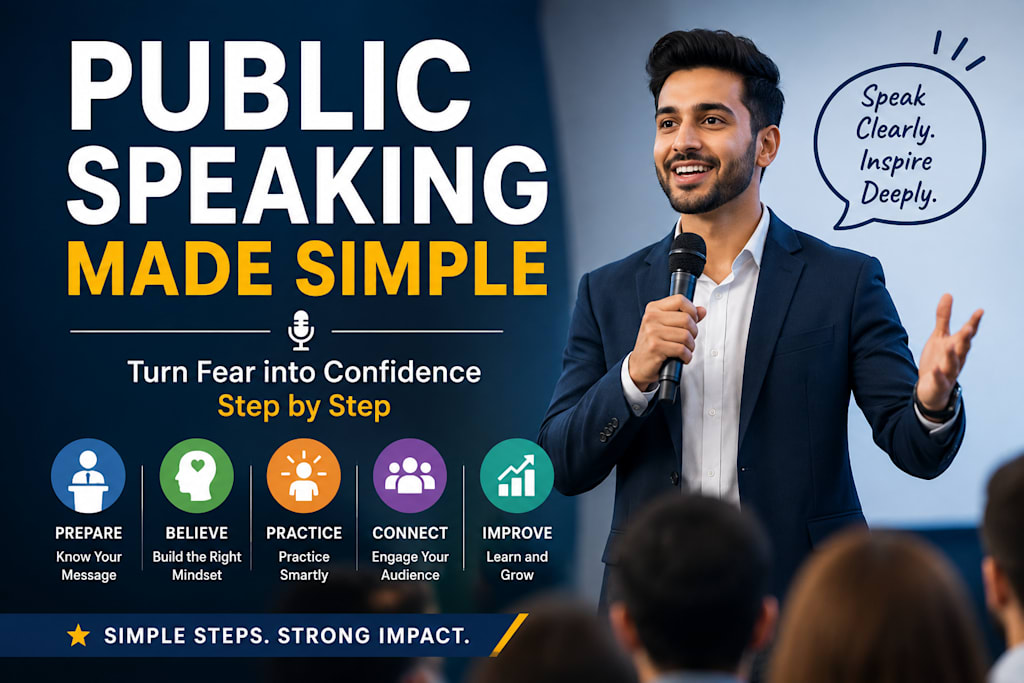
Turn Fear into Confidence Step by Step
Public speaking is often seen as one of the most intimidating skills to master. For many, the thought of standing in front of an audience—whether it’s five people or five hundred—triggers anxiety, self-doubt, and even fear. But here’s the truth: public speaking doesn’t have to be complicated or overwhelming. With the right approach, anyone can learn to speak confidently and effectively.
This guide breaks public speaking down into simple, practical steps so you can move from nervous to natural—one stage at a time.
Why Public Speaking Feels Difficult
Before simplifying public speaking, it’s important to understand why it feels so hard in the first place.
Most fear comes from:
Fear of being judged
Fear of making mistakes
Lack of preparation
Negative past experiences
Your brain treats public speaking as a “threat,” even though it isn’t. The key to overcoming this is not eliminating fear entirely—but learning how to manage and work with it.
Step 1: Shift Your Mindset
The biggest barrier to effective speaking isn’t skill—it’s mindset.
Instead of thinking:
“What if I mess up?”
Replace it with:
“What value can I give?”
Public speaking is not about being perfect. It’s about being helpful, clear, and human. Audiences don’t expect perfection—they expect connection.
Simple mindset shifts:
Focus on your message, not yourself
Accept that mistakes are normal
See speaking as a conversation, not a performance
Once you change how you think, everything else becomes easier.
Step 2: Know Your Message Clearly
One of the main reasons speakers struggle is because they aren’t clear on what they want to say.
Before preparing slides or writing a script, ask yourself:
What is my main message?
What should the audience remember?
What action do I want them to take?
If you can’t explain your topic in one or two simple sentences, your message is too complicated.
Tip:
Use this formula:
“I want my audience to understand that…”
Clarity creates confidence.
Step 3: Structure Your Talk Simply
You don’t need a complex structure to give a great speech. Keep it simple and logical.
Basic Structure:
Introduction
Grab attention
Introduce your topic
Explain why it matters
Main Points (2–3 key ideas)
Keep it focused
Use examples or stories
Conclusion
Summarize key points
End with a strong message or call to action
This structure works for almost any type of speech—from presentations to casual talks.
Step 4: Practice the Smart Way
Practice is essential—but not all practice is effective.
Avoid memorizing your speech word-for-word. This can make you sound robotic and increase anxiety if you forget a line.
Instead:
Practice your key points
Speak out loud, not just in your head
Rehearse in front of a mirror or record yourself
Better practice methods:
Practice in short sections
Time yourself
Simulate real conditions
The goal is to become comfortable with your material—not to memorize it perfectly.
Step 5: Master Your Body Language
Your words are important—but your body speaks too.
Confident body language can make a huge difference in how your message is received.
Key tips:
Stand straight and relaxed
Maintain natural eye contact
Use hand gestures to emphasize points
Avoid pacing too much or staying stiff
Even if you feel nervous, your body language can project confidence—and over time, it will actually help you feel more confident.
Step 6: Control Your Voice
A strong voice keeps your audience engaged.
Common mistakes include:
Speaking too fast
Speaking too softly
Using a monotone voice
Improve your voice by:
Slowing down your pace
Pausing between important points
Varying your tone and pitch
Speaking clearly and loudly enough
Pauses are especially powerful. They give your audience time to absorb your message and make you sound more confident.
Step 7: Handle Nervousness Effectively
Feeling nervous is completely normal—even experienced speakers feel it.
The goal is not to eliminate nerves but to control them.
Simple techniques:
Take deep breaths before speaking
Arrive early to get comfortable with the space
Start with a smile
Focus on one friendly face in the audience
Remember:
Your audience doesn’t know you’re nervous unless you show it.
Step 8: Connect with Your Audience
Great speakers don’t just talk—they connect.
To build connection:
Use simple, relatable language
Share stories or personal experiences
Ask questions (even rhetorical ones)
Show enthusiasm
When your audience feels involved, they’re more likely to listen and remember your message.
Step 9: Use Visual Aids Wisely
Slides and visuals can support your message—but they should never replace it.
Keep slides simple:
Use minimal text
Highlight key points
Include visuals where helpful
Avoid reading directly from slides. Your audience should listen to you, not just read your presentation.
Step 10: Learn from Every Experience
Public speaking is a skill that improves over time.
After each speech, ask yourself:
What went well?
What can I improve?
Don’t be too hard on yourself. Progress comes from consistent effort, not perfection.
Common Mistakes to Avoid
Even simple speaking can go wrong if you fall into these traps:
Overloading your speech with too much information
Speaking too quickly
Avoiding eye contact
Relying too heavily on notes
Trying to sound overly formal or “perfect”
Keep it natural, clear, and focused.
The Power of Simplicity
The best speakers are not the ones who use big words or complex ideas. They are the ones who communicate clearly and connect deeply.
Simplicity helps you:
Stay focused
Reduce anxiety
Deliver your message effectively
When in doubt, simplify.
Building Confidence Over Time
Confidence doesn’t come instantly—it builds gradually.
Start small:
Speak in front of friends or family
Participate in meetings
Record short videos of yourself
Each step helps you become more comfortable and skilled.
Final Thoughts
Public speaking doesn’t have to be scary or complicated. By focusing on simple steps—clear messaging, basic structure, and genuine connection—you can transform your speaking skills.
Remember:
You don’t need to be perfect
You just need to be clear and authentic
With practice and the right mindset, anyone can become a confident speaker.
Your Next Step
Start today.
Pick a simple topic, practice for a few minutes, and speak out loud.
Because the more you speak, the easier it becomes—and the closer you get to mastering the art of public speaking.
About the Creator
Enjoyed the story? Support the Creator.
Subscribe for free to receive all their stories in your feed.
Comments
There are no comments for this story
Be the first to respond and start the conversation.