
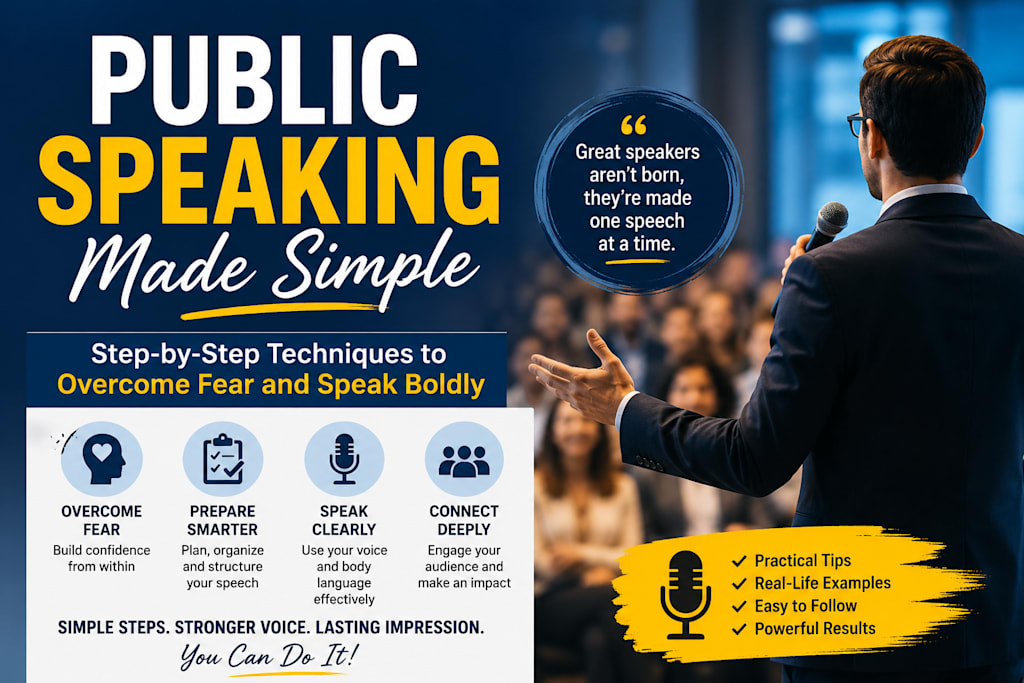
Public Speaking Made Simple
Step-by-Step Techniques to Overcome Fear and Speak Boldly
Introduction
Public speaking is often seen as a daunting skill—something reserved for confident leaders, performers, or professionals. For many, the thought of standing in front of an audience triggers anxiety, self-doubt, and even fear. But the truth is simple: public speaking is a learnable skill, not an inborn talent.
Like any other ability, it improves with the right mindset, preparation, and consistent practice. Whether you're presenting in a meeting, speaking at an event, or creating content online, mastering public speaking can transform how you communicate and how others perceive you.
This guide breaks down public speaking into simple, practical steps so you can move from nervous to confident—one step at a time.
1. Understand the Fear of Public Speaking
Before you can overcome fear, you need to understand it.
Fear of public speaking often comes from:
Fear of judgment
Fear of making mistakes
Fear of forgetting what to say
Lack of experience
Your brain treats speaking in front of a group as a high-risk situation. But in reality, the audience is usually supportive—not critical.
Simple shift in thinking:
Instead of asking, “What if I mess up?”
Ask, “What value can I give?”
When your focus shifts from yourself to your message, fear begins to lose its power.
2. Start with Clear Preparation
Confidence doesn’t come from luck—it comes from preparation.
Before any speech or presentation:
Know your topic well
Understand your audience
Define your main message
Ask yourself:
What is the one key idea I want people to remember?
Why does this matter to them?
Keep it simple:
A clear message is more powerful than a complicated one.
3. Use a Simple Structure
A strong structure makes speaking easier and more effective.
Use this basic format:
1. Opening
Grab attention (question, story, or fact)
Introduce your topic
2. Main Points (2–3 key ideas)
Keep them short and clear
Support with examples or stories
3. Closing
Summarize your message
End with a strong takeaway or call to action
Example:
Opening: “Have you ever felt nervous speaking in front of others?”
Main: Causes of fear, simple techniques, practice tips
Closing: “Confidence comes from action—start today.”
4. Practice Smart, Not Just Hard
Many people practice the wrong way—by memorizing everything.
Instead:
Practice speaking naturally
Focus on understanding, not memorization
Rehearse out loud
Try this:
Speak in front of a mirror
Record yourself and watch it back
Practice with a friend
Goal: Sound like yourself—not like you're reading a script.
5. Master Your Body Language
Your body speaks before your words do.
Strong body language includes:
Standing straight
Making eye contact
Using natural hand gestures
Avoiding fidgeting
Simple tip:
Imagine you're having a conversation, not giving a performance.
When your body is calm and open, your voice becomes more confident automatically.
6. Improve Your Voice Delivery
Your voice is your most powerful tool.
Focus on:
Clarity – Speak clearly, not too fast
Pace – Pause instead of rushing
Tone – Add variation to avoid sounding monotone
Power of pause:
Silence can make your message stronger.
Pause after important points—it gives your audience time to absorb.
7. Handle Nervousness Effectively
Feeling nervous is normal—even experienced speakers feel it.
Instead of trying to eliminate nerves, learn to manage them.
Quick techniques:
Take deep breaths before speaking
Start slowly
Focus on your first sentence
Mental trick:
Turn nervous energy into excitement.
Your body reacts similarly to both.
8. Connect with Your Audience
Great speakers don’t just talk—they connect.
To build connection:
Make eye contact
Use simple, relatable language
Ask questions
Share personal stories
People remember how you make them feel more than what you say.
Key idea:
Speak to your audience, not at them.
9. Embrace Mistakes
Mistakes are part of the process.
You might:
Forget a point
Mispronounce a word
Lose your train of thought
That’s okay.
What to do:
Pause
Smile
Continue
Most audiences won’t even notice small mistakes unless you highlight them.
Confidence isn’t about perfection—it’s about recovery.
10. Build Confidence Through Practice
Confidence grows with action.
Start small:
Speak in small groups
Practice daily conversations
Record short videos
Gradually increase your comfort zone.
Consistency matters more than intensity.
Even 5–10 minutes of daily practice can create big improvements over time.
11. Use Simple Storytelling
Stories make your speech more engaging and memorable.
Instead of just giving information:
Share experiences
Use real-life examples
Paint a picture with words
Example:
Instead of saying, “Practice improves speaking,”
Say, “The first time I spoke, I was nervous—but after practicing daily, everything changed.”
Stories create emotional connection—and that’s what people remember.
12. Prepare for Different Situations
Public speaking isn’t just about stages.
It includes:
Meetings
Presentations
Interviews
Online videos
Adapt your style based on the situation:
Formal → structured and precise
Casual → relaxed and conversational
Being flexible makes you a stronger communicator.
13. Build a Speaking Habit
Public speaking becomes easier when it becomes part of your life.
Ways to practice regularly:
Share ideas in group discussions
Teach something you know
Create content (videos, podcasts)
The more you speak, the more natural it feels.
14. Focus on Value, Not Perfection
Many people hold back because they want everything to be perfect.
But perfection isn’t necessary—clarity and value are.
Ask yourself:
Am I helping my audience?
Am I sharing something useful?
If the answer is yes, you’re already succeeding.
15. Keep Improving
Even great speakers keep learning.
After every speaking experience:
Reflect on what went well
Identify areas to improve
Keep practicing
Growth comes from awareness and action.
Conclusion
Public speaking doesn’t have to be complicated or overwhelming. When broken down into simple steps, it becomes a skill anyone can develop.
Start by understanding your fear, preparing clearly, and practicing consistently. Focus on connection, not perfection. Use your voice, body language, and stories to engage your audience.
Most importantly, take action.
You don’t become confident by waiting—you become confident by speaking.
Every time you speak, you improve.
Every time you try, you grow.
Public speaking is not about being perfect—it's about being heard.
About the Creator
Enjoyed the story? Support the Creator.
Subscribe for free to receive all their stories in your feed.
Comments
There are no comments for this story
Be the first to respond and start the conversation.