
Living on Autopilot
How Daily Habits Can Distance Us from the Life We Really Want
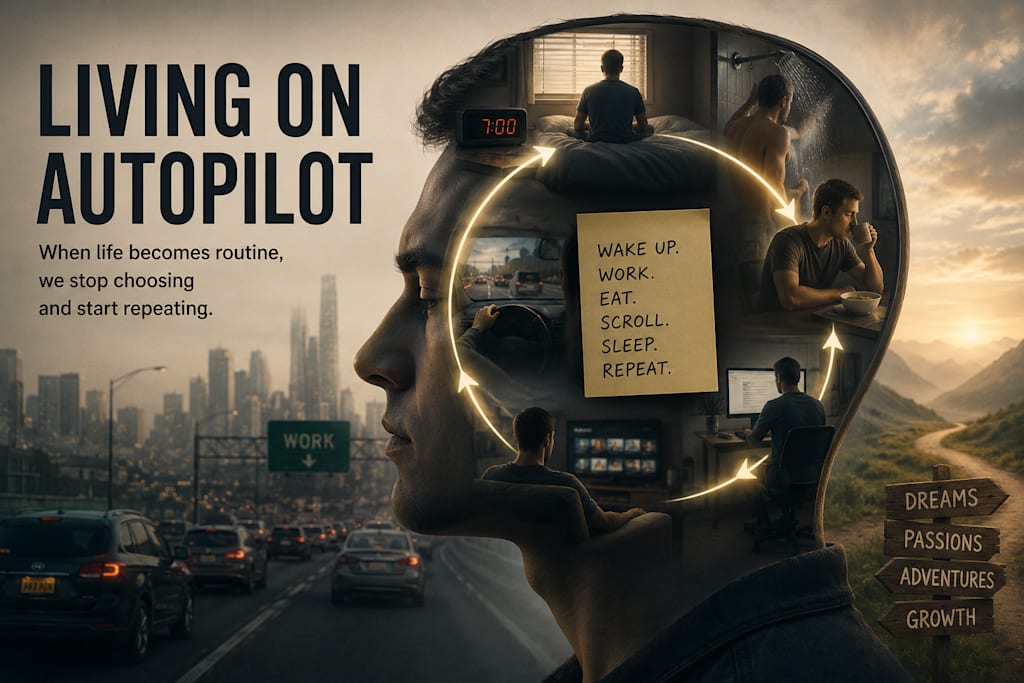
Have you ever driven to work and realized you don't remember much of the journey? Or reached the end of the day wondering where all your time went? These moments reveal something many people experience but rarely stop to think about: living on autopilot.
Autopilot isn't always a bad thing. In fact, it helps us perform everyday tasks efficiently without exhausting our mental energy. We don't consciously think about brushing our teeth, tying our shoes, or making our morning coffee because these routines have become automatic. Our brains are designed to create habits that save effort.
The problem begins when this automatic way of living expands beyond simple routines and starts controlling our decisions, relationships, and ambitions. Instead of actively choosing how we spend our lives, we simply repeat yesterday.
The Comfort of Routine
Humans naturally seek patterns. Predictability makes us feel safe. Routines reduce uncertainty and make life manageable, especially during stressful periods.
Think about your average weekday. You wake up, check your phone, get ready, commute, work, eat lunch, return home, scroll through social media, watch television, and eventually go to bed. Tomorrow often looks remarkably similar.
There's nothing inherently wrong with routine. In fact, healthy routines improve productivity, reduce anxiety, and support physical health.
But routine becomes dangerous when it transforms into unconscious repetition. Days blend into weeks, weeks into months, and before long, years have passed without significant personal growth or intentional change.
The Invisible Drift
Living on autopilot rarely happens overnight. It develops gradually.
You postpone learning a new skill because you're busy this week. Then next week arrives with new excuses. You stop calling old friends because life becomes hectic. You tell yourself you'll travel "someday." You postpone hobbies until work becomes less demanding.
Unfortunately, "someday" rarely appears on the calendar.
Small postponements accumulate until they quietly reshape your life.
Without realizing it, you drift rather than decide.
Technology Makes It Easier
Modern technology has made autopilot more accessible than ever.
Apps are designed to capture attention. Streaming platforms automatically play the next episode. Social media endlessly refreshes with new content. Online shopping recommends products before you even realize you want them.
None of these services are inherently harmful. They provide convenience and entertainment.
The issue arises when passive consumption replaces active living.
Instead of choosing what deserves our attention, algorithms begin making those decisions for us.
Hours disappear into endless scrolling, leaving us entertained but rarely fulfilled.
The Difference Between Busy and Intentional
Many people mistake constant activity for meaningful progress.
A packed schedule creates the illusion of productivity. Meetings, emails, errands, notifications, and obligations fill every available moment.
Yet being busy isn't the same as moving toward your goals.
Someone can spend ten hours working every day while making little progress on what truly matters.
Another person may spend only two focused hours pursuing meaningful work and create lasting change.
Intentional living asks a simple question:
"Does what I'm doing today bring me closer to the life I want?"
If the answer is consistently no, autopilot may be in control.
Dreams Fade Quietly
Children often dream boldly.
They imagine becoming astronauts, artists, inventors, musicians, entrepreneurs, explorers, or athletes.
As adults, those dreams don't usually disappear because they're impossible.
They disappear because daily routines slowly replace curiosity.
Bills need paying.
Responsibilities increase.
Energy decreases.
Eventually, practicality overshadows imagination.
People convince themselves that dreaming is unrealistic, when often they've simply stopped making space for possibility.
Comfort Zones Grow Stronger
Autopilot keeps us inside familiar territory.
The same restaurants.
The same conversations.
The same television shows.
The same commute.
The same opinions.
Comfort itself isn't the enemy.
The problem is that growth almost always exists outside familiar patterns.
Every meaningful improvement begins with temporary discomfort.
Learning a language feels awkward.
Starting a business feels uncertain.
Joining a gym feels intimidating.
Meeting new people feels uncomfortable.
Because autopilot prioritizes familiarity, it quietly resists these experiences.
Relationships Can Become Automatic Too
Not only do routines affect personal growth—they also shape relationships.
Couples may begin speaking only about schedules, bills, and responsibilities.
Friends communicate mainly by reacting to social media posts instead of having real conversations.
Families eat together while everyone looks at separate screens.
The relationship still exists, but intentional connection slowly disappears.
Meaningful relationships require presence.
Listening.
Curiosity.
Shared experiences.
Gratitude.
These qualities cannot operate on autopilot.
Success Without Satisfaction
Some people achieve impressive careers while feeling strangely empty.
They followed every expected milestone.
Graduate.
Get hired.
Earn promotions.
Buy a house.
Save money.
Build stability.
From the outside, everything appears successful.
Inside, however, they may wonder:
"Is this actually the life I wanted?"
This question often appears after years of unconscious momentum.
Success achieved without reflection can feel surprisingly hollow.
Mindfulness as an Antidote
Mindfulness simply means paying attention to the present moment without judgment.
It doesn't require hours of meditation.
It begins with noticing.
Notice your thoughts.
Notice your habits.
Notice your reactions.
Notice where your attention naturally goes.
Awareness interrupts automatic behavior.
Once you notice a habit, you regain the power to change it
Without awareness, habits continue indefinitely.
Small Questions Create Big Changes
Escaping autopilot doesn't require quitting your job or moving across the world.
It often begins with asking better questions.
Why am I doing this?
Does this still matter to me?
What brings me genuine joy?
What drains my energy?
What have I been postponing?
If today repeated for the next five years, would I be happy?
These questions encourage reflection instead of reaction.
Reclaiming Your Attention
Attention is one of life's most valuable resources.
Where attention goes, life follows.
If every spare moment belongs to notifications, advertisements, and endless content, very little remains for creativity or meaningful relationships.
Protecting attention may involve simple changes.
Silence unnecessary notifications.
Leave your phone in another room while eating.
Read instead of scrolling.
Take walks without headphones.
Spend quiet moments simply thinking.
These habits strengthen intentional awareness.
Rediscovering Curiosity
Autopilot shrinks curiosity.
Intentional living expands it.
Ask questions.
Learn new skills.
Visit unfamiliar places.
Read books outside your usual interests.
Talk to people with different experiences.
Curiosity reminds us that life contains more possibilities than routine suggests.
Every new experience slightly rewires how we see the world.
Gratitude Interrupts Habit
When experiences become repetitive, we stop noticing them.
Morning sunlight.
A warm meal.
Supportive friends.
Good health.
The ability to walk.
Clean water.
A peaceful evening.
Autopilot treats these as ordinary.
Gratitude transforms them into gifts.
Taking even a few moments each day to appreciate ordinary blessings makes life feel richer without changing external circumstances.
Choosing Rather Than Reacting
Many daily decisions happen automatically.
We wake up and immediately check our phones.
We respond to every notification.
We eat while distracted.
We spend evenings recovering instead of creating.
Intentional living asks us to pause before reacting.
Instead of asking, "What demands my attention?"
Ask, "What deserves my attention?"
The difference is profound.
Progress Comes From Tiny Decisions
People often wait for dramatic breakthroughs.
A new year.
A promotion.
A fresh start.
A major life event.
Yet transformation usually happens through tiny, repeated choices.
Reading ten pages daily.
Walking for twenty minutes.
Calling one friend.
Writing one paragraph.
Learning one new word.
Saving a small amount of money.
These actions appear insignificant individually.
Repeated consistently, they reshape lives.
Accepting That Change Feels Uncomfortable
Leaving autopilot can feel unsettling.
You'll question familiar routines.
You may disappoint people who benefited from your predictability.
Old habits will compete with new intentions.
This discomfort doesn't necessarily mean you're making the wrong choice.
Often, it means you're growing.
Growth rarely feels comfortable in the moment.
Its rewards become visible only over time.
Living Deliberately
Intentional living doesn't mean planning every minute.
It means aligning everyday choices with personal values.
If family matters, spend meaningful time together.
If creativity matters, create regularly.
If health matters, move your body consistently.
If learning matters, remain curious.
Your calendar often reveals your priorities more honestly than your intentions.
The Life We Build
Our lives are not defined by occasional extraordinary moments.
They are built from ordinary days repeated thousands of times.
Every morning routine.
Every conversation.
Every meal.
Every evening.
Every small decision contributes to the person we become.
Autopilot allows these moments to pass unnoticed.
Awareness transforms them into opportunities.
Conclusion
Living on autopilot isn't a personal failure—it's a natural tendency of the human brain. Habits help us conserve mental energy and navigate daily life efficiently. However, when unconscious routines begin directing our choices, relationships, and dreams, they can slowly pull us away from the life we truly want.
The good news is that change doesn't require a dramatic reinvention. It begins with awareness. By paying closer attention to how we spend our time, where we focus our energy, and whether our actions reflect our values, we regain the ability to choose instead of simply reacting.
A meaningful life is rarely built through extraordinary moments alone. It is shaped by ordinary decisions made with intention, day after day. Every pause before reaching for your phone, every conversation you fully engage in, every small step toward a forgotten dream is a reminder that you are not merely passing through life—you are actively creating it.
The goal is not to eliminate routine but to ensure that your routines serve the life you want to live. When your daily habits align with your deepest values, even the simplest days become meaningful. Instead of waking up years from now wondering where the time went, you can look back knowing that you chose your path with purpose, presence, and intention.
About the Creator
Enjoyed the story? Support the Creator.
Subscribe for free to receive all their stories in your feed.
Comments
There are no comments for this story
Be the first to respond and start the conversation.