
I Once Wanted Expensive Things. Now I Treasure Things Money Cannot Replace.
Growing older has taught me that the things we value most are not necessarily the things that cost the most.

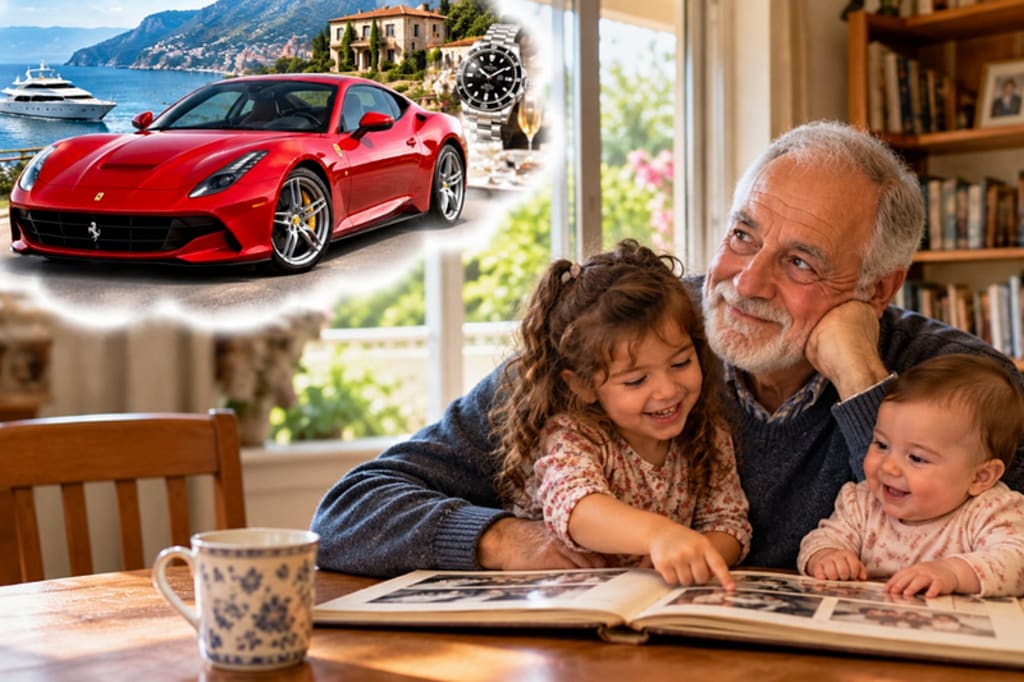
The Ferrari I No Longer Notice
There was a time when I would see a Ferrari driving along the road and feel a certain envy.
I would admire its sleek appearance, imagine its performance and wonder what it would be like to own such an expensive machine.
Not that I ever seriously expected to buy one. But there was something appealing about the idea.
A Ferrari represented wealth, success and the ability to purchase something that most people could only dream about.
These days, when a Ferrari passes me on the road, I hardly give it a second glance.
It isn’t that I’ve developed an objection to expensive cars. Nor do I begrudge their owners the pleasure of driving them.
I simply don’t want one anymore.
And that has made me realise something about growing older.
The things we once wanted desperately can eventually become things we no longer want at all.
What’s Wrong With My Mazda?
I own a small Mazda that is three years old.
It runs well, is economical and does everything I require of it.
I can easily imagine driving it for many more years.
My wife, however, occasionally suggests that in a few years I should buy another car.
“Why?” I ask.
She doesn’t really have an answer.
I suspect she believes that buying a new car would make me happy. Perhaps she thinks that after a lifetime of working, I should reward myself with something newer and more expensive.
I appreciate the sentiment.
But I cannot see how replacing a perfectly good car with another perfectly good car would improve my life.
The new car might have a few additional features. It might have a more sophisticated dashboard or a slightly different appearance.
But it would still take me to the supermarket, the shops and wherever else I needed to go.
And my present car already does that rather well.
I sometimes wonder whether we have become conditioned to believe that replacing something with a newer version must necessarily improve our lives.
A new car. A new television. A new mobile phone.
But if the old one works perfectly well, what exactly are we gaining?
I have reached a stage in life where I find myself asking that question more frequently.
The Pleasure of Something Old
Curiously, while I have lost much of my interest in expensive new possessions, I have not lost my enthusiasm for acquiring things.
I have a modest collection of vintage objects.
Among them are old typewriters, fountain pens, microscopes, watches and various scientific instruments.
Some are quite old. Others are relatively ordinary objects that would probably attract little attention from most people.
But I find them fascinating.
When I acquire something for my collection, my first thought is rarely how much it might be worth.
My first thought is:
What is the history behind it?
Who made it? When was it manufactured? Who might have owned it? What was happening in the world when it was first used?
An old typewriter interests me not merely because of its mechanical construction, but because I wonder what might once have been written on it.
Perhaps business correspondence. Perhaps letters between family members. Perhaps a manuscript that never found a publisher.
An old microscope makes me wonder about the person who once peered through its eyepiece.
Was it a doctor? A student? An enthusiastic amateur fascinated by the microscopic world?
And an old pocket watch invites another set of questions.
Who carried it? Was it a treasured possession? Was it handed down through generations, or did it spend decades forgotten in a drawer?
Usually, I will never know the answers.
But that is part of the attraction.
These objects have survived long enough to reach my hands, and I find myself wanting to understand something about the lives they have passed through.
The Fountain Pen That Takes Me Back to School
Among my possessions is an old Platignum fountain pen.
It is not particularly valuable.
But I have had it since my primary school days.
That makes it rather special.
I remember attending primary school in the mid-1960s, when our wooden desks had small inkwells, often made of porcelain.
We wrote using long wooden penholders fitted with detachable metal nibs.
Every few words, we dipped the nib into the ink.
Blotting paper was an essential part of our equipment.
In 1966, the principal summoned a friend and me into his office.
He showed us a case containing brand-new fountain pens, which he offered to sell us for approximately two shillings each.
They had small levers on their barrels for filling them with ink.
Neither of us was interested.
We declined the offer.
Sixty years later, I find myself wondering what became of those pens.
Perhaps some collector now owns one.
Perhaps they were discarded years ago.
And perhaps I should have bought one after all.
The irony is that I now find more pleasure in examining an old fountain pen than I would in admiring an expensive new car.
I don’t need the pen to write with.
I have plenty of pens.
But I enjoy holding a small piece of history in my hand.
The Piano That Must Never Be Sold
My daughter shares my fascination with older objects.
My son does not have the same interest, and that is perfectly understandable. We all have different tastes.
But my daughter has always appreciated the character and history of things that have survived from earlier times.
When she was studying piano many years ago, my wife and I bought her an old, expensive upright piano.
It was a substantial purchase, but we wanted her to have a good instrument.
The piano is still in our living room.
My daughter no longer lives with us, but she has made one thing absolutely clear.
We are never to sell it.
I find that rather touching.
To someone else, it might simply be an old upright piano occupying a considerable amount of space.
To my daughter, it is something entirely different.
It is the piano on which she practised as a child.
It is connected with her lessons, her music and the years she spent growing up in our home.
Another piano might be newer, more expensive or technically superior.
But it would not be her piano.
And I think that explains something about the value we attach to possessions.
There is the price someone might pay for an object.
And then there is the value that object has to the person who owns it.
The two can be very different.
What Would I Do If I Won TattsLotto?
Recently, while waiting for the Saturday TattsLotto draw, I found myself entertaining the familiar fantasy of winning several million dollars.
As a former mathematics teacher, I am perfectly aware of the odds.
I know that the probability of winning the major prize is extraordinarily small.
But that doesn’t prevent me from imagining the telephone ringing with the wonderful news that I have won.
And what would I do with the money?
I know the answer without hesitation.
I would pay off my children’s mortgages.
I would also keep money aside so that I could help them whenever they needed it.
I have even imagined how I would go about it.
Somehow, without their knowledge, I would find out exactly how much they owed.
Then, after making the necessary arrangements with their banks, I would pay off the loans.
I wouldn’t tell them beforehand.
I would simply wait.
Eventually, one of them would discover that the mortgage had disappeared.
I can imagine the telephone call.
“Dad, something very strange has happened.”
“Oh? What’s that?”
“My mortgage has been paid off!”
“That’s wonderful news.”
“Dad, do you know anything about this?”
“Why would you ask me?”
I suspect I would enjoy that conversation more than driving a Ferrari.
Of course, this is all hypothetical. The odds of winning TattsLotto are hardly encouraging.
But the fantasy itself has taught me something.
When I imagine suddenly becoming wealthy, my first thought is no longer about what I could buy for myself.
It is about what I could do for the people I love.
Have I Become Less Materialistic?
I think I have.
But perhaps that is not quite the right way to describe it.
I still enjoy acquiring things.
I can spend considerable time examining an old fountain pen, researching a pocket watch or investigating the history of a scientific instrument.
I still experience the excitement of finding something interesting for my collection.
The difference is that I no longer associate pleasure with expense.
An object costing twenty dollars can fascinate me more than something costing twenty thousand.
And sometimes the less valuable object has the more interesting story.
I have also come to appreciate that there is a difference between wanting something and needing it.
When I was younger, I sometimes imagined that owning something expensive would make me happier.
Now I realise that happiness does not necessarily increase with the price of our possessions.
My Mazda is sufficient.
My collection gives me pleasure.
My home is comfortable.
And the people who matter most to me cannot be replaced by anything money can buy.
That is not to say that money is unimportant.
Of course it is important.
It provides security, independence and opportunities. It can relieve financial pressures and make life considerably easier.
But beyond a certain point, having more money does not automatically mean enjoying life more.
Sometimes it simply means having more expensive things to worry about.
Who Will Treasure These Things After Me?
As I grow older, I occasionally wonder what will become of my collection.
The typewriters, fountain pens, microscopes, watches and other objects have given me many hours of enjoyment.
But eventually, they will belong to someone else.
My son is unlikely to develop the same enthusiasm for them that I have.
My daughter, however, is different.
She shares my fascination with their history, craftsmanship and character.
I have little doubt that she will cherish them.
And that gives me considerable satisfaction.
Not because the collection is particularly valuable, but because I know that someone will appreciate the things that have meant so much to me.
Perhaps one day my grandchildren will ask their mother about an old typewriter or a curious-looking scientific instrument.
Perhaps she will explain what it was used for and why their grandfather found it so interesting.
And perhaps, in that small way, some of my own curiosity will survive.
The thought pleases me far more than the idea of leaving behind an expensive car.
About the Creator
George Dimitriadis
Retired mathematics teacher from Melbourne, Australia. I write humorous classroom stories featuring Jimmy, a student who questions mathematical conventions, as well as personal reflections on life, nostalgia and everyday absurdities.
Enjoyed the story? Support the Creator.
Subscribe for free to receive all their stories in your feed.
Comments
There are no comments for this story
Be the first to respond and start the conversation.