
I Am a Public Health Practitioner and I Am Exhausted — Here Is What I Know About Why You Are Too
The System Was Designed to Run You Empty. Here's the Science, the Truth, and the Permission to Finally Say: Enough

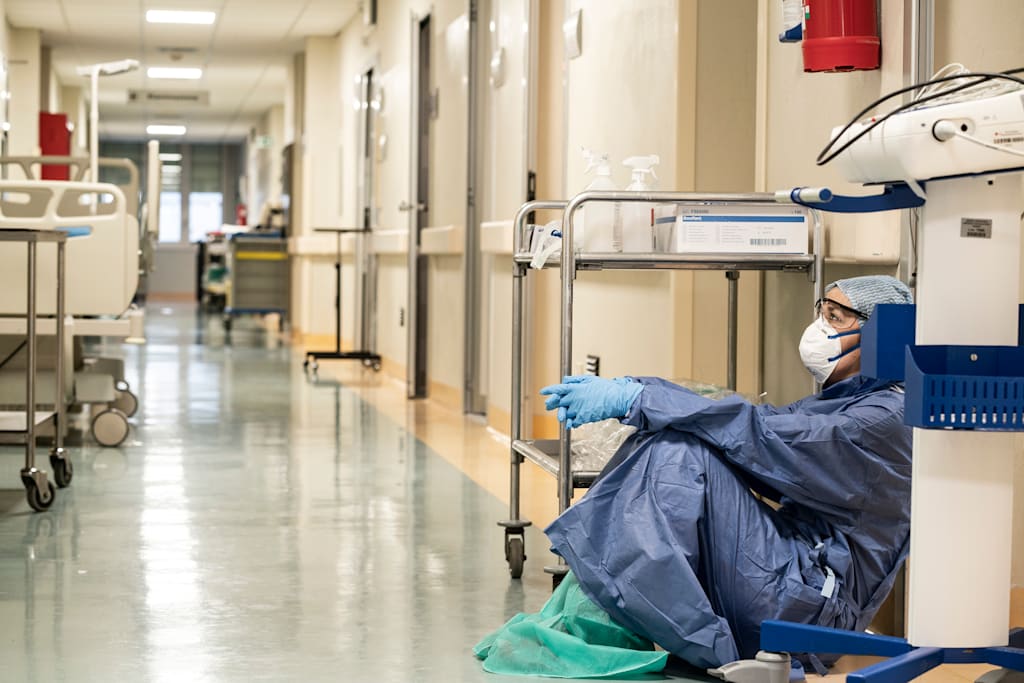
You didn't get into this field for the money. Nobody does.
You got in because somewhere — in a classroom, in a community, at a funeral you attended too young — something clicked. You understood that health was not a personal failing. That zip codes determine life expectancy more than genetic codes. That the water people drink, the air they breathe, the food they can afford, the stress they absorb — all of it is political. All of it is preventable. And you decided that knowledge was too important to keep to yourself.
So you studied. You sacrificed. You took the underpaid fellowship, sat through the grant-writing workshops at 7 PM on a Tuesday, drove to communities that the healthcare system had long abandoned, and told yourself the work mattered more than the salary, more than the sleep, more than the ache in your chest that started somewhere around year three and never really left.
And now you are exhausted.
Not tired. Not in need of a vacation. Exhausted — the deep-bone, soul-level depletion that no amount of PTO can fix, because the problem isn't that you haven't rested. The problem is that the system you work inside was never built to sustain the people doing the most important work within it.
I know this because I live it. I know this because I've watched brilliant colleagues disappear from the field. I know this because every public health conference I've attended has a wellness breakout session — and it is always the smallest room.
Let me tell you what I know.
The Invisible Weight of Moral Injury
We talk about burnout in public health constantly. Burnout is the buzzword. But burnout — defined as emotional exhaustion, depersonalization, and reduced personal accomplishment — is only part of the story. The more accurate and more devastating phenomenon that most public health workers are experiencing is moral injury.
Moral injury was first described in military veterans: the psychological wound that occurs when you are forced to act in ways that violate your deeply held moral beliefs, or when you witness something that violates them, and you are powerless to stop it. It was never supposed to be a public health term. And yet here we are.
When you sat in a community meeting and watched a policy decision get made that you knew would harm the people in that room — and you had the data, you had the evidence, and nobody listened — that was moral injury.
When you watched COVID-19 devastate Black and brown communities while resources flowed elsewhere, and you wrote the report, you gave the briefing, and nothing changed — that was moral injury.
When a child in your catchment area was hospitalized for lead poisoning from pipes your agency had already flagged two years prior — that was moral injury.
Burnout can be treated with rest. Moral injury cannot. Moral injury requires something much harder: a reckoning with the gap between what you believe your work should accomplish and what the system actually allows it to accomplish. That gap, for most of us in public health, is enormous. And we carry it every single day.
You Were Handed an Impossible Brief
Here is something nobody tells you during your MPH orientation: Public health is asked to solve the consequences of problems it has no authority to fix.
Poverty makes people sick. We know this. The evidence is irrefutable. But public health departments do not set minimum wages. They do not build affordable housing. They do not regulate predatory lending. They do not write zoning laws that determine whether a grocery store or a liquor store opens in your neighborhood.
What public health departments do get is a budget — usually underfunded, routinely cut during the very crises it is needed most — and an expectation that they will somehow compensate for the failures of housing policy, education policy, criminal justice policy, and economic policy simultaneously.
You are being asked to mop the floor while the tap is still running.
And then, when the floor is still wet, when the data still shows disparities, when the community health outcomes don't improve fast enough, the implicit message — sometimes the explicit message — is that you haven't worked hard enough. You haven't been innovative enough. You haven't found the right community partners, the right messaging framework, the right social media strategy.
This is gaslighting on an institutional scale. And many of us have internalized it so deeply that we have started to believe it.
The Surveillance of Your Own Suffering
One of the particularly cruel ironies of working in public health is that we are trained to observe, measure, and analyze suffering — in everyone but ourselves.
We build epidemiological models. We conduct needs assessments. We track morbidity and mortality. We are exquisitely literate in the language of population-level distress. And yet most of us are shockingly illiterate about our own.
Research on public health workforce wellbeing — which has grown substantially since 2020 — paints a grim picture. Studies published in journals like the American Journal of Public Health and Preventing Chronic Disease consistently show elevated rates of depression, anxiety, secondary traumatic stress, and intent to leave the field among public health professionals. The figures worsened dramatically during the pandemic, when public health workers became targets of harassment, threats, and political attacks while simultaneously managing the largest infectious disease emergency in a century.
But here is what the data doesn't fully capture: the anticipatory exhaustion — the tiredness that comes not just from what has already happened, but from knowing, with professional certainty, what is coming next. When you have spent years studying health inequities, climate change and health, antimicrobial resistance, mental health infrastructure gaps, and aging demographics — you carry a burden that most people around you are mercifully unaware of. You see the iceberg. Everyone else is admiring the view from the deck.
That knowledge is a privilege and a weight simultaneously. And very few of our workplaces offer space to process either one.
The Pandemic Tore the Mask Off
For those of us who were in the field before 2020, the COVID-19 pandemic did something specific and irreversible: it showed us exactly how much our society values public health — and the answer was both clarifying and devastating.
We watched public health infrastructure that had been defunded for decades suddenly be expected to perform miracles. We watched epidemiologists and health officers become household names — not because they were celebrated, but because they were attacked. We watched political leaders override public health guidance in real time, on television, while our colleagues worked around the clock.
We watched our peers burn out, break down, and leave the field in numbers we are still accounting for. A 2022 study found that nearly half of state and local public health workers reported symptoms of post-traumatic stress. Nearly a third reported intentions to leave their jobs within the following year.
Many of them did.
And those who stayed? We are still here. Still underpaid. Still overextended. Still writing grant reports in the evenings and answering community calls on weekends. Still trying to make the math work on programs that deserve ten times the funding they receive.
Still exhausted.
What Resilience Culture Gets Wrong
Can we talk about resilience? Specifically, can we talk about how the resilience narrative has been weaponized against public health workers?
Resilience — the ability to adapt, recover, and grow in the face of adversity — is a genuine and important psychological capacity. But when institutions deploy "resilience" as a response to systemic problems, something deeply dishonest is happening.
When your organization offers a mindfulness workshop in response to a 40% staff vacancy rate — that is not resilience. That is deflection.
When a health department encourages self-care while refusing to hire the personnel needed to make the workload survivable — that is not resilience. That is exploitation with better branding.
Telling exhausted public health workers to be more resilient is like telling someone to swim harder while you drill holes in the boat. The problem is not their stroke. The problem is the boat.
True resilience is not an individual practice. It is a structural condition. It requires adequate staffing, livable wages, genuine psychological support, protected time, and institutional cultures that treat workers as full human beings rather than service delivery mechanisms.
Until we demand that distinction loudly and clearly, we will keep accepting individual solutions to collective problems — and burning through a generation of talented, committed public health professionals in the process.
This Is What I Want You to Know
You are not weak for being exhausted. You are not failing for struggling. You are not somehow insufficient because the gap between what you want to accomplish and what the system allows you to accomplish feels impossibly wide.
You are a human being who chose an extraordinarily hard field, has been systematically under-resourced, asked to solve problems beyond your mandate, exposed to community suffering as a professional requirement, and offered inadequate support in return. Of course you are exhausted. It would be strange if you weren't.
And here is the other thing I want you to know: your exhaustion is data. It is not weakness. It is a signal — a public health signal — that something in the system is wrong. The fact that so many of us feel it, across contexts, across career stages, across specializations, means this is not a personal problem. This is an epidemic of institutional neglect masquerading as individual burnout.
Name it as such. Talk about it with that framing. Because the moment we stop treating our exhaustion as a personal failure to manage stress and start treating it as evidence of a system in crisis, we change the conversation. We move from self-blame to advocacy. From coping to demanding.
A Call to the Ones Still Standing
To my colleagues in the field — the ones still showing up, still writing the reports, still sitting in community meetings that run two hours over, still believing in the work even on the days it breaks you:
I see you. What you are doing is not ordinary. The sustained commitment to population health in the face of everything we face is one of the most quietly extraordinary acts of professional dedication I know.
But I am also asking you — I am begging you — not to accept exhaustion as the price of purpose. Not to treat depletion as proof of dedication. Not to confuse burning yourself out with burning bright.
This field needs you sustainable. It needs you in it for decades, not just for the years before the breakdown. And that requires you to take your own wellbeing as seriously as you take the communities you serve.
It requires us — collectively — to stop whispering about our exhaustion in hallways and start putting it in front of the people who fund us, lead us, and write the policies we implement.
It requires us to say, clearly and without apology: This is not sustainable. We are not machines. And the communities we serve deserve a public health workforce that is whole.
That is not a complaint. That is a public health intervention.
And it starts with telling the truth about how tired we are.
About the Creator
Soibifaa
Public Health Practitioner | Cobbler | Content Creator ✨
Blending health, creativity & craftsmanship to inspire purposeful living and meaningful connections. Passionate about storytelling, people, and creating impact one step at a time.
Enjoyed the story? Support the Creator.
Subscribe for free to receive all their stories in your feed.
Comments
There are no comments for this story
Be the first to respond and start the conversation.