
How to Tell a Story When the Lesson Is That There Is No Lesson
A case study in anti-narrative that earns every beat—no uplift, no arc, just a sequence of decisions and their cost.
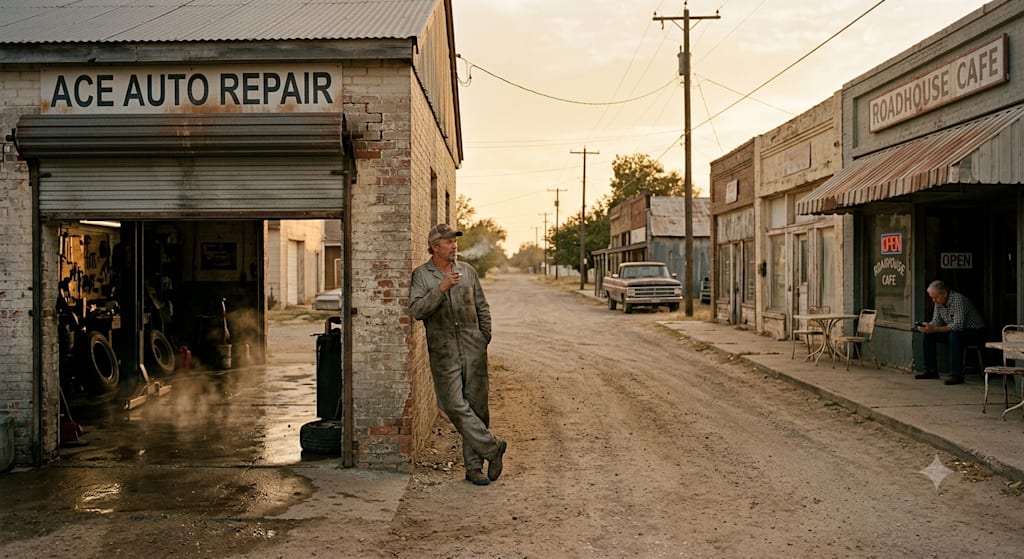
Jack looked up from behind the counter and saw an old Ford pull up outside the shop. The driver left the engine running, the exhaust pipe shuddering like a leg that shakes when someone can't make up their mind.
He set down his wrench but didn't get up.
The door opened, and a man in a polo shirt stepped out, a leather folder tucked under his arm. He stood at the entrance, glanced at the sign, then at the parts scattered across the floor, his face wearing the expression of someone picking over fish at a market.
"Buddy, this place—" he waved a hand, "needs work. The front is ancient; it's a mess in here. Customers have nowhere to stand."
Jack said nothing.
"I'm in tire distribution. I know the city scene," the man shifted the folder to his other arm. "The way you're set up right now, you'll never do real business."
Jack picked up a rag and began wiping the grease from between his fingers, one by one.
"I don't want it," he said. "You might know the city. I know this town."
The man blinked, then smiled—half puzzled, half offended.
That evening, after the tire distributor had left and the shop was closed, Jack stood outside with a cigarette and found himself thinking about the move eight years ago.
They'd just made a few thousand dollars, their first real money. New equipment, a new sign, the shop cleaned up spotless, the bank account drained to zero, still a couple thousand owed on the credit card. They were barely past twenty and too young to know what fear felt like. Their kid was still a baby crying in someone's arms. They took a photo together under the new sign, convinced things were finally heading up.
Then the landlord parked his trucks across the entrance.
Two of them, side by side, sealing the doors shut. There were still customers' cars inside.
The landlord was Emily's father.
Jack called him. On the other end, just one sentence: "The rent needs backpay."
No discussion. No warning. Right after they'd emptied every dollar into renovating the place.
In the end, they walked away from the new sign. Walked away from the new floor tiles. They borrowed twenty thousand from Emily's sister, rented the spot they were in now, and moved out.
Later, someone asked him: why not just pay his father-in-law the twenty thousand?
What Jack said to Emily was this: "He'd block our doors today over rent. Tomorrow it would be over something else. You give in when he corners you like this, there'll be worse tricks waiting."
You think I don't know how to deal with people?
He tapped off the ash. I'm too good at it.
He could count on one hand the people he'd met who were better at reading a room than he was.
But his father-in-law—he really couldn't do the math. Those two trucks blocking the doors? The shop had serviced both of them. In auto repair, labor is always the biggest charge. He'd never taken a cent for those two trucks, and his father-in-law would never have offered. A son works for the old man, and you can't put a price on that—but they were renting the old man's property. That price, you could put a number on.
His own father had him by the throat like that.
It was hard to think of any relationship in the world that didn't sharpen itself against money, sooner or later.
The next afternoon, a Nissan came in on a tow truck, power steering leaking. The owner stood by, brows knotted so tight they almost touched.
Jack pulled the sensor right there in front of him, swapped in a new O-ring, topped off the fluid. Took less than twenty minutes.
He shut the hood and said, "Done."
The owner stared. "How much?"
Jack opened his mouth. The labor charge stuck in his throat. The number that came out was so low it made him want to laugh at himself.
Later, telling Emily about it, she didn't look up from chopping onions in the kitchen.
"You could've kept the car, said pick it up tomorrow. At least another two hundred."
"I know."
"Then why didn't you?"
He thought for a moment. "Hand moved faster than my brain."
There's an instinct in people. The instinct that makes you pull the part out, fix it, put it back, right then and there—like straightening a crooked picture frame the second you see it.
But that instinct doesn't have much to do with running a business.
A week later, at six-thirty in the evening, an old Chevy sat on the lift. Head gasket had been replaced, oil and coolant changed, idler pulley and clock spring done. The bill was already over seventeen hundred.
Jack put in his earbuds, got a novel playing, and was about to replace the parking brake cable as well.
Emily leaned out from the office, watched him for a while, then walked over and stood beside the car.
"You planning to finish the whole thing tonight?"
Jack pulled out one earbud. "Just the brake cable left."
"If the owner shows up tomorrow and sees everything already done, it's going to be hard to collect that seventeen hundred on the invoice."
Jack's hands stopped.
He looked at the tool in his grip, then at the underside of the car, and set the wrench down.
Truth was, his body had already called it for the day. He didn't feel it, but Emily did. Keep going, and he'd struggle just to get out of bed in the morning. Not worth it.
That's just how it is.
People pay money to buy your sweat, your exhaustion, your blood and guts poured into the work. That's what proves your sincerity. That's what makes them feel the money was well spent.
So you tell me: is Jack good at business if he finishes the job tonight, or if he does it in front of the owner tomorrow?
And then there was the Mercedes that afternoon.
Air conditioning on, engine temperature straight to red. The owner called the dealership. They told him the radiator was clogged. But his radiator was clean enough to see your face in it.
Jack checked it over and figured it was the water pump on its way out.
The owner had full-sleeve tattoos, leaning against the door, smoking. "Replace it," he said. Short, like chopping vegetables.
Jack was about to start taking things apart.
Emily came out of the office, pulled him aside, and spoke in Portuguese—when they switched to Portuguese in the shop, it usually meant the customer wasn't supposed to understand.
"First, he's in a hurry. You know what Mercedes parts cost."
Jack nodded.
"Second, changing the water pump might not fix it. And the most important thing—"
She paused, and a laugh slipped out before she could stop it.
"Look at those arms. You put a new pump in and it still doesn't work, you really think he won't throw a punch?"
Jack laughed too.
He walked back and said to the tattooed man: "Better take it to the dealership."
The man looked at him, crushed out his cigarette, started the engine. Before he pulled away, he tossed something out the window.
Probably something along the lines of "doesn't know how to do business."
Jack stood there and watched the Mercedes taillights disappear around the corner.
Their shop had survived this long precisely because he didn't know how to do business.
Frank, on the next street over, had run a cell-phone store, sold fruit, driven for a delivery app, opened a barbecue joint, and now operated a restaurant. The town had a new construction site, thousands of workers pouring in, other eateries so busy smoke was practically coming off their heels. Frank's place had ten tables and nine of them empty.
Did Frank know how to do business?
He was brilliant at it.
Jack pulled the rolling door halfway down and sprinkled water onto the concrete out front. Heat rose from the ground, carrying that smell of a summer street.
Emily came around the corner carrying two boxes of chow mein, walking past the row of empty tables. Frank sat in his doorway, looking at his phone. She gave him a nod.
Frank nodded back.
Between them hung the golden light of a small-town evening at six-thirty, and an understanding neither of them needed to say out loud—some business, once you do it, isn't yours anymore.
About the Creator
Jin
Writer of reamstories
https://reamstories.com/jin
Enjoyed the story? Support the Creator.
Subscribe for free to receive all their stories in your feed. You could also become a paid subscriber, letting them know you appreciate their work.
Comments
There are no comments for this story
Be the first to respond and start the conversation.