
He Crossed Out 16 Features on a Whiteboard. The Last One Let a Paralyzed Man Speak.
Elliott Walter built a brain-wave device to let locked-in patients talk. But the real invention was a partnership he nearly destroyed getting there.
Elliott Walter drew something he wasn’t supposed to draw during a cognitive science lecture at Stanford. The professor was explaining hippocampal encoding, and there, in the margin of his notebook, was a device sketch: a cap‑like electrode array, labeled Dream Translation. The student next to him glanced down, the corner of her mouth twitching. He didn’t stop. After class he tore the sketch out, folded it, and slipped it into his pocket. Three days later it was pinned above his dorm‑room bed, next to a discarded EEG patch he’d picked up off a lab floor.
He cornered Maya Castro three times at Blue Bottle Coffee. The first time she said, “I don’t have time.” The second time: “You should get a real job.” The third time he said nothing at all. He opened his laptop and ran a demo only he could really understand: on the screen, a string of LED beads pulsed in time with his heartbeat, the signal coming from a wristband he’d built. Maya’s spoon stopped halfway to her mouth. Her latte went cold.
“Is that a sensor or black magic?” she asked.
“I soldered it myself.” Elliott pushed his coffee cup toward her. “I need a brain that understands compilers.”
Maya stared at him for fifteen seconds. “You’d better not be a con artist,” she said.
The first thing she did after joining was turn the wristband into a lightweight, wearable skull cap. They named the project Hyperion. That summer, Elliott got an offer from Google: $260,000 a year, plus a signing bonus. He printed the email, folded it into a paper plane in the warehouse they’d converted into a lab, breathed on it for luck, and threw it at the far wall. The plane buried itself in a stack of takeout containers. That night he lay on the cheapest IKEA mattress, the radiator hissing without pause. At three in the morning he texted his mother: Mom, I’m fine. The room’s a little cold.
Hyperion’s first closed beta was a disaster. The decoded brainwave output read like randomly generated poetry. Maya slapped the report down on the table. “We need to cut.”
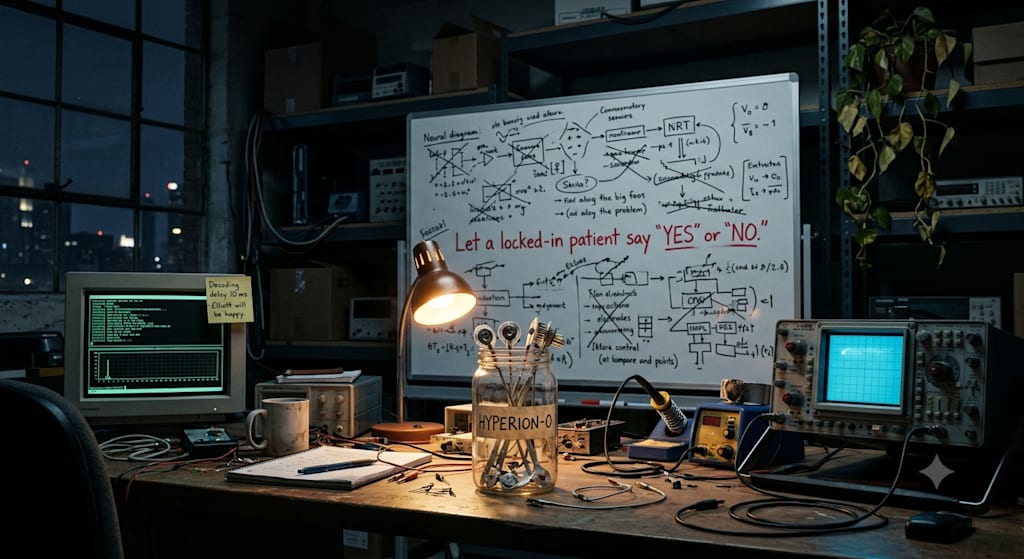
Elliott didn’t argue. He walked to the whiteboard, which was covered edge to edge with seventeen feature boxes: emotion recognition, dream journaling, memory indexing, silent commands, pet translation… He uncapped a red marker and began crossing out, circles so violent the board dented. One line remained: Let a locked‑in patient say “yes” or “no.”
Maya was quiet for a long time. Finally she said, “That’s probably enough to keep us busy for two years.”
“Yeah,” he said.
For the next five months, Elliott lived in the lab. His sleeping bag was under the server rack because that was the warmest spot. He survived on auto‑ship Amazon boxes: cases of Red Bull and frozen pizza. When Maya pushed the door open in the mornings, she’d catch the mixed smell of coffee, sweat, and soldering flux. One day she found a handwritten sticky note stuck to the edge of his monitor, the handwriting rushed: If we can cut the decoding delay by another 12 milliseconds, Mom can speak a full word. She didn’t ask whose mother. Elliott never explained the note, just like he never explained why he’d stared at the oscilloscope and cried on Mother’s Day.
The pivot came during the investor pitch. Maya had prepared a full slide deck for a social meditation aid: big market, low risk, beautiful numbers. When it was Elliott’s turn to speak, he opened a different file. The screen showed a photo of a man with ALS. “This is Frank,” he said. “He’s been trapped inside his body for six years. We want him to tell his daughter goodnight.”
The air in the conference room turned solid. Under the table, Maya pinched her own thigh. One of the lead partners took off his glasses, wiped them, and said, “This will be very hard to commercialize.”
“I know,” Elliott said.
The man put his glasses back on. “I like hard things.”
After the first check cleared, they moved into an office with actual windows. But the pressure only got uglier. Elliott began reviewing every line of code. Every commit Maya made came back flagged for refactor. One Friday she shoved her keyboard away. “I’m not your hand.”
“I need to make sure —”
“You don’t need to make sure. You need to control everything.”
“Because if this goes wrong, there’s nothing left.” His voice jumped. “I can’t make Frank wait another year.”
Maya stood, picked up a clear jar from his desk, the one holding the old electrodes from the night of their first successful test, the label reading Hyperion‑0. “You never asked if I was willing to wait another year.” She set the jar back down and walked out.
Elliott didn’t follow. He picked up the jar and turned it in his hands. In the glass he caught his own reflection: the hollowed‑out eye sockets from months without real sleep.
For the next week, the office held only him. The coffee machine stayed on. The pothos in the corner yellowed and curled. He sat at Maya’s desk, her screen dark, the desk mat still showing a coffee stain shaped like the state of Oregon. In her drawer he found a stack of used sticky notes. The last one read: Decoding delay 10 ms — Elliott will be happy. Dated three months ago. He put the stack back exactly where it was, faced her empty chair, and said, “I’m sorry.”
He spent two days rewriting the architecture. Then he did something the old Elliott would never have done: he packed up the technical docs and every access key into an encrypted zip file, sent it to Maya, and added one line: What should I do? No explanation, no defense, just that single question.
Maya came back on the fourth day. She pushed open the glass door. Elliott was watering the dying pothos. She held up her phone. “That thing you sent, I patched seven memory leaks.”
“I figured.”
“Then figure what I’m about to say next.”
“You’re probably going to tell me to stop carrying everything alone.”
“Wrong.” She dropped her backpack. “I’m going to say, when Frank does his first fitting, we’re both in the room.”
He didn’t look up. The watering can kept tilting, the soil around the pothos roots finally turning dark. “Okay.”
The night the FDA approved their clinical trial, they didn’t celebrate. Elliott got an email from a professor he’d helped seven years earlier, back when he was a lab assistant: Leonard Kaufman, at the time just an overlooked neuroscience researcher who’d asked for a favor building a database. Elliott had pulled an all‑nighter to recover Kaufman’s corrupted data and refused a single dollar. Now Kaufman was a Nobel laureate. The last line of his email read: You saved twenty years of my research back then. I’ve already written to the review board about Frank’s trial. Don’t thank me. It’s compounding.
The acquisition offer came after the Phase II data dropped. Four hundred million, full buyout, team folded into the larger company. Maya and a few early employees waited for him in the conference room. Elliott read the contract cover to cover, flipped to the signature page, and picked up the pen. Everyone held their breath. He capped the pen, turned the contract facedown on the table, pushed his chair back, and stood.
“We’re not selling.”
Maya couldn’t help it. “Why?”
“Because this is the only thing I own,” he said. “Not a salary, not a title. Ownership.” He walked to the window. “And Frank still hasn’t said goodnight to his daughter.”
Hyperion went public the year Elliott turned thirty‑one. The bell‑ringing ceremony was set for the Nasdaq. Maya went as the team’s representative. Photographers searched everywhere for him. Eventually Maya pulled out her phone and video‑called the lab. The screen showed Elliott in his old lab coat, electrode gel smeared on the cuff, standing behind the original Hyperion‑0 prototype, the jar still there.
“They’re waiting for you to ring the bell,” Maya said.
Elliott waggled an oscilloscope probe at the camera. “I’m ringing it right now. The waveform just stabilized.”
Maya flipped the phone around to show the entire exchange floor. His face filled the giant screen, and the room broke into laughter.
Before he hung up, he added, “There’s champagne in the fridge, you guys drink. I’ve still got one subject’s data to run.”
Maya gave the camera a thumbs‑up and ended the call, then muttered to herself, “That guy finally stopped needing to control everything.”
The Hyperion‑0 prototype eventually went to a museum. The placard didn’t say The invention that changed the world. It said just one line: The first full word it ever decoded was “tomorrow.”
And Elliott is still in the lab. His newest sticky note is on the monitor, the handwriting steadier than it was years ago: Let the ones who can never speak say their child’s name.
About the Creator
Jin
Writer of reamstories
https://reamstories.com/jin
Enjoyed the story? Support the Creator.
Subscribe for free to receive all their stories in your feed. You could also become a paid subscriber, letting them know you appreciate their work.
Comments
There are no comments for this story
Be the first to respond and start the conversation.