
Emotionally Exhausted Generation
How modern life is draining us silently
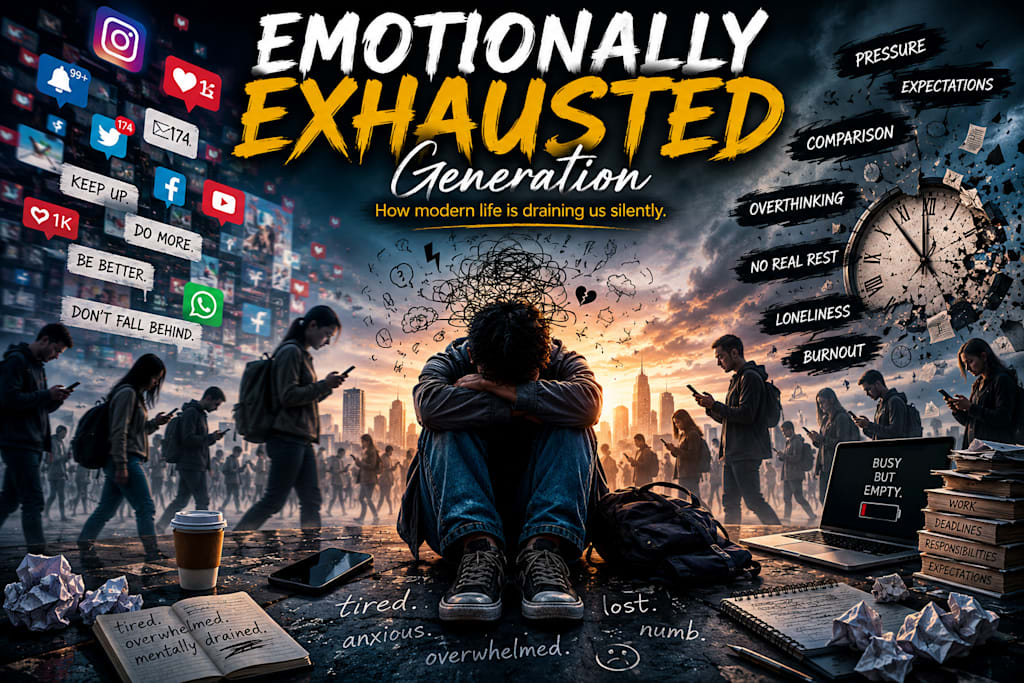
The modern world is faster, louder, and more connected than ever before. On the surface, this should make life easier. We have instant communication, endless information, and tools designed to simplify daily tasks. Yet beneath this convenience lies a growing, unspoken reality: people are more emotionally exhausted than ever. This exhaustion isn’t always dramatic or visible. It doesn’t always look like breakdowns or crises. More often, it appears as quiet fatigue, constant overwhelm, and a lingering sense that something just isn’t right.
Emotional exhaustion has become a defining trait of this generation.
One of the biggest reasons for this is the constant mental noise we live with. In previous generations, people had clearer boundaries between work, social life, and personal time. Today, those boundaries have blurred almost completely. Work emails arrive at night, messages demand immediate replies, and social media keeps the brain engaged even during supposed “rest.” The mind rarely gets a true pause. Even moments of silence are filled with scrolling, comparing, or consuming content.
This constant stimulation prevents emotional recovery. Just like the body needs rest after physical effort, the mind needs stillness after emotional strain. Without that recovery time, exhaustion builds slowly and steadily.
Another major factor is the pressure to keep up. Modern life creates an illusion that everyone else is doing better, achieving more, and living more fulfilled lives. Social media plays a central role in this. People are constantly exposed to curated versions of success—perfect careers, relationships, lifestyles. Even when we know these images are filtered and selective, they still affect us. They create unrealistic standards that feel impossible to reach.
This leads to a subtle but persistent sense of inadequacy. People begin to feel like they are falling behind, even when they are doing perfectly fine. The result is emotional strain that doesn’t come from real failure, but from perceived comparison.
At the same time, expectations have expanded in every direction. Individuals are expected to be successful in their careers, maintain strong relationships, stay physically healthy, be mentally resilient, and still find time for personal growth. Each of these areas requires emotional energy. Trying to excel in all of them simultaneously is overwhelming.
The problem is not ambition—it’s the lack of limits. When everything feels equally important, nothing feels manageable. This creates a constant state of pressure where people feel like they are never doing enough, no matter how much they accomplish.
Emotional exhaustion is also deeply connected to the way we process feelings today. There is more awareness around mental health than ever before, which is a positive shift. However, awareness without balance can sometimes lead to over-analysis. People spend a lot of time thinking about their emotions, questioning them, and trying to understand every detail.
While reflection is healthy, constant self-analysis can become draining. It turns every feeling into a problem to solve rather than an experience to move through. Instead of processing emotions naturally, people get stuck in them.
Another overlooked factor is the decline of genuine rest. Rest is often confused with distraction. Watching videos, scrolling through feeds, or switching between apps feels like relaxation, but it rarely restores emotional energy. True rest involves disconnection—stepping away from input and allowing the mind to settle.
Without real rest, emotional fatigue accumulates. People may sleep enough hours, but still wake up feeling drained because their minds never fully switch off.
Relationships also play a role in emotional exhaustion. While connection is essential, modern communication has changed how relationships function. There is an expectation to always be available, always responsive, and always engaged. This creates pressure even in personal interactions.
Additionally, conversations often stay on the surface. Despite constant communication, many people feel emotionally disconnected. They talk frequently, but rarely feel truly understood. This lack of depth contributes to loneliness, which is another form of emotional drain.
Work culture adds another layer to this issue. Many environments reward constant productivity and availability. Taking breaks can feel like falling behind. Even when people are not working, they may feel guilty for resting. This mindset turns rest into something that must be earned rather than something that is necessary.
Over time, this leads to burnout. But unlike traditional burnout, which is often tied directly to work, modern emotional exhaustion spreads across all areas of life. It’s not just about being tired of a job—it’s about being tired of everything.
One of the most challenging aspects of emotional exhaustion is how invisible it is. People often continue functioning despite feeling drained. They go to work, maintain relationships, and complete daily tasks. From the outside, everything appears normal. Internally, however, there is a constant sense of heaviness.
This invisibility makes it harder to address. Because there is no clear breaking point, people don’t always recognize the need to step back. They keep pushing forward, assuming the feeling will pass on its own.
Another issue is normalization. Feeling tired, stressed, and overwhelmed has become so common that it is often dismissed as a normal part of life. Phrases like “everyone feels this way” or “that’s just how life is” reinforce the idea that emotional exhaustion is unavoidable.
But normal does not mean healthy.
The long-term effects of emotional exhaustion are significant. It reduces motivation, weakens focus, and makes even simple tasks feel difficult. It can also affect physical health, leading to headaches, sleep problems, and low energy. Over time, it impacts relationships, creativity, and overall quality of life.
Despite how widespread this issue is, it is not permanent or unchangeable. Small shifts can make a meaningful difference.
One of the most effective steps is creating boundaries. This means setting limits on work, screen time, and availability. It may feel uncomfortable at first, especially in a culture that values constant responsiveness. However, boundaries protect emotional energy. They create space for recovery and help restore balance.
Another important step is redefining rest. Rest should not be passive consumption. It should involve activities that genuinely calm the mind—walking, journaling, sitting in silence, or engaging in hobbies without pressure. These moments allow the brain to reset.
Reducing comparison is also essential. This doesn’t necessarily mean leaving social media entirely, but it does mean becoming more aware of its impact. Curating what you consume and limiting exposure can reduce the pressure to measure your life against others.
Learning to accept “enough” is another powerful shift. Not every area of life needs to be perfect. Prioritizing what truly matters and letting go of unnecessary expectations can significantly reduce emotional strain.
Emotional awareness should also be balanced with emotional release. Instead of analyzing every feeling, it can be helpful to simply experience it and move forward. Not every emotion needs a deep explanation.
Connection, when genuine, can also help reduce exhaustion. Meaningful conversations, even if they are rare, provide a sense of understanding and support that surface-level interactions cannot.
Finally, it’s important to recognize that slowing down is not failure. In a world that constantly pushes for more, choosing to pause is an act of self-preservation. It allows space to recover, reflect, and rebuild emotional strength.
The emotionally exhausted generation is not weak—it is overwhelmed. It is navigating a world that demands constant attention, comparison, and performance. The exhaustion is not a personal flaw; it is a response to an environment that rarely allows rest.
Understanding this is the first step toward change.
The goal is not to escape modern life, but to interact with it more intentionally. To create moments of stillness within the noise. To choose depth over constant activity. To recognize that emotional energy is limited and deserves protection.
Because without that awareness, exhaustion becomes the background of everyday life. And when exhaustion becomes normal, people forget what it feels like to truly be at ease.
Reclaiming that sense of ease may not happen instantly, but it begins with small, conscious choices. And those choices, over time, can transform not just how people live—but how they feel while living.
About the Creator
Enjoyed the story? Support the Creator.
Subscribe for free to receive all their stories in your feed.
Comments
There are no comments for this story
Be the first to respond and start the conversation.