
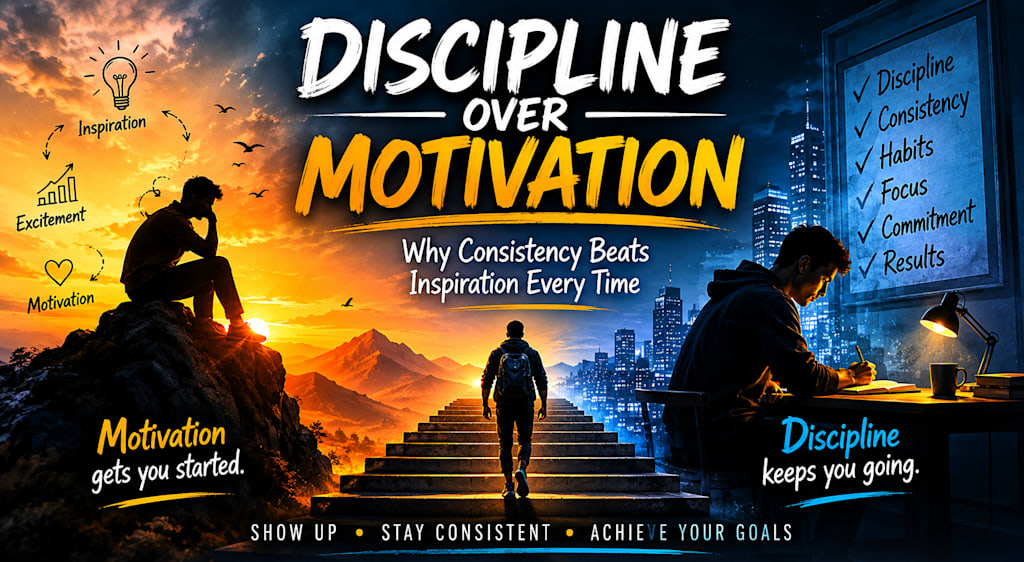
Discipline Over Motivation
Why Consistency Beats Inspiration Every Time
Introduction
There’s a popular belief that success begins with motivation—that sudden burst of inspiration that makes you feel unstoppable. You watch a video, read a quote, or see someone succeed, and suddenly you’re ready to change your life. But here’s the uncomfortable truth: motivation is unreliable.
It comes and goes. Some days you feel energized, other days you don’t even want to get out of bed. If your progress depends on how you feel, then your results will always be inconsistent.
That’s where discipline steps in.
Discipline is not exciting. It doesn’t give you a rush. But it is steady, predictable, and powerful. While motivation may start the journey, discipline is what actually gets you to the destination.
The Problem with Motivation
Motivation feels great—but it’s temporary.
Think about how often you’ve said:
“I’ll start tomorrow.”
“I’ll do it when I feel ready.”
“I’m just not in the mood today.”
That’s motivation talking. It depends on emotions, and emotions are unstable.
Why motivation fails:
It fades quickly after the initial excitement
It depends on your mood
It disappears when things get hard
It’s inconsistent
For example, going to the gym feels easy when you're motivated. But what about the days you're tired, stressed, or busy? Motivation won’t carry you through those days.
And those are the days that matter most.
What Discipline Really Means
Discipline is often misunderstood as punishment or strict control. In reality, it’s much simpler.
Discipline means doing what needs to be done—even when you don’t feel like doing it.
It’s showing up when:
You’re tired
You’re bored
You’d rather do something else
Discipline is not about perfection. It’s about consistency.
Instead of asking:
“Do I feel like doing this today?”
A disciplined person asks:
“Is this something I said I would do?”
And then they do it—regardless of how they feel.
Discipline Builds Identity
Every time you act with discipline, you reinforce a powerful identity:
“I am someone who shows up.”
“I am someone who keeps promises.”
“I am someone who follows through.”
This identity matters more than motivation.
Motivation says:
“I feel like doing this.”
Discipline says:
“This is who I am.”
And once something becomes part of your identity, it no longer requires constant effort—it becomes natural.
The Compound Effect of Consistency
Small actions, repeated daily, lead to massive results over time.
Writing 300 words a day = a book in a year
Saving a small amount regularly = financial stability
Exercising consistently = long-term health
None of these require extreme motivation. They require consistency.
Discipline turns big goals into small, repeatable actions.
Instead of:
“I need to change my life overnight”
You focus on:
“What can I do today?”
And then you repeat it tomorrow.
Why Discipline Wins in the Long Run
Motivation gets you started. Discipline keeps you going.
Here’s how they compare:
Motivation Discipline
Emotional Logical
Short-term Long-term
Unpredictable Reliable
Needs energy Creates results
Motivation is like a spark.
Discipline is like fuel.
Without fuel, the spark dies quickly.
Building Discipline (Even If You Don’t Have It)
Discipline is not something you’re born with. It’s something you build.
Here’s how:
1. Start Small
Don’t try to change everything at once.
10 minutes of work
5 minutes of exercise
1 small task
Small wins build momentum.
2. Remove Decision-Making
The more you think, the more likely you are to quit.
Create routines:
Same time
Same place
Same action
This turns effort into habit.
3. Focus on Systems, Not Goals
Goals are important, but systems create results.
Instead of:
“I want to lose weight”
Focus on:
“I will exercise every day at 7 AM”
Systems remove excuses.
4. Accept Discomfort
Discipline requires doing things you don’t enjoy.
You won’t always feel:
Excited
Inspired
Ready
But you can still act.
Discomfort is not a sign to stop—it’s a sign you’re growing.
5. Stay Consistent, Not Perfect
You will miss days. That’s normal.
What matters is:
Getting back on track quickly
One bad day doesn’t ruin progress. Quitting does.
The Role of Environment
Your environment can either support your discipline or destroy it.
Make it easier to stay consistent:
Remove distractions
Keep tools ready
Surround yourself with focused people
For example:
If you want to read more, keep a book nearby
If you want to exercise, prepare your clothes in advance
Discipline becomes easier when your environment supports it.
Discipline Creates Freedom
At first, discipline feels restrictive.
Waking up early
Following routines
Sticking to plans
But over time, it creates freedom.
Financial discipline → financial independence
Health discipline → physical freedom
Time discipline → more control over your life
Without discipline, you are controlled by:
Emotions
Habits
Distractions
With discipline, you control your direction.
Real-Life Example
Imagine two people:
Person A (Motivated):
Works hard when inspired
Skips when not in the mood
Starts strong, finishes weak
Person B (Disciplined):
Works every day
Doesn’t rely on feelings
Progresses slowly but steadily
After a year, Person B will outperform Person A—every time.
Not because they are more talented.
But because they are more consistent.
Breaking the Motivation Cycle
Many people get stuck in this loop:
Feel motivated
Start something new
Lose motivation
Quit
Repeat
Discipline breaks this cycle.
Instead of restarting every time, you keep going—even when it’s boring.
And that’s where real progress happens.
The Truth About Success
Success is not built in moments of excitement.
It’s built in:
Quiet mornings
Repetitive tasks
Unseen effort
The things no one celebrates are the things that matter most.
Discipline is not glamorous.
But it works.
Conclusion
Motivation will come and go. It’s emotional, unpredictable, and temporary.
Discipline, on the other hand, is stable and dependable. It doesn’t care how you feel. It only cares about what you do.
If you rely on motivation, you’ll only move forward when it’s easy.
If you rely on discipline, you’ll move forward no matter what.
And that’s the difference between starting something—and actually finishing it.
Final Thought
Stop waiting to feel ready.
Start showing up anyway.
Because in the end, success doesn’t belong to the most motivated.
It belongs to the most disciplined.
About the Creator
Enjoyed the story? Support the Creator.
Subscribe for free to receive all their stories in your feed.
Comments
There are no comments for this story
Be the first to respond and start the conversation.