True Crime
Bajaur Blast: 11 Security Personnel Killed in Suicide Attack on Check Post in Khyber Pakhtunkhwa
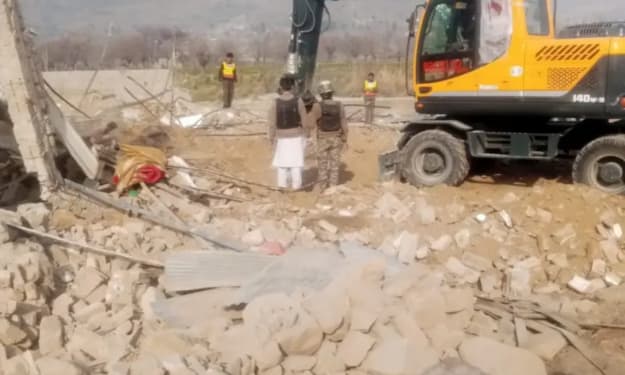
When we were pulling people out from under the rubble, there was still firing at the check post. The personnel stationed there returned fire. And when the wounded were being transported to the hospital in ambulances and vehicles, there was firing at that time as well. This is the account of an eyewitness who reached the site to help after an explosion at a joint check post of the FC and law enforcement agencies in Bajaur district of Khyber Pakhtunkhwa province on Monday evening. Given the situation in the area, he requested that his name not be disclosed. According to him, after the Isha prayer, a powerful explosion was heard in the area, and it felt as though it had occurred right in their immediate vicinity. “More or less, this was the situation in every house in the area, where people felt as if the powerful blast had happened near their own homes.” On Tuesday afternoon, in a statement issued by the military’s media wing, ISPR, it was said that 11 security personnel and one girl were killed in the attack. ISPR stated that on Monday, militants attacked a joint check post of the security forces and law enforcement agencies in Bajaur district. According to the statement, the militants rammed an explosives-laden vehicle into the check post, causing the building to collapse. According to ISPR, nearby buildings were also damaged in the explosion, resulting in the death of a girl and injuries to seven civilians. Firing also took place while the injured were being transported Since the incident, there has been an atmosphere of fear in Bajaur district. According to local residents, security forces have cordoned off the blast site in the Loi Mamond area and are not allowing anyone to approach. Residents said that helicopters were seen in the sky early in the morning, after which the bodies were transported to the hospital. So far, no organization has claimed responsibility for the attack. The Chairman of Tehsil Nawagai, Dr. Khalil-ur-Rehman, said that he was in his hujra (guest house) last night when suddenly the door burst open due to the powerful explosion. “We couldn’t understand what was happening. Our hujra is located a few kilometers from the blast site.” He said he received calls from nearby areas reporting that an explosion had occurred near their homes. Similar reports were coming in from nearby villages, but it was unclear what exactly had happened. According to Dr. Khalil-ur-Rehman, he went to the affected check post after receiving the information. He said that residential houses near the check post were also damaged in the explosion and several civilians were injured. Dr. Khalil-ur-Rehman added that when the injured were being transported in ambulances, unidentified individuals opened fire, to which the forces responded. An eyewitness, describing the incident and subsequent rescue operations, said that the destroyed check post was a two-story building. He said that after the explosion, announcements were made from local mosques informing residents and asking them to come to the site to help rescue those trapped under the rubble. According to locals, the building had previously been used as a religious seminary. The eyewitness said, “When we arrived there and began pulling people out from the rubble, unidentified individuals were still firing at the check post.” He added, “It was a difficult time. Six bodies were recovered during the night.” The Chief Minister of Khyber Pakhtunkhwa, Suhail Afridi, condemned the attack, calling it a cowardly act. He said that after the Bajaur blast, rescue agencies had been directed to carry out immediate and comprehensive relief operations. The Chief Minister added that a comprehensive and effective strategy is essential for the complete elimination of terrorism. ‘A month and a half ago, people were sent back saying the area had been cleared’ A few months ago, a military operation was carried out in the Loi Mamond area against armed militants. Dr. Khalil-ur-Rehman said that a large number of people had displaced themselves for the operation, leaving their homes and staying in camps. He said that people spent about a month and a half in the camps. According to him, about a month and a half ago, people were sent back to their areas after being told that the region had been cleared. He said the government should review its policies, as such policies are causing harm to the people. The situation in Bajaur has been tense for a long time, and attacks have targeted not only security forces but also religious leaders and their gatherings. Some attacks have been claimed by the banned organization ISIS. On July 30, 2023, a suicide bombing at a Jamiat Ulema-e-Islam (Fazl-ur-Rehman) rally in the Khar area killed 60 people and injured more than 100. ISIS claimed responsibility for that attack. Similarly, in July 2025, an attack was carried out on the Assistant Commissioner’s convoy on Nawagai Road in Bajaur, in which the Assistant Commissioner and four others were killed. During that period, there were also incidents of targeted killings of police officers and attacks on tribal leaders.
By Real content8 months ago in Chapters
US Military Assets Near Iran: USS Abraham Lincoln, Gerald R. Ford and Growing Middle East Tensions
The U.S. aircraft carrier USS Abraham Lincoln is currently positioned near Iran. It is worth noting that Washington has been increasing pressure on Iran over its nuclear program and its bloody crackdown on recent protests, even as negotiations continue. Meanwhile, U.S. and Iranian officials are set to begin a second round of talks in Switzerland on Tuesday. Iran has stated that the meeting in Switzerland will focus on its nuclear program and the possible lifting of U.S. economic sanctions, while Washington has indicated it wants to raise additional issues during the negotiations. The Abraham Lincoln is accompanied by three guided missile destroyers, 90 aircraft including F-35 fighter jets, and 5,680 personnel. Although the carrier was deployed to the Gulf region at the end of January, it had not appeared in satellite imagery until now. According to the latest information, the vessel is currently near the coast of Oman, approximately 700 kilometers from Iran. Reports also indicate that the United States has dispatched the world’s largest warship, the USS Gerald R. Ford, toward the Middle East, where it could arrive within the next three weeks. The presence of the Abraham Lincoln further underscores that the U.S. has increased its military footprint in the Middle East in recent weeks. There has been a notable rise in the number of American destroyers, warships, and fighter jets in the region. What military assets has the U.S. moved to the Middle East? Publicly available images from the European Sentinel-2 satellite show the aircraft carrier Abraham Lincoln in the Arabian Sea, currently about 150 miles (240 kilometers) off the coast of Oman. The carrier had not been visible in satellite images after entering the region in January because it was operating in open waters where satellite coverage is limited. Unlike land-based military assets, which are often clearly visible in satellite imagery, naval vessels are harder to track in open seas. This latest development means that satellite imagery has now identified up to 12 U.S. warships in the Middle East, including the Abraham Lincoln, a nuclear-powered Nimitz-class carrier that forms a carrier strike group with three destroyers. Additionally, two long-range missile-capable destroyers and three specialized combat ships designed for littoral operations are currently stationed at the naval base in Bahrain. Two more destroyers have been spotted in the eastern Mediterranean near the U.S. base at Souda Bay, while another vessel is present in the Red Sea. At Muwaffaq Salti Air Base in Jordan, the number of F-15 and EA-18 fighter jets has increased. There has also been a rise in cargo aircraft, refueling planes, and communications aircraft arriving in the Middle East from the U.S. and Europe. How is Iran responding? On February 6, U.S. Central Command released images of the Abraham Lincoln operating in the Arabian Sea alongside destroyers, fighter jets, surveillance aircraft, and Coast Guard vessels. The move appeared to be a display of American military strength, and Iran responded accordingly. On Monday (February 16), Iran’s Islamic Revolutionary Guard Corps (IRGC) launched naval exercises in the Strait of Hormuz. During the drills, IRGC Commander-in-Chief Major General Mohammad Pakpour was seen inspecting naval vessels at a port, after which missiles were fired from one of the ships. These scenes were reported by the IRGC-affiliated Iranian news agency Tasnim. The Strait of Hormuz is considered one of the world’s most vital commercial waterways and a key route for global oil shipments. One-fifth of the world’s oil and gas passes through this strait. Tasnim’s report showed the Iranian commander flying by helicopter and observing the exercises. Expert opinion on U.S. military preparations Military intelligence expert Justin Crump said the current U.S. military preparations in the Middle East show “greater depth” and differ from preparations made before the arrest of former Venezuelan President Nicolás Maduro in January 2026 or before last June’s airstrikes on Iranian nuclear facilities. In all those U.S. military actions, a carrier strike group and several destroyers were involved, but assets were deployed under very different circumstances in Venezuela and Iran. Before operations against Venezuela, the U.S. had deployed the Gerald R. Ford to the Caribbean, where eight other warships were already present. However, fewer aircraft were used at that time because fighter jets could easily be dispatched from U.S. mainland bases or from Puerto Rico if necessary. The U.S. had also deployed amphibious assault ships in the Caribbean, which served as helicopter launch platforms, as seen during Maduro’s arrest. However, Venezuela’s military is generally considered weak and lacks the capacity to mount effective defense or retaliation against the United States. Last year, when the U.S. carried out Operation Midnight Hammer targeting Iranian nuclear facilities, it was striking a country with a far more capable military than Venezuela’s. It should be noted that Iran has the capability to target U.S. bases across the Middle East. During Midnight Hammer, the U.S. deployed two carrier strike groups in the region, five destroyers in the Mediterranean and Red Sea, and three warships in the Gulf. It also moved squadrons of fighter jets and refueling aircraft from the U.S. to Europe. However, the B-2 stealth bombers that struck Iran’s nuclear facilities at Fordow, Isfahan, and Natanz were launched from bases in Missouri. Justin Crump, CEO of the risk and intelligence firm Sibylline, said the presence of U.S. warships and aircraft, along with eight air bases in the region, gives the U.S. the capacity to conduct around 800 missions per day to render any Iranian retaliation “ineffective.” He added that what is currently being observed is not merely preparation for an attack but a broader defensive deployment that can be scaled up or down depending on circumstances. Compared with Venezuela or last year’s Operation Midnight Hammer, this posture has greater depth and sustainability. It is designed to neutralize any potential Iranian response and to defend U.S. assets in the region as well as Israel.
By Real content8 months ago in Chapters
AI, Surveillance, and the Fragile Line Between Deterrence and Disaster
AI, Surveillance, and the Fragile Line Between Deterrence and Disaster The next great danger in global conflict is not only missiles or soldiers, but machines that think faster than humans. As artificial intelligence (AI) becomes deeply embedded in military planning, surveillance, and nuclear command systems, the risk of accidental war is growing quietly but dangerously. What once depended on human judgment is now increasingly shaped by algorithms, sensors, and automated decision-making. In this new environment, a single error, misreading, or cyber manipulation could push the world toward catastrophe.
By Wings of Time 9 months ago in Chapters
Russia-Ukraine War Enters Fourth Year: Can Flamingo, Oreshnik Missiles, F-16 Jets and AI Drones Change the Balance?
On the 24th of this month, four years will be completed since Russia’s invasion of Ukraine. This war has continued without pause for four years, and there are still no visible signs that it will end. Negotiations between Russia and Ukraine are being held in Abu Dhabi under U.S. mediation. On Thursday, another round of these talks ended without any progress. If diplomacy is failing to deliver results, do the two countries possess such advanced weapons that could potentially tilt the balance of war in favor of either side? New Missiles: Flamingo vs. Oreshnik
By Real content9 months ago in Chapters