Resolution
Coffee may eventually turn cancer treatments on and off.
Without thinking twice, the majority of us reach for coffee. Scientists are now transforming that well-known shock into something even more accurate: a switch that can regulate gene editing within living cells.
By Francis Dami7 months ago in Chapters
After Khamenei: How the Middle East Crisis Could Redraw Global Politics
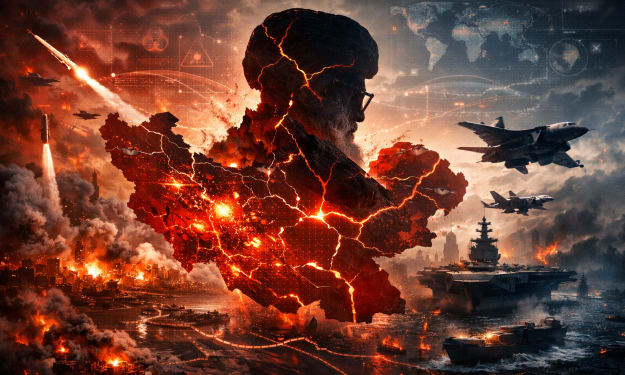
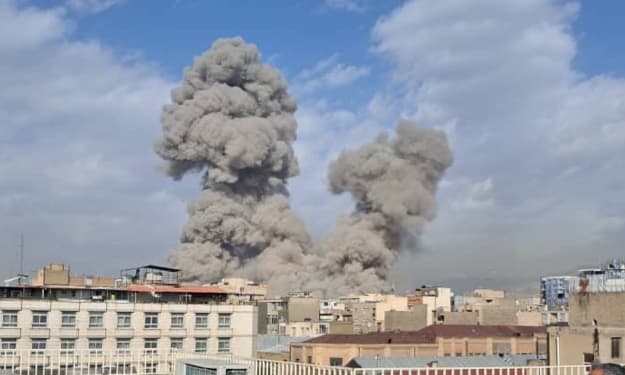
After Khamenei: How the Middle East Crisis Could Redraw Global Politics The confirmed death of Ayatollah Ali Khamenei after joint strikes by the United States and Israel has sharply intensified the ongoing conflict in the Middle East—turning what was a dangerous regional crisis into a moment with global implications. Khamenei, who led Iran for nearly four decades and wielded extraordinary political and military influence, was killed when missiles and airstrikes hit Tehran in the opening phase of a major military operation targeting Iranian leadership and strategic infrastructure. The impact of his death is already reverberating across the region and the world in ways that may last for years.
By Wings of Time 7 months ago in Chapters
The First Hours of World War III
The First Hours of World War III World War III will not begin with a formal declaration, a single invasion, or a dramatic announcement on television. If it comes, it will begin quietly—through alerts, miscalculations, automated systems, and decisions made under extreme pressure. The early hours of a global war will feel confusing, fragmented, and unreal, long before the world understands what has happened.
By Wings of Time 7 months ago in Chapters
How World War III Could Begin in Our Time
The First Sparks: How World War III Could Begin in Our Time World War III may not start with a single declaration or one massive attack. Instead, it could begin quietly, through a series of connected crises, misunderstandings, and power struggles already happening today. The world is more connected than ever, but that connection also makes global conflict easier to spread.
By Wings of Time 7 months ago in Chapters
Is This War Turning Into World War III?
Is This War Turning Into World War III? The question many people around the world are quietly asking today is unsettling but unavoidable: Is the current war climate pushing humanity toward World War III? What once appeared to be localized conflicts in the Middle East are now entangled with global rivalries, advanced technologies, and fragile alliances. History shows that world wars rarely begin with a single dramatic declaration. Instead, they grow out of overlapping crises, miscalculations, and escalating power struggles—many of which are visible today.
By Wings of Time 7 months ago in Chapters
Karachi Violence During Anti-US Protests: 9 Killed as Pakistan Reacts to Iran Conflict Escalation
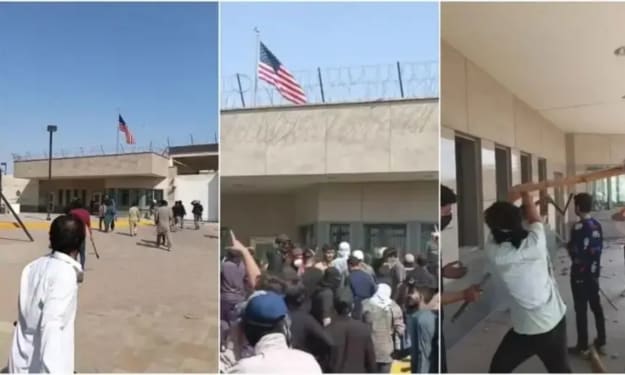
Protests are continuing in various cities across Pakistan, including Karachi and Islamabad, against the attacks by the United States and Israel on Iran and the killing of Supreme Leader Ayatollah Ali Khamenei. On Sunday, at least nine people were killed and several others injured in firing during a protest outside the US Consulate in Karachi. Angry protesters also set fire to United Nations offices in Gilgit and Skardu. Demonstrations were also held in Islamabad, Lahore, Peshawar, Pakistan-administered Kashmir, and other cities. Videos circulating on social media show some individuals breaking through the gate and entering the US Consulate in Karachi, after which they smashed the glass at the reception area and security rooms. The DIG of Karachi Police’s East Zone said that some agitated individuals managed to enter the consulate, but police arrived at the scene and brought the situation under control. A senior doctor at Civil Hospital Karachi said that nine bodies and at least 32 injured people were brought to the hospital following violent clashes with police. An official from the private rescue service Edhi Foundation also confirmed that they transported nine bodies and dozens of injured individuals to the hospital. Protesters Demand Removal of US Flag from Consulate Building
By Real content7 months ago in Chapters
US and Israel’s War with Iran: Preemptive Strike or War of Choice? Global Risks, Regime Change, and Middle East Crisis
The decision by the United States and Israel to plunge into a new war with Iran has pushed the global landscape toward extremely dangerous and unpredictable consequences. Israel has attempted to justify its attack by describing it as a “preemptive action.” However, evidence suggests that this strike was not carried out in response to an imminent threat, as the term “preemptive” implies. In reality, they chose to fight this war a war of choice. The United States and Israel likely calculated that Iran’s Islamic government is currently extremely weak. The government is not only facing a severe economic crisis but is also dealing with the aftermath of a harsh crackdown on Iranian protesters. Additionally, Iran’s defense system was reportedly badly damaged following last summer’s conflict with Israel. The United States and Israel appear to have concluded that this opportunity should not be wasted. This action is also another heavy blow to the already fragile structure of international law. In their statements, President Donald Trump and Prime Minister Benjamin Netanyahu said that Iran poses a threat to their countries (the United States and Israel), while Trump even described Iran as a “global threat.” Certainly, Iran’s Islamic government is their staunch adversary, but it is difficult to understand how the legal justification of self-defense applies in a situation where two major powers (Israel and the United States) stand on one side and Iran on the other. War is a political act. Once armed conflict begins, it becomes extremely difficult to control. That is why leaders must have clear objectives. Netanyahu has, for decades, viewed Iran as Israel’s most dangerous enemy. For him, this is a major opportunity to inflict maximum damage on Tehran’s government and military capabilities. General elections are scheduled in Israel later this year, and Netanyahu believes that whenever Israel chooses the path of war, it strengthens his political position. On the other hand, Donald Trump’s objectives tend to shift over time. Last January, he assured Iranian citizens protesting in Iran that “help is coming.” However, at that time, much of the U.S. Navy was engaged in efforts to remove Venezuelan leader Nicolás Maduro from power and arrest him, limiting Trump’s military resources and options. A few weeks ago, when the United States was deploying two aircraft carriers to the Middle East, Trump spoke extensively about the dangers of Iran’s nuclear ambitions — despite having declared last summer, following U.S. bomber strikes on Iran, that Iran’s nuclear program had been “wiped off the face of the earth.” The Iranian government has consistently denied seeking nuclear weapons. However, it has enriched uranium to levels that have no use in a peaceful nuclear power program. At the very least, it appears that Iran wants to keep the option of building a nuclear bomb open. Nevertheless, Israel and the United States have not presented any evidence that Iran was on the verge of doing so. In a video message, Trump told the Iranian people that their “time for freedom” is near. Netanyahu made a similar statement on Saturday, suggesting that the current war could provide the Iranian people with an opportunity to overthrow their government. But that is far from certain. There is no precedent for regime change being achieved through airstrikes alone. In 2003, Saddam Hussein’s government in Iraq was toppled only as a result of a large-scale ground invasion led by the United States not merely airstrikes. In 2011, Muammar Gaddafi’s government in Libya fell only because rebel forces received sustained air support from NATO and several Arab states. In both cases, however, the outcome was state collapse. Civil wars erupted, and thousands were killed. Libya remains a failed state, while Iraq is still grappling with the consequences of the U.S. invasion and the widespread bloodshed that followed. Even if this were to become the first instance in which the United States successfully topples a government using air power alone, there is no reason to believe that Iran’s current Islamic government would be replaced by a liberal democracy that respects human rights. No credible alternative government in exile currently exists. Over nearly half a century, Iran’s ruling system has developed a complex political structure based on a mixture of ideology, corruption, and the ruthless use of force when necessary. Last month, the Iranian government clearly signaled that it was prepared to kill protesters. Iran’s hardline security forces have previously complied with orders to shoot and kill hundreds of their own citizens for challenging the existing system and demanding freedom. Perhaps the United States and Israel are attempting to assassinate Iran’s Supreme Leader, Ayatollah Ali Khamenei. Israel views its capacity for targeted killing as a strategic tool. But Iran’s Islamic government is a different matter. It is not merely an armed group or movement; it governs a state. It is not a one-man show. Even if Supreme Leader Khamenei were killed, he would be replaced immediately — most likely by another cleric backed by Iran’s Revolutionary Guards, who would continue defending the government against domestic and foreign threats with a clear strategy. Trump reportedly offered them immunity in exchange for surrender, but otherwise threatened certain death. There is little chance that the Revolutionary Guards would be tempted by such an offer. In the ideology of the Islamic Republic and within Shiite Islam, “martyrdom” is regarded as a form of enduring life. Trump tends to see politics and everyday life primarily through the lens of transactions and business, as described in his book “The Art of the Deal.” However, when dealing with Iran, the power of ideology and belief cannot be ignored and that is a force that is extremely difficult to measure. The current crisis has been unfolding since the beginning of this year, when the United States began shifting its military focus toward the Middle East. At that time, there were indications that Iran’s Islamic leadership believed war might be inevitable, prompting them to initiate indirect talks with Washington. Iranian leaders do not trust the United States or Israel. During his first term, Trump unilaterally withdrew from the Iranian nuclear agreement — the Joint Comprehensive Plan of Action (JCPOA) which had limited Iran’s nuclear program and was considered a major achievement of the Obama administration. Recently, there were signs that Iran might be willing to accept a “JCPOA II”-type agreement to buy time. However, it appears that the United States was also demanding strict limits on Iran’s missile program and an end to its support for regional allies opposed to Israel and the United States. For Iran, these demands were unacceptable, as they would amount to surrendering to the United States and Israel. Abandoning its missiles and regional allies would effectively pave the way for regime change. Iran’s leaders are now likely calculating how to survive this war, how to emerge from it, and how to manage its consequences. Meanwhile, neighboring countries — including Saudi Arabia — are deeply concerned about the uncertain and potentially far reaching outcomes of today’s events. Given the Middle East’s capacity to generate instability, and with the outbreak of yet another intense conflict, the existing instability in the region and the wider world — already turbulent, violent, and dangerous — is likely to deepen further.
By Real content7 months ago in Chapters
Uzbekistan and Afghanistan Target $5 Billion Trade Deal Amid Regional Economic Shift
Taliban government says it has discussed increasing bilateral trade with Uzbek authorities, and both countries are committed to raising their mutual trade to “five billion dollars.” Uzbek Deputy Prime Minister Jamshid Khodjaev said that Uzbekistan and Afghanistan have agreed to significantly expand their economic relations and increase bilateral trade to $5 billion. Khodjaev announced this goal after speaking via video conference with the Taliban government’s Minister of Industry and Commerce, Nooruddin Azizi. During the meeting, both sides reviewed existing cooperation and discussed plans for future development. “In just five years, mutual trade has increased 2.5 times — from $653 million in 2021 to $1.7 billion in 2025. Our current goal is to raise this level to $5 billion,” Khodjaev said. The two officials also discussed practical steps to further deepen trade and economic cooperation, including preparations for an upcoming visit by an Afghan delegation to Uzbekistan. In a video statement, Nooruddin Azizi said that Afghanistan’s trade volume with Uzbekistan has currently reached $1 billion annually, and the total trade volume has exceeded $1.5 billion. There are also plans to hold a business forum in Kabul after Ramadan and to prepare a detailed roadmap identifying priority sectors for cooperation. During the talks, emphasis was placed on the need to swiftly implement a preferential trade agreement, and both countries agreed to put the agreement into effect as soon as possible. Officials also discussed ways to promote joint investment and industrial projects. Key areas of cooperation include: Processing of agricultural products Construction materials Textile industry Strengthening food security They also discussed essential trade facilitation requirements such as exhibition halls, logistics centers, and the construction of warehouses to improve the marketing and distribution of goods. Despite regional challenges, trade between Uzbekistan and Afghanistan has steadily increased over the past five years — and now both governments are seeking to accelerate this process through a structured economic partnership and closer regional integration. Tehran has approved a plan for a joint international free trade zone with Afghanistan and China. According to a source within the Taliban government in Afghanistan, Morteza Zakarian, head of economic affairs in Iran’s southern Khorasan province, said that an international trade and industrial free zone will be established in the province between Iran, Afghanistan, and China. The project offers a strategic opportunity to increase exports, create employment opportunities for residents of border areas, and strengthen regional economic ties. “Pars Today” quoted Zakarian as saying that Afghan and Chinese partners have expressed willingness to provide financial support and even build a special industrial city. Iranian media reported that Iranian President Masoud Pezeshkian has approved the proposal, which also aims to support technology transfer and strengthen economic institutions. Zakarian emphasized that the combined population, geographic locations, and production capacities of Iran, Afghanistan, and China provide complementary resources that could contribute to the development of a strong global economic zone. Decline in Pakistani Exports to Afghanistan This expansion of Afghanistan’s economic ties with Uzbekistan and Iran comes at a time when Pakistani exports to Afghanistan have declined by nearly 59 percent due to frozen trade. Reports indicate a sharp drop in Pakistan’s exports to Afghanistan during the first seven months of the current fiscal year, reflecting the deepening trade stalemate and political crisis. Official data from Pakistan’s central bank shows that the value of exports fell from $550 million during the same period last year to approximately $228 million. The decline in exports from July to January is attributed to the suspension of trade between the two countries since early October, which has been cited as a major reason for the sharp decrease in Pakistan’s regional exports. The trade disruption has severely limited official cross-border exchange activities. In recent months, relations between Islamabad and Kabul have been strained due to tensions along the Durand Line and mutual accusations over security concerns, further complicating efforts to restore stable economic interaction. The Taliban government in Afghanistan has advised traders and importers to explore alternative trade routes and diversify supply sources to avoid shortages in local markets. They have stressed reducing reliance on a single transportation route and encouraged businesses to seek regional partnerships to ensure a steady supply of essential goods.
By Real content7 months ago in Chapters