
Journal of Mohandas K. Gandhi
Chapter 3 : The Ashram Constitution

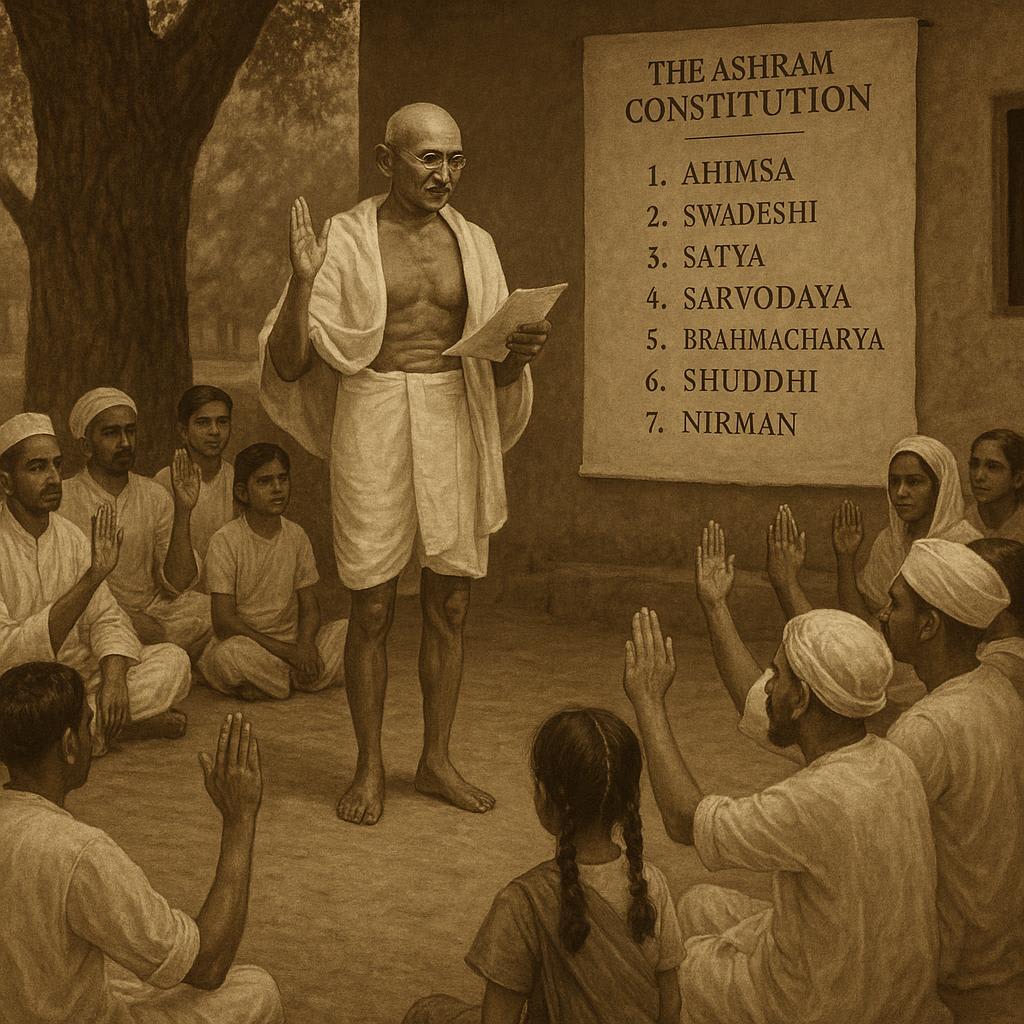
March 15, 1930 – Sabarmati Ashram
The Ashram Constitution
This morning, under the neem tree at the center of our ashram, I gathered the elders, the weavers, the young satyagrahis, and even the children. The early light filtered through the branches like a benediction. We sat not as leaders and followers, not as high and low, but as equals—braiding purpose from silence.
For Bharat Ahimsa to live beyond the poetry of speeches, it must be planted in law—not in the British sense, but in the moral architecture of vows. And so today, I set forth what may someday be called the Constitution of the Ashram Republic.
It is not a paper of decrees, but of disciplines.
We agreed upon seven vows, the seven threads that will bind this land of conscience:
- Ahimsa – Not merely non-violence in action, but in thought, word, and desire.
- Swadeshi – To use only what we produce in our own soil, with our own hands.
- Satya – Truth above loyalty, truth above fear.
- Sarvodaya – The upliftment of all, especially the most neglected.
- Brahmacharya – Discipline of body and desire, channeling energy to service.
- Shuddhi – Purity of work, of heart, of means.
- Nirman – The ceaseless act of building, of spinning a better world from daily life.
This is our pact. No armies. No taxes. No courts. Only a life bound by intention and lived in public view.
I watched as each person in the circle placed their right palm upon the earth and spoke, “I accept.” A girl of only twelve, Meera, with calloused hands from spinning, spoke the vows with more certainty than most grown men I have seen in legislatures. I wept quietly.
Later, I wrote down these vows and buried a copy in a clay pot beneath the central banyan. The earth will remember if men forget.
Evening came with a knock on the gate: a British officer. He had no warrant, no arrogance, only a letter. It was from the Viceroy. It warned that if I continued this “subversive parallel governance,” I would be imprisoned. I smiled and handed him a spun khadi cloth and said, “Then I suggest you prepare a cell large enough for all of us.”
He did not reply.
Tonight, as I sit cross-legged with my journal, I feel not fear, but clarity. The Ashram is no longer merely a sanctuary—it is the seed of a nation. One that will grow not through conquest, but through example. Not through control, but through vow.
Let it be known: the first constitution of Bharat Ahimsa has been spoken, lived, and vowed—not in parliament, but in an ashram.
M.K. Gandhi
About the Creator
Alain SUPPINI
I’m Alain — a French critical care anesthesiologist who writes to keep memory alive. Between past and present, medicine and words, I search for what endures.
Enjoyed the story? Support the Creator.
Subscribe for free to receive all their stories in your feed. You could also become a paid subscriber, letting them know you appreciate their work.
Comments
There are no comments for this story
Be the first to respond and start the conversation.