
Journal of Mohandas K. Gandhi
Chapter 4 : Salt and Satyagraha

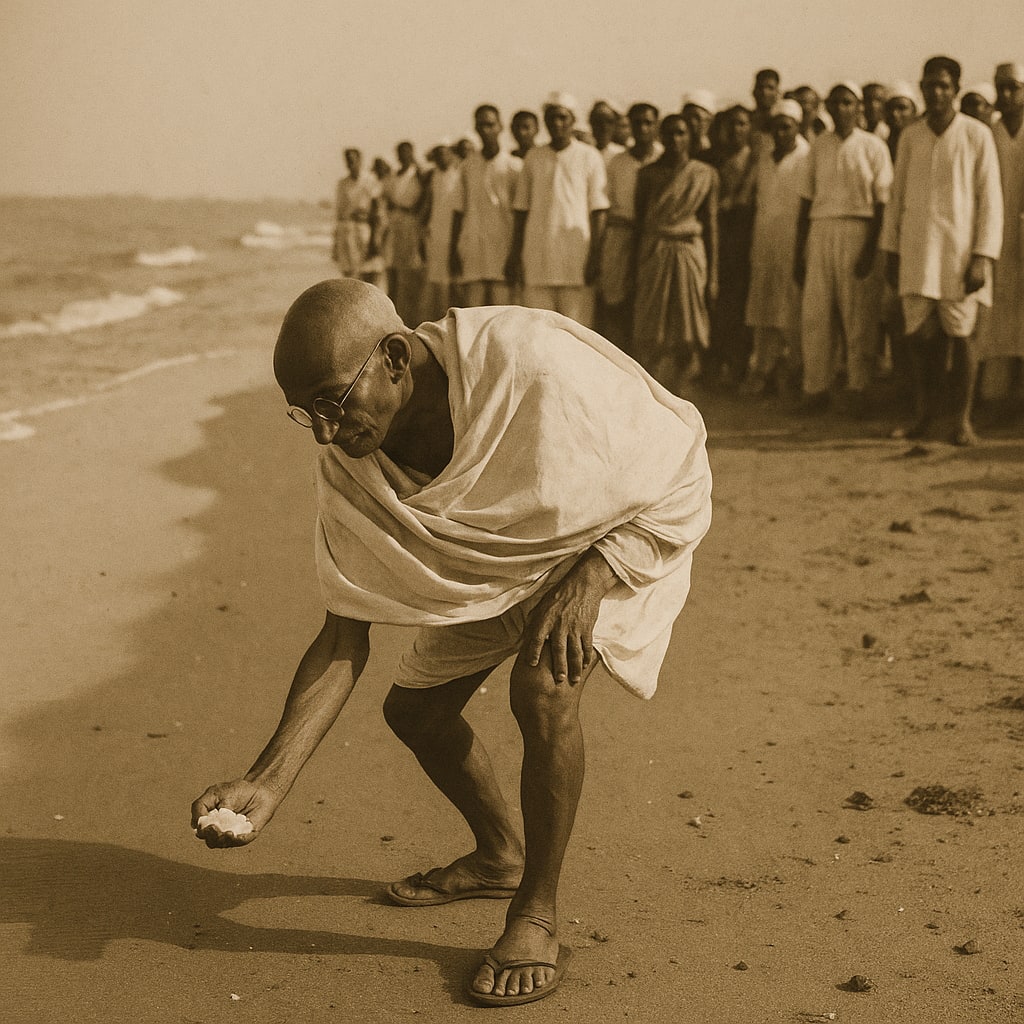
March 25, 1930 – Coastal Gujarat
Salt and Satyagraha
Today, we reached the edge of empire — and the edge of the sea.
It is difficult to describe what it feels like to walk for twenty-four days, village to village, step after dusty step, until the land finally ends and the sea breathes before you like some ancient witness. The horizon shimmered like a blade. Our feet were cracked. Our cotton garments stiff with sweat and earth. But we were whole.
Behind me walked not just satyagrahis, but carpenters, schoolteachers, barbers, untouchables, and Brahmins alike. I heard no caste, no slogans — only the quiet shuffle of purpose. In many ways, this was no march; it was a slow birth.
At mid-morning, we stopped at the beach near Navsari. The tide had just withdrawn, exposing patches of crusted white on the dark sand. A silence fell over us as if the sea had hushed the world itself. I bent down, knees trembling from the walk, and scooped up a small mound of salt.
I held it high.
There were no shouts, no chants — just a wave of inhalation, like the whole crowd was breathing with one lung. And then, they came. Hundreds followed, bending to gather their own handfuls. Some kissed it. Others held it to their hearts. One woman whispered to her child, “This is the taste of freedom.”
In the British code, what we did was illegal. But what is law, if it forbids a man from touching the salt of his own soil? The act was not a provocation — it was a restoration. The salt had been ours long before maps were drawn, before taxes were levied, before we were taught to kneel.
Later, we boiled seawater in earthen pots brought by villagers from across the district. Children stirred the liquid with bamboo sticks. Even old women, bent with age, laughed like young girls as the steam rose in swirls. One widow said to me, “I have nothing, Bapu, but now I have salt. And I will never give it back.”
News came swiftly. In Surat, police seized salt pots and broke them on the streets. In Bhavnagar, a schoolteacher was dragged from class for distributing salt to students. And yet, the people kept going — walking barefoot to the coast, burning wood for boiling, and lifting salt to the sky as if it were sacred ash.
I know what is coming. I have been told that an order has been signed: my arrest is imminent. But I feel no dread. This body is only a tool — it will rest when needed. But the movement is no longer mine to guide. It belongs to the hands that gathered salt today.
In the West, they speak of revolutions with blood and bullets. Here, we have chosen crystals and vows. And I believe they will echo longer than any empire.
Let it be remembered: we took nothing from the British. We simply touched what was already ours — and in doing so, became something new.
M.K. Gandhi
About the Creator
Alain SUPPINI
I’m Alain — a French critical care anesthesiologist who writes to keep memory alive. Between past and present, medicine and words, I search for what endures.
Enjoyed the story? Support the Creator.
Subscribe for free to receive all their stories in your feed. You could also become a paid subscriber, letting them know you appreciate their work.
Comments
There are no comments for this story
Be the first to respond and start the conversation.