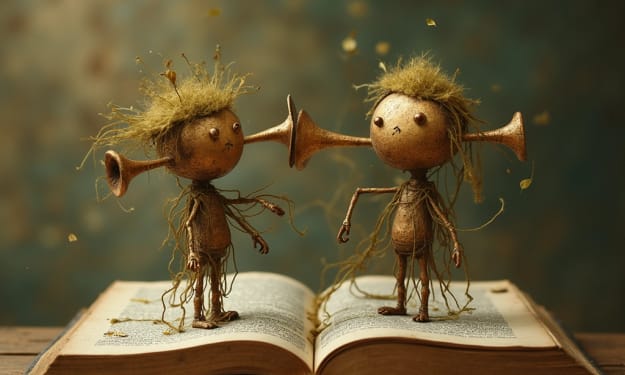
Harmonic Verses
View DetailsThe Winners!
Smoke and Mirrors!. Runner-Up in Harmonic Verses Challenge.
VERSE 1 Street lights blur to rain Another night, another town, the same old same Packed up dreams in a beaten case Twenty years of chasing fame The marquee lights spell out my name But nobody here knows my face
By Neli Ivanova2 years ago in Beat
The Truth of Who We Are. Runner-Up in Harmonic Verses Challenge.
Hundreds of years, we endured their fears; magistrates, citizens, royalty alike doomed us right from the start. They watched us through the lustrous years; they wouldn’t forgive and forget. Heretics and demons, our very lives they must forbid. Our special teas and willow trees cleared our minds and hearts. We tried to reason, they claimed it treason, and called it all the dark arts.
By Barb Dukeman2 years ago in Beat

























































All the great Submissions
Sing Your Story: How to Turn Words into Unforgettable Song Lyrics
Why Some Lyrics Stick (And Others Flop) Ever wondered why some lyrics stay with us for a lifetime, while others fade into obscurity? Think of The Beatles’ "Yesterday" or Queen’s "Bohemian Rhapsody"—what makes them so memorable? Great lyrics don’t just rhyme; they tell a story, evoke emotions, and flow seamlessly with the music.
By Alain SUPPINI2 years ago in Beat
Educated, Intelligent, or Smart? The Key Differences That Define Success
The terms educated, intelligent, and smart are often used interchangeably, but they have distinct meanings that set them apart. While they can sometimes overlap, understanding their differences is essential for appreciating how each one applies to personal development, problem-solving, and success in life. These three qualities contribute to a person's ability to think, learn, and make decisions, but they do so in different ways. Education refers to the formal process of acquiring knowledge through schooling, training, or structured learning. It involves studying subjects like mathematics, science, literature, and history, usually in an academic setting such as schools, universities, or specialized training programs. Being educated means having a certain level of knowledge that has been systematically taught and learned. An educated person has credentials such as degrees, diplomas, or certifications that validate their learning. However, education does not necessarily equate to intelligence or smartness. A person can have multiple degrees but still struggle to apply their knowledge effectively in real-world situations. Intelligence, on the other hand, is a person’s ability to think critically, solve problems, and grasp complex concepts. It is a natural trait that varies from person to person and is not solely dependent on formal education. Intelligence can be measured in different ways, such as logical reasoning, memory, problem-solving skills, creativity, and adaptability. There are various types of intelligence, including logical-mathematical intelligence, emotional intelligence, linguistic intelligence, and spatial intelligence. A highly intelligent person might not have received a formal education but can still understand and analyze information deeply. Intelligence allows people to learn quickly, recognize patterns, and think abstractly, making it a crucial factor in innovation and progress. Smartness refers to the ability to use knowledge and intelligence effectively in everyday situations. A smart person knows how to navigate challenges, make wise decisions, and adapt to their environment. Unlike education, which is learned through formal instruction, and intelligence, which is an inherent cognitive ability, smartness is more about practical application and common sense. A smart individual can assess situations quickly, read people well, and use their knowledge to achieve success. Street smartness, for example, is a form of intelligence that allows individuals to handle real-world situations skillfully, even if they lack formal education. Smartness often comes from experience, observation, and learning from past mistakes rather than from books or classroom lessons. One key difference between being educated, intelligent, and smart is the source of each trait. Education comes from external sources, such as teachers, textbooks, and structured curriculums, and requires effort to acquire. Intelligence is mostly inborn, though it can be nurtured and developed over time through mental exercises and challenges. Smartness, however, is built through experience, exposure, and the ability to learn from life situations. A person can be educated without being particularly intelligent or smart. Similarly, someone can be intelligent but lack formal education or smart decision-making skills. A smart person may not have an advanced education or exceptionally high intelligence, but they have the ability to make things work in their favor through cleverness and adaptability. Another major difference lies in how each quality is applied. Education primarily equips individuals with theoretical knowledge, which is useful for specific careers or professions but does not always translate to real-world problem-solving. Intelligence is applied in analytical thinking, creativity, and the ability to process information efficiently. Smartness is about using both intelligence and knowledge in a way that brings practical benefits. For example, an educated person may know the theory behind starting a business, an intelligent person may come up with innovative ideas for the business, but a smart person will know how to make the business succeed by managing risks, networking, and understanding market demands. The third difference is how each trait affects success and decision-making. Education can provide credentials and open doors to opportunities, but without intelligence or smartness, an educated person might struggle to achieve success beyond the academic world. Intelligence allows individuals to understand complex issues and develop groundbreaking ideas, but without the practical application that smartness brings, those ideas may remain theoretical. Smartness enables people to make the best use of their knowledge and intelligence, turning ideas into real-world achievements. A smart person is often seen as resourceful and quick-witted, able to solve problems in ways that an educated or intelligent person might not consider. To illustrate these differences further, consider three individuals: one who is highly educated, one who is extremely intelligent, and one who is very smart. The highly educated individual has multiple degrees and vast knowledge in their field, but they may struggle with practical decision-making outside their area of study. The extremely intelligent person can quickly grasp new concepts, solve complex puzzles, and understand abstract theories, but they may lack the social skills or practical knowledge to navigate real-life situations effectively. The very smart person, even without advanced education or exceptional intelligence, knows how to use what they have to succeed, whether through strategic thinking, persuasion, or quick adaptability. Each of these qualities has its own strengths and limitations. Education is valuable because it provides structured knowledge and skills that society recognizes as credentials for success. Intelligence is crucial because it determines a person’s ability to learn, understand, and create new solutions. Smartness is essential because it allows individuals to apply knowledge and intelligence in a way that leads to real-world success. The ideal situation is to possess a balance of all three—being educated, intelligent, and smart. However, if one had to choose, smartness often proves to be the most practical trait for navigating life effectively. Many successful people have demonstrated that formal education is not always necessary for achieving great things. Entrepreneurs like Steve Jobs and Richard Branson did not complete higher education, yet they used their intelligence and smartness to build global businesses. On the other hand, some highly educated individuals struggle to find success because they rely solely on theoretical knowledge without applying it practically. Meanwhile, people with high intelligence might get stuck in analysis and overthinking without taking decisive action. Understanding the difference between being educated, intelligent, and smart can help individuals focus on developing all three aspects in a balanced way. While education provides the foundation of knowledge, intelligence enhances the ability to think critically, and smartness ensures that knowledge and intelligence are used effectively in everyday life. Those who can combine these qualities will be better equipped to handle challenges, make wise decisions, and achieve lasting success.
By Nora Ariana2 years ago in Journal
When I see you in my dreams . Top Story - March 2025.
When I saw him the second time, it was quiet, save for the regulars’ idle chat, in hushed whispers, excitement lacing their words, bouncing in jittery waves. Whether it was from their conversation or the anticipated performance, I didn’t know. The small stage in front was still and dark.
By Melissa Ingoldsby2 years ago in Beat
When Will I Meet the Love of My Life? Trusting the Journey of the Heart
Love is one of the most profound and mysterious forces in the universe. Many people spend their lives searching for that one special connection, longing to meet the love of their life. The journey to finding true love is often filled with anticipation, excitement, and sometimes even moments of doubt. However, love has a way of appearing when it is least expected, revealing itself in the most surprising and beautiful ways. The key lies in being open, embracing the journey, and trusting that love will come at the right time. For those born under the sign of Cancer, love is an ocean, deep and vast, filled with emotions and an innate desire for genuine connections. Cancers are known for their nurturing nature, their ability to love unconditionally, and their longing for meaningful relationships. However, like the waves of the sea, love for them can be unpredictable. It may take time, but when it arrives, it is usually profound and life-changing. The love of your life may enter your world at an unexpected moment, perhaps when you are fully immersed in your own personal growth, embracing your true self, and following your passions. Many people assume that love is something to be actively pursued, but often, it is something that finds you when you are ready. It may come in the form of an old friend, a chance encounter, or someone who was always near but never truly seen until the right moment. When the heart is open and intuition is strong, love has a way of blossoming in unexpected places. It is not about forcing the timing or desperately searching; rather, it is about allowing love to unfold naturally and trusting that the right person will come into your life at precisely the right moment. Embracing patience is crucial when it comes to love. The universe has its own timeline, and sometimes, love arrives later than expected. This does not mean that love is absent; it simply means that the right connection is still forming, waiting for the perfect alignment. People who have waited for true love often realize that every moment of waiting was worth it because they found a connection that was deep, meaningful, and lasting. In the meantime, focusing on self-growth, happiness, and fulfillment creates the perfect environment for love to thrive when it does arrive. One of the most important aspects of finding true love is knowing oneself deeply. Self-love is the foundation of any strong relationship. Those who truly understand their worth, their desires, and their boundaries are more likely to attract a partner who complements their soul. Love should never be about filling a void; rather, it should be about two whole individuals coming together to create something even more beautiful. When a person is in tune with their own needs and emotions, they are better equipped to recognize and embrace love when it appears. Trusting the journey of love also means embracing the lessons that come with it. Every experience, whether joyful or painful, plays a role in shaping one’s understanding of love and relationships. Some relationships serve as stepping stones, teaching valuable lessons about what is truly desired in a partner. Others may come and go, but they leave behind wisdom and insight that guide the way to the right person. Every experience contributes to personal growth, making each individual better prepared for the moment when true love finally arrives. The beauty of love is that it often does not follow logic or predictable patterns. It can surprise, challenge, and completely transform a person’s life in ways they never imagined. It is in those moments of surrender, when one stops trying to control every aspect of love and instead trusts in its natural flow, that the most magical connections occur. Love has a way of weaving its own intricate tale, bringing together two souls that are meant to find each other. For those who wonder when they will meet the love of their life, the answer is often closer than they think. It is not about a specific date, a planned encounter, or a calculated effort. It is about being open to the unexpected, trusting in the timing, and embracing the beautiful unpredictability of love. The love of your life may already be on their way, navigating their own journey, waiting for the right moment when both paths align. Until then, the best thing to do is live fully, love oneself deeply, and believe that love will arrive exactly when it is meant to.
By Nora Ariana2 years ago in Education