Vocal Book Club
The Last Ruler of Jammu and Kashmir. Content Warning.
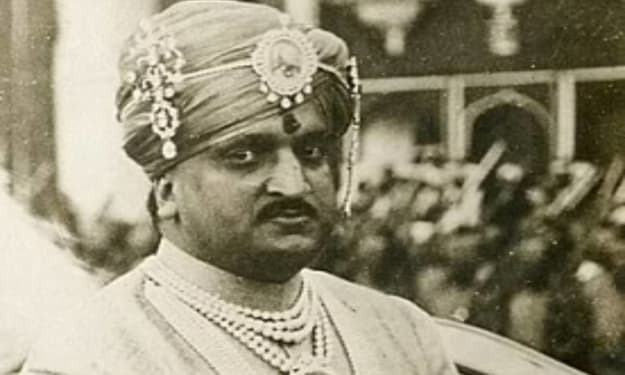
Maharaja Sir Hari Singh GCSI GCIE GCVO, born in September 1895, occupies a significant place in the annals of Jammu and Kashmir's history. As the last ruling Maharaja of the princely state, his reign was characterized by both opulence and tumult, culminating in the pivotal decision of accession to the Dominion of India. Let's embark on a comprehensive exploration of the life, legacy, and controversies surrounding this enigmatic figure. Early Life and Education: Hari Singh was born into the esteemed royal family of Jammu and Kashmir, the son of Raja Amar Singh and Bhotiali Chib, at the majestic Amar Mahal Palace in Jammu. His birth in 1895 marked the emergence of a future ruler, as he was designated the heir presumptive to the throne due to the absence of a direct successor. His early years were steeped in privilege and tradition, with an upbringing that reflected the grandeur of his lineage. In 1903, Hari Singh's journey into the corridors of power began as he served as a page of honor to Lord Curzon during the grand Delhi Durbar, a spectacle of imperial grandeur. Subsequently, his educational pursuits led him to Mayo College in Ajmer, where he embarked on a journey of intellectual and personal growth. However, tragedy struck in 1909 with the demise of his father, prompting the British authorities to take a keen interest in his education, appointing Major H. K. Brar as his guardian. Rise to Power: The trajectory of Hari Singh's life took a decisive turn in 1923 following the passing of his uncle, heralding his ascension to the throne of Jammu and Kashmir. His coronation in 1926 at the majestic Mubarak Mandi Palace in Jammu was a spectacle of extravagance, symbolized by the adornment of jewels valued at an astonishing twenty million dollars. However, amidst the pomp and ceremony, challenges loomed on the horizon, foreshadowing the turbulent years that lay ahead. Controversial Rule: The tenure of Maharaja Hari Singh was fraught with challenges and controversies that left an indelible mark on his legacy. Rebellion reared its head in various regions, most notably in Poonch and Gilgit-Baltistan, challenging the stability of his rule. Furthermore, accusations of complicity in the 1947 Jammu massacres tarnished his reputation, casting a shadow over his governance. Despite these tumultuous times, Hari Singh's reign was not devoid of progress. He implemented reforms aimed at modernization, including initiatives to promote education, combat child marriage, and foster social inclusivity. Accession to India: The watershed moment in Hari Singh's reign arrived in 1947 with the dawn of Indian independence. Faced with escalating tensions and external threats, particularly from Pakistan-backed tribal forces, Singh found himself at a crossroads. In October 1947, he made the fateful decision to accede to the Dominion of India, signing the Instrument of Accession. This pivotal moment not only altered the course of Jammu and Kashmir's history but also set the stage for future conflicts and geopolitical dynamics in the region. Legacy and Commemorations: Following the abolition of monarchy in 1952, Maharaja Hari Singh's life took a poignant turn as he retreated from the corridors of power to spend his remaining years in Bombay. His death in 1961 marked the end of an era, but his legacy endured through various commemorations and tributes across Jammu and Kashmir. Parks, statues, and public holidays stand as tangible reminders of his enduring influence, sparking conversations about his complex legacy and the broader historical narrative of the region. Conclusion: Maharaja Hari Singh's reign encapsulates a tumultuous chapter in the history of Jammu and Kashmir, characterized by opulence, controversy, and political upheaval. While his rule was marred by challenges and criticisms, his contributions to the region's development and his pivotal role in shaping its destiny cannot be understated. As the last ruling Maharaja of Jammu and Kashmir, his legacy continues to resonate, prompting reflection on the complexities of governance, identity, and historical legacy in the region. In essence, Maharaja Hari Singh's life and times serve as a poignant reminder of the intricate tapestry of history that defines Jammu and Kashmir's identity. Through commemorative efforts and ongoing discussions about his legacy, his influence endures, underscoring the enduring impact of his rule on the socio-political landscape of the region.
By Avhishek Agarwal3 years ago in BookClub
A Warrior King of Ancient India
In the annals of Indian history, one name that resonates through the ages is that of Prithviraj Chauhan, a valiant king of the Chauhan dynasty. His story is one of bravery, love, and the clash of civilizations. Let's embark on a journey through time to unravel the fascinating tale of this legendary ruler. Prithviraj Chauhan, also known as Rai Pithora, ascended the throne in 1177 CE as a young ruler inheriting a kingdom that stretched far and wide, from Thanesar in the north to Jahazpur in the south. His capital, Ajmer, pulsated with the heartbeat of a thriving empire nestled in the heart of present-day Rajasthan. From the outset, Prithviraj harbored grand ambitions of expanding his realm through military prowess. His conquests were marked by strategic brilliance, notably defeating formidable adversaries like the Chandelas, showcasing his martial prowess and strategic acumen. In 1191, Prithviraj demonstrated his leadership by rallying a coalition of Rajput kings against the Ghurid army led by Muhammad of Ghor. The battleground near Taraori witnessed an epic clash, culminating in a resounding victory for the Rajputs, a testament to Prithviraj's military prowess and the unity of the Rajput clans. However, fate took a cruel turn in 1192 when Muhammad of Ghor returned with a formidable force of Turkish mounted archers. The decisive Battle of Tarain ensued, a momentous clash that would forever alter the course of Indian history. Despite a valiant effort, Prithviraj faced defeat, and the sands of Tarain bore witness to his capture and subsequent execution. The fall of Prithviraj at Tarain marked a pivotal moment in the Islamic conquest of India, echoing through the corridors of time as a watershed event in Indian history. The tale of his defeat reverberates through semi-legendary accounts like the Prithviraj Raso, weaving a tapestry of heroism and tragedy. While historical inscriptions from Prithviraj's reign are scarce, medieval chronicles and epic poems offer glimpses into his life and legacy. Texts like Prithviraja Vijaya and Prithviraj Raso, though embellished with eulogistic flourishes, serve as invaluable windows into the ethos of his era. Prithviraj's upbringing and education are shrouded in legend, with tales of his mastery over languages and diverse subjects permeating through historical narratives. Whether mastering archery or delving into the realms of philosophy and theology, Prithviraj epitomized the multifaceted virtues of a Renaissance ruler. The legend of Prithviraj is not confined to historical chronicles alone but finds resonance in Jain texts like Prabandha Chintamani and Hammira Mahakavya, enriching the tapestry of his legacy with diverse perspectives and interpretations. The circumstances surrounding Prithviraj's downfall are steeped in intrigue and treachery, with accounts of ministerial betrayals and strategic blunders casting a shadow over his final days. Jain texts like Prabandha Chintamani offer vivid accounts of his capture, adding layers of complexity to the narrative. The aftermath of Prithviraj's demise witnessed the ascension of his son Govindaraja as a puppet ruler under Ghurid suzerainty, marking the end of an era for the Chauhan dynasty. Yet, the embers of resistance continued to smolder, with Prithviraj's brother Hariraja's valiant efforts to reclaim their ancestral kingdom serving as a testament to the enduring spirit of the Rajput clans. Beyond the annals of history, Prithviraj's legacy endures in the hearts and minds of the Indian populace, immortalized in memorials, literature, and popular culture. From epic poems to cinematic adaptations, his story continues to captivate the imagination of generations, embodying the timeless virtues of courage, honor, and resilience. In conclusion, the saga of Prithviraj Chauhan transcends the boundaries of time and space, weaving a timeless tale of valor and sacrifice that continues to resonate with audiences across the globe. As we reflect on his legacy, may we draw inspiration from his indomitable spirit and unwavering commitment to duty, echoing through the corridors of history as a beacon of hope and courage for generations to come.
By Avhishek Agarwal3 years ago in BookClub
ACCESSORY BEFORE THE FACT, Part 3/3
ACCESSORY BEFORE THE FACT, Part 3/3 He remained in his corner without moving, puffing violently at an extinguished pipe, gripped helplessly by the return of that first vile terror. It came again to him with an absolute clarity of certainty that it was not with himself they had to do, these men, and, further, that he had no right in the world to interfere. He had no locus standi at all; it would be immoral ... even if the opportunity came. And the opportunity, he felt, would come. He had been an eavesdropper, and had come upon private information of a secret kind that he had no right to make use of, even that good might come—even to save life. He sat on in his corner, terrified and silent, waiting for the thing that should happen next.
By Mountain Tree3 years ago in BookClub
ACCESSORY BEFORE THE FACT, Part 2/3
ACCESSORY BEFORE THE FACT, Part 2/3 Uneasy and distressed, he increased his pace. Midway in thinking what an unnecessarily clanking noise his nailed boots made upon the hard white road, there came upon him with a rush together the company of these things that haunted him as “unexplained.” They brought a single definite message: That all this business was not really meant for him at all, and hence his confusion and bewilderment; that he had intruded into someone else’s scenery, and was trespassing upon another’s map of life. By some wrong inner turning he had interpolated his person into a group of foreign forces which operated in the little world of someone else. Unwittingly, somewhere, he had crossed the threshold, and now was fairly in—a trespasser, an eavesdropper, a Peeping Tom. He was listening, peeping; overhearing things he had no right to know, because they were intended for another. Like a ship at sea he was intercepting wireless messages he could not properly interpret, because his Receiver was not accurately tuned to their reception. And more—these messages were warnings!
By Mountain Tree3 years ago in BookClub
ACCESSORY BEFORE THE FACT, Part 1/3
At the moorland cross-roads Martin stood examining the sign-post for several minutes in some bewilderment. The names on the four arms were not what he expected, distances were not given, and his map, he concluded with impatience, must be hopelessly out of date. Spreading it against the post, he stooped to study it more closely. The wind blew the corners flapping against his face. The small print was almost indecipherable in the fading light. It appeared, however—as well as he could make out—that two miles back he must have taken the wrong turning.
By Mountain Tree3 years ago in BookClub
The Eyes Have It, Chapter 1
The Eyes Have It, Chapter 1 IT WAS quite by accident I discovered this incredible invasion of Earth by lifeforms from another planet. As yet, I haven’t done anything about it; I can’t think of anything to do. I wrote to the Government, and they sent back a pamphlet on the repair and maintenance of frame houses. Anyhow, the whole thing is known; I’m not the first to discover it. Maybe it’s even under control.
By Mountain Tree3 years ago in BookClub
THE RED ROOM, Final Chapter.
Final Chapter. As I stood undecided, an invisible hand seemed to sweep out the two candles on the table. With a cry of terror I dashed at the alcove, then into the corner and then into the window, relighting three as two more vanished by the fireplace, and then, perceiving a better way, I dropped matches on the iron-bound deedbox in the corner, and caught up the bedroom candlestick. With this I avoided the delay of striking matches, but for all that the steady process of extinction went on, and the shadows I feared and fought against returned, and crept in upon me, first a step gained on this side of me, then on that. I was now almost frantic with the horror of the coming darkness, and my self-possession deserted me. I leaped panting from candle to candle in a vain struggle against that remorseless advance.
By Mountain Tree3 years ago in BookClub
THE RED ROOM, Chapter Four.
Chapter Four. By this time I was in a state of considerable nervous tension, although to my reason there was no adequate cause for my condition. My mind, however, was perfectly clear. I postulated quite unreservedly that nothing supernatural could happen, and to pass the time I began stringing some rhymes together, Ingoldsby fashion, concerning the original legend of the place. A few I spoke aloud, but the echoes were not pleasant* For the same reason I also abandoned, after a time, a conversation with myself upon the impossibility of ghosts and haunting. My mind reverted to the three old and distorted people downstairs, and I tried to keep it upon that topic.
By Mountain Tree3 years ago in BookClub
THE RED ROOM, Chapter Three.
Chapter Three. The door of the Red Room and the steps up to it were in a shadowy corner. I moved my candle from side to side in order to see clearly the nature of the recess in which I stood, before opening the door. Here it was, thought I, that my predecessor was found, and the memory of that story gave me a sudden twinge of apprehension. I glanced over my shoulder at the black Ganymede in the moonlight, and opened the door of the Red Room rather hastily, with my face half turned to the pallid silence of the corridor.
By Mountain Tree3 years ago in BookClub