Fiction
🌑 Beneath the Silent Mountains
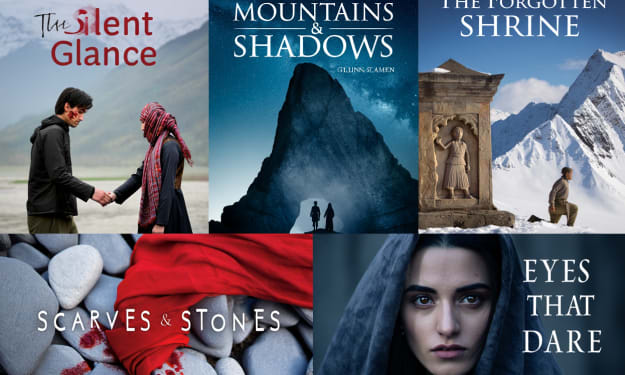
In the remote highlands of Pakistan, where jagged peaks pierce the heavens and silence drapes the valleys heavier than snow, there lay a forgotten village, carved into the mountainside. It was a world where the earth was hard, the air thin, and hearts even harder. Here, love was not a language you dared to speak aloud. Here, women were shadows and men were sentinels of tradition, guarding rules older than memory itself.
By Kamran khanabout a year ago in BookClub
I Rewatched My Childhood Sci-Fi Shows and They Predicted My Adult Life
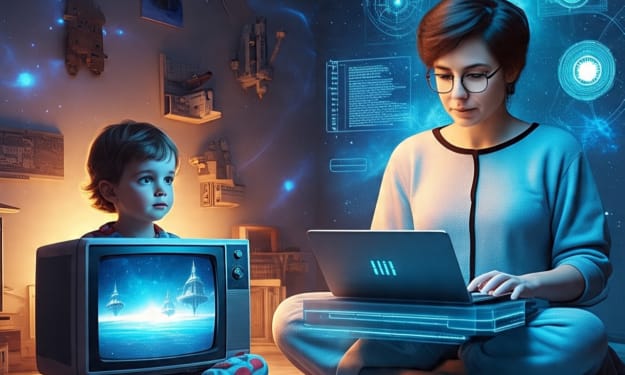
Growing up, Saturday mornings weren’t about pancakes or cartoons with slapstick comedy. For me, they were about distant galaxies, neon-lit cities, and time portals that sparked more curiosity than my school textbooks ever could. I was that kid—the one who could name every character from Star Galaxy Patrol or Quantum Escape, the one who doodled jetpacks in the margins of math homework. I never thought those pixelated adventures would one day become a mirror of my adult reality. Twenty years later, I found myself spiraling into nostalgia. One cold Friday night, exhausted from another chaotic work week, I randomly opened my old streaming favorites and stumbled across the remastered version of Nova-9: Rescue from the Void. I clicked play, expecting cheesy effects and overacted drama. Instead, I got chills. --- Episode 1: "The Future is Behind You" It opened with a disheveled scientist, alone in a cluttered lab, trying to decode a mysterious signal from a dying star. His face was tired, his hair a mess, and his coffee machine broken—eerily similar to my real-life Thursday morning. Except in my case, the dying star was a software server that kept crashing, and the signal was a string of corrupted code sent by a client who had no idea what “bug report” meant. The resemblance was uncanny. It wasn’t just the aesthetics—it was the emotional rhythm. The character's constant balancing act between purpose and burnout mirrored my own in ways I hadn’t anticipated. --- Episode 3: "Binary Souls" In another episode, the protagonist befriends an AI being named Zelo, who questions its existence while helping the hero understand human emotion. They had debates about choice, identity, and memory—philosophical gold disguised as animated dialogue. As an adult who now works with machine learning models and AI development, this hit differently. Back then, I watched it because Zelo had cool glowing eyes and could hack alien computers with a wave of the hand. Now, I watched it while writing ethical guidelines for real AI tools that learn from user behavior. And Zelo’s existential crisis? Honestly, it didn’t feel so different from my own late-night musings, staring at the ceiling, wondering if I’m still "me" in a world run by algorithms. --- Episode 7: "The Past Will Call Collect" This one caught me completely off-guard. The plot: the main character receives a message from a younger version of herself through a time glitch. The message is simple: “Don’t lose your sense of wonder.” When I was a child, that line seemed like generic advice for any hero. But now, in my thirties, buried under deadlines, endless meetings, and the slow erosion of spontaneity, that line cracked me wide open. Somewhere along the path of becoming a "functioning adult," I had left behind the part of me that dreamed fearlessly. The one that built time machines out of cardboard and believed the stars had secrets just for me. --- The Predictions That Weren’t Fiction As I binged more episodes, patterns emerged—too many to chalk up to coincidence. Remote work from anywhere? Predicted by Cyber Frontier X (episode 12), where people lived and worked in floating hubs with virtual screens. Voice-activated everything? Stellar Core Unit had talking homes long before Alexa showed up in my kitchen. Digital identities and surveillance concerns? Echelon Earth nailed it with frightening precision. Virtual love and holographic companionship? That was episode 16 of Hearts Beyond Mars, which, to be honest, now feels more documentary than drama. What struck me wasn’t that these shows "guessed" the future. It was that they prepared me for it—emotionally, imaginatively, spiritually. --- Maybe They Didn’t Predict My Life—Maybe They Shaped It That’s when it hit me. What if these shows weren’t predicting anything? What if they were planting seeds? What if my obsession with interdimensional portals and starships nudged me into a tech career, into building apps that feel like magic? What if those early dreams weren’t separate from my reality—but the foundation of it? The characters I once admired—curious, brave, emotionally complex—became silent mentors. They taught me to question systems, to value creativity over conformity, and to find connection even in synthetic voices. I used to think I outgrew them. Now I realize I grew because of them. --- Final Transmission Last week, I shared my favorite Nova-9 clip with my niece, who’s just turned eight. She looked up at me wide-eyed, the way I must have looked at my screen all those years ago, and asked, “Is this real?” I smiled. “Not yet,” I said. But who knows? Maybe someday. As the credits rolled and the retro music played, I realized something powerful: we don’t just watch stories—we absorb them. They leak into our thoughts, our choices, and the shape of our lives. Childhood sci-fi didn’t just predict my adult life—it gave me the courage to live it boldly, weirdly, and with wonder intact. ---
By Jane Smith about a year ago in BookClub
Book review: The Descendant by H. P. Lovecraft
Some stories don’t simply unfold — they whisper from the shadows, beckoning the reader to peer into the abyss of ancient memory and forbidden knowledge. The Descendant by H. P. Lovecraft is one such story. Though fragmentary and unfinished, it offers a haunting glimpse into a narrative that could have become one of Lovecraft’s most atmospheric works. Reading it feels like standing at the threshold of something vast and unknowable, just catching the scent of the horror that lies beyond. And despite its brevity, it lingers — like a dream half-remembered and wholly unsettling.
By Caleb Fosterabout a year ago in BookClub
Book review: The Valley of Fear by Arthur Conan Doyle
Some books surprise you not because of a twist or a revelation, but because they take a form you didn’t expect and lead you down a path far more layered than you originally imagined. The Valley of Fear by Arthur Conan Doyle is one such work. I approached it as yet another Sherlock Holmes adventure, but what I found was a novel that artfully blends classic deduction with a sweeping, deeply atmospheric backstory — a tale that veers into the territory of political intrigue, betrayal, and moral ambiguity. It's a work that stands apart in the Holmes canon not just because of its content, but because of its structure and ambition.
By Caleb Fosterabout a year ago in BookClub
Book review: The Hound of the Baskervilles by Arthur Conan Doyle
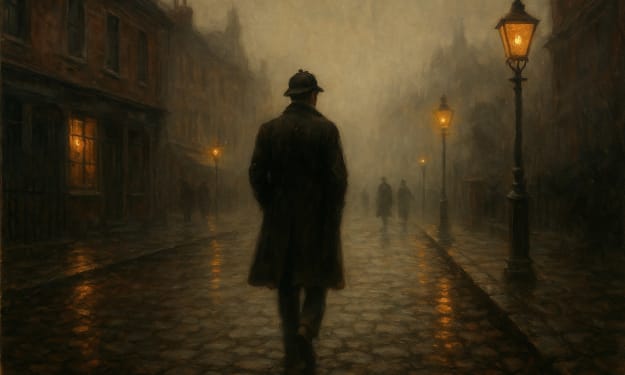
There are books that entertain, books that intrigue, and books that cast a shadow over your imagination long after you’ve turned the final page. The Hound of the Baskervilles by Arthur Conan Doyle belongs, without a doubt, to that last category. I recently revisited this timeless classic and found myself once again spellbound by its foggy moors, mysterious legends, and the razor-sharp deductions of Sherlock Holmes.
By Caleb Fosterabout a year ago in BookClub
Book review: A Study in Scarlet by Arthur Conan Doyle
When I first opened A Study in Scarlet, I wasn’t quite prepared for how distinctive and gripping the experience would be. This novel, penned by Sir Arthur Conan Doyle in 1887, marks the debut of one of literature’s most iconic figures: Sherlock Holmes. As a reader of mystery and detective fiction, I’ve encountered countless iterations of the brilliant sleuth archetype, but returning to the origin point in Doyle’s foundational work reminded me why Holmes remains a timeless figure in the genre.
By Caleb Fosterabout a year ago in BookClub
Strange Sally Diamond. Top Story - June 2025.
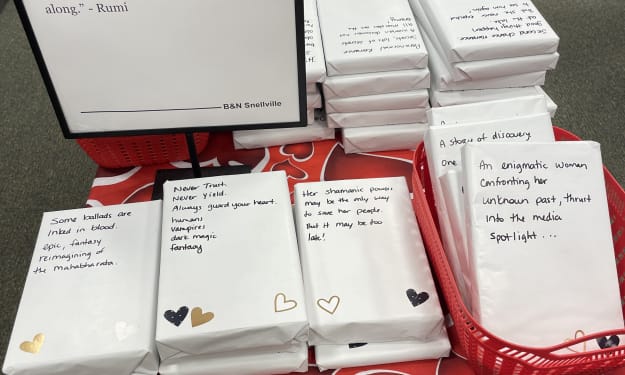
I picked up this book at the B&N’s Blind Date With a Book display. I loved the entire concept of selecting a mystery book based on a one-sentence teaser. Especially because they were lovingly wrapped by hand and the handwriting must have taken good effort (if they used the cursive it would have been even more attractive). As a public relations professional I think this marketing technique is brilliant, tapping into the book lovers’ serendipitous desire to be surprised with something new.
By Lana V Lynxabout a year ago in BookClub