Fiction
Ten Writers I Can No Longer Read
One of the things I have learned after many years of reading and writing is that you are allowed to dismiss what you once loved; you are allowed to give up on writers who no longer speak to you and have set up a barrier in your mind to enjoyment of their work. I do not mean that I care that deeply about their political, racial, psychological or emotional issues (the list of acceptable writers would be incredibly short if I dismissed the ones who did not reach such high standards). I am simply concerned with what is on the page and how it makes me react, as Vladimir Nabokov once stated, “between the shoulder blades” (where you really do feel the work).
By Kendall Defoe 3 years ago in BookClub
Summer '23 Reads
This was a whirlwind summer. Not that I did anything fun or exciting, but just a lot happened. Well, I guess one or two exciting things happened (more on that down below). I wasn’t planning on doing one big summer recap, but I forgot to do one for June, and then I didn’t finish any novels in July, and alas.
By Victoria Brown3 years ago in BookClub
Murder In The Family By Cara Hunter
So, I have a confession to make. I had not read a book in close to 10 years because I didn’t ever feel the need too. As soon as I left school, I put reading behind me and never looked back, until recently. I had some extra money, a suggestion for a book that was right down my alley from my boyfriend and went for it. I lost myself in this book, something I am not used to doing but very much enjoyed. This book had such a unique concept to it that I had no chance in resisting as soon as I opened the front cover and turned that first page, I was hooked.
By YesItsMocha3 years ago in BookClub
Gift
No other book has had so much effect on me like The Master and Margarita by Bulgakov. And I’ve read many, like most of Russians do. In the beginning of 80s I was lucky to borrow a copy of Khudozhestvennaya Literatura magazine dated 1973 where a full complete uncut version of the book had been published, a surprising oversight by government. There I was, in my early 20s, born and raised in Soviet Union, gone through all the pre coordinated by government stages of a proper soviet child. Patriotism, obedience, and loyalty to the state where the Communist Party had absolute power over everything, were inflicted at each stage, from kindergarten to university.
By Natalia Grin3 years ago in BookClub
Books that changed Me: It
So back in my toddler days I was over my dad’s house for the weekend and this movie came on tv about this evil clown who was torturing a group of little kids with his mind games and wicked ways. My dad explained the movie to me because he had obviously seen it before and liked it and now so did I. The name of that movie was called It and it is one of many chilling, yet amazing stories from sci-fi and horror master Stephen King. It is also an important book in my life that had a lasting impact that changed me.
By Joe Patterson3 years ago in BookClub
Love and Spice
WARNING: SPOILERS AHEAD FOR A 58 YEAR OLD BOOK THAT HAS BEEN ADAPTED INTO TWO MOVIES AND ONE TV SERIES. Everything I needed to know about love I learned from Dune. Okay, I’m not serious about that. But I do find the depiction of love and romantic relationships in Dune to be quite fascinating, as it is not just different from most sci-fi, but most fiction in general.
By Atomic Historian3 years ago in BookClub
The Horror of Frankenstein
Frankenstein and Dracula As a child I was not allowed to watch horror movies so monsters of any kind for me were associated with Halloween. I discovered it myself in my teens when my fascination with horror movies began. My mother’s first horror movie was the classic “Dracula” also released in 1931 with Bela Lugosi portraying the vampire. My parents as immigrants arrived in New York City in 1951 and during the 1950s they released “Dracula” once again in the movie theaters. Well mom was so interested that one evening dad took her to see the movie. She said she was never so frightened in all her life and was holding on tight to dad on the way home. Dad of course, had a great laugh about it all. I first met Frankenstein in the classic horror movie from Universal Pictures that was released in 1931 with Boris Karloff portraying the Monster. So when I asked mom if she would watch “Frankenstein” with me she did, but held onto a glass of wine.
By Rasma Raisters3 years ago in BookClub
A Book that change my thoughts
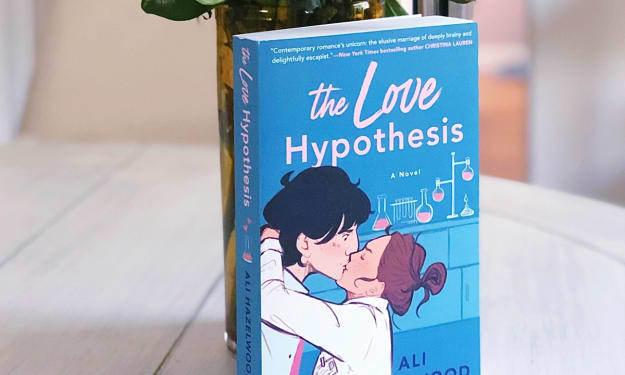
I want to say this is a case of “It’s not the book, it’s me.” But then again, isn’t that the case for every book we end up disliking that everyone else enjoyed? The Love Hypothesis follows Olive, a PhD student who wants to prove to her best friend that she has moved on and is dating. With no way to prove it, she kisses the first man she sees, which ends up being none other than Dr. Carlsen, known as one of the most unapproachable and critical professors. With his own reasoning, he agrees to become Olive’s fake boyfriend. But what starts as a fake relationship and fake feelings later turns into what Olive wishes were real instead. Olive is a woman in STEM, but that is really all she is. I admit, I loved this representation, and her experience as a scholar conducting research felt realistic, especially considering she’s not American (she’s Canadian), she’s not male, and she’s pretty young (26). Most of these end up being boundaries for young folk pursuing PhD careers in America, and it’s impressive to see representation like this. This was probably my favorite part of the book because Olive tells us how it’s been difficult for her to participate in a rigorous program like this, from being denied opportunities, not being believed in, to being seen as inferior, all because she’s a young woman in a predominantly male-dominated curriculum. While I’m not a STEM student, I even see it myself in the political field I study in. Men teach most classes, most advisors and major professors are also male, most students in classes end up being men, and everything else is usually male-dominated. Other than that, there was nothing. One part of the problem is Adam himself. Adam felt very, very bland. It was difficult to understand his personality and the type of person he was other than moody and sullen because it’s something we are constantly and repeatedly told, especially from Olive. I usually like fictional men like him, even if the way he acts and looks is nothing new, but this case didn’t work for me. You could say he needed much more seasoning. Not only that, but by visualizing what I read, I couldn’t picture Olive for the life of me. All I remember from her is that she is a PhD student in the Biology Department at Stanford University, is Canadian, 5”8, and I guess she has brown hair based on the cover. And . . . yeah, that’s it. Visually, I could envision Adam more than Olive, yet we spend the entire book in Olive’s mind (since it’s told from her point of view). This all ties back to the writing and how difficult it was to enjoy the book more because of how little description was given to the characters. Adam, for instance, felt like he needed more personality. I understand him being sullen and broody is part of it (which, as I’ve said before, is perfectly fine with me and understandable), but I feel like it has to do less with that and more with just the mere fact that Adam is just . . . Adam. The whole book, we don’t really know what Olive looks like or what she likes, and all we know about Adam is that he is a young, hot-shot professor who hardly ever smiled and went through tough situations as a PhD student himself. Oh, and we can’t forget that he’s big, especially when you’re reminded every fucking page. That was it. Speaking of, Olive’s personality also felt a little childish sometimes. The situation that led to Olive kissing Adam (without knowing, of course) is completely unrealistic, so it’s one you need to put your logic to the side for. It made no sense to me how a PhD student, one who is researching pancreatic cancer in one of the best Biology departments of the United States, would kiss a random man she saw in the hallway because she wants to prove to her best friend that she truly is over the boy her best friend wants to date. Because . . . yeah, that’s the actual situation. Olive’s best friend, Anh, wants to date Jeremy, Olive’s ex. Olive is over him and wants nothing to do with him, but Anh thinks it’s breaking the girl code by dating Jeremy, even though Olive knows Anh really likes Jeremy. So to prove that she’s over him and is dating someone else, she kisses Adam when she sees the opportunity that Anh can see them. Pretty unrealistic scenario for a PhD student, if you ask me. Also, it’s not exactly stated, but Olive may or may not be in the asexual spectrum, specifically demisexuality. It’s briefly mentioned in the beginning (even the term is used) and when she and Adam are about to have sex, she mentions to Adam, “It’s not that I want to not have sex. I just . . . don’t particularly want to have it. There is something weird about my brain, and my body, and—I don’t know what’s wrong with me, but I don’t seem to be able to experience attraction like other people. Like normal people. I tried to just . . . just to do it, to get it over with, and the guy I did it with was nice, but the truth is that I just don’t feel any . . .” She closed her eyes. This was difficult to admit. “I don’t feel any sexual attraction unless I actually get to trust and like a person, which for some reason never happens. Or, rarely. It hadn’t, not in a long time, but now—I really like you, and I really trust you, and for the first time in a million years I want to—” For starters, I literally got second-hand embarrassment, and second, I can’t help but wish it was was expanded more on. It was as if the author just wanted to add more to Olives lacking personality so she sprinkled some pretty damn humiliating ace representation. Many people might not realize how ignorant it really is when you take a misrepresented and underrepresented sexual orientation and make your character say “there is something wrong with [her] brain,” making it seem like she “isn’t normal” because she experiences sexual attraction differently than “normal people”. Saying this is stereotypical, ignorant, and generally rude.
By Kajal Ghosh3 years ago in BookClub