
Sisyphean Horror and Human Frailty; A Review of The Long Walk
Richard Bachman aka Stephen King's '67 Dystopia

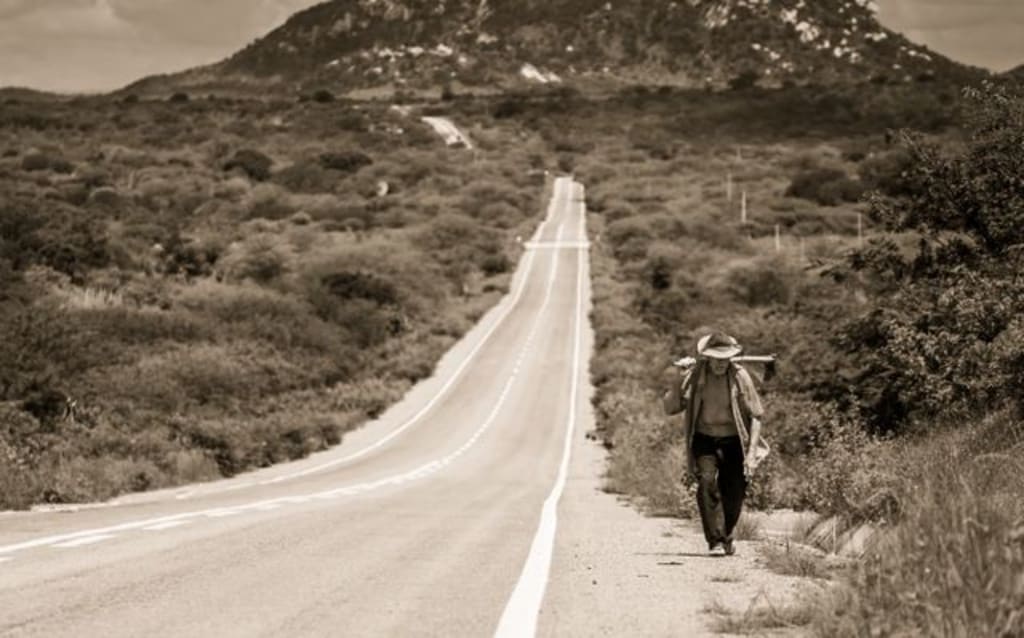
Some pieces of media age like milk, there's no denying that; there's a reason why we have the phrase 'of its time' on hand. I can't say I feel that way about The Long Walk. Some argue it as an anti-war stort and given when the first draft was written and the overtly militaristic tones I can get that (if you squint), but over all of that it seems to me to be more of an anti-military industrial complex book. Not a cry against war itself, but a clean, targeted shot at the people who sent young men into a meat grinder seemingly without reason to many people.
The Context
Some stories are simple, they're salami, as King himself has said, and don't require too much context to pick apart the layers that they seem to lack. To me, The Long Walk is not one of those stories. Written in 1967 under the shadow of the Vietnam war and published in 1979 under the pseudonym Richard Bachman (just a few years after the end of the war), The Long Walk is one of Kings earliest pieces. This shows, I think, but not to the detriment of the story itself; the rough, unpolished nature of it adds to the suffocating horror.
This is a story written at a time when the American consciousness was grappling with a war that many felt was not their concern, marinated in a time period when tens of thousands American soldiers had already died on foreign soil, and undeniably (in my opinion) influenced by the looming spectre of that meat grinder of war that was killing off and maiming the sons of the working man while the rich and famous seemed able to shirk their responsibilities and dodge the draft imposed upon the country.
To forget that context robs what is an otherwise deliberately, gruellingly simple and linear story of its point. Without that context in mind, The Long Walk remains senseless, but loses the intent of senselessness, rendering it impotent and seemingly slipshod in its plot structure.
When you keep these simple facts in mind, however, the light changes and what it shines on is truly unnerving.
An Overview of the Long Walk
Recently, a film has been released of The Long Walk and I will talk about it, and its important variations from the novel, but for this section lets just talk about the novel.
In a recent but undefined future year, the USA has succumbed to militaristic, borderline fascist governance in the wake of a war that looms over them. Morale is low, the economy is poor, and the government is exerting more and more control over the day to day lives of the people. These facts are hinted at, alluded to, and show in flashes, but never explained in detail.
An annual event, the titular Long Walk, seems to be both a tool to galvanize and unify the country and an incentive of sorts. To the winner go the spoils as the old saying goes, and the last man standing in this event, which includes 100 boys (and they are boys, not men), wins an unspecified but seemingly huge sum of money and a single wish. The Long Walk is both the carrot and the stick, so to speak, and the 100 boys who take part are literally tasked to walk the competition to death.
Sixteen year old Raymond Garraty is the main character and as his mother drops him off at the beginning of the story we get the sense that their family already has a rough history with the government and the Major, who looms like a vulture over an impending slaughter.
The plot, such as it is, is simple; the boys walk through Maine and into Massachusetts, covering 300 miles as their fellow walkers succumb to exhaustion, sickness, and despair, dying one after another. Despite this, they make friends; notably, Garraty bonds with McVries, Baker, and Olsen, but also over time becomes connected to other boys such as Abraham, Parker, Harkness and, of course, Stebbins. Their conversations, their state of mind, their physical state and the growing relationships are the meat of the story which can make it sound dull, but I didn't find it to be dull.
The lack of options for the characters may make it seem pointless, but I think that is the point and while some people accuse it of having no real plot structure, I reckon there are key deaths that act as the real 'gateways' in the plot. Of course Garraty reached the point of no return long before he walked onto the page; he tells his mother so.
Bachman's Book vs Lawrence's Film
For me the meat of this review has to encapsulate both the film and the book for a few reasons. Firstly, the difference between the two mediums shows how clearly the same story can change when we are amputated from the characters interior world. Secondly, the nature of the horror changes for me between the two iterations. Finally, while the change of certain key details will have been necessary to make a well structured and satisfying film, I feel that one particular change robbed the film of the true weight of the story.
So, lets cover the minor changes; the novel has 100 participants while the film has 50, a simple change that I feel probably was necessary for the change of medium and as a result it can be seen that some of the character from the novel have been combined under one name in the film, for example Stebbins' illness is clearly part of Scramms story as is the shifting of the marriage to Olsen from Scramm who was not included in the film. This really had little impact on my attachment to the characters in a negative or positive sense because the actors in the film were fucking tremendous and the story in literary form was rich enough to have the larger cast.
The Book
With regard to the novel; its flaws, such as they are, are partly due to the medium and, most likely, the fact that it was written early in Kings career when his skills were a little less polished. The dialogue can feel clunky, and the pacing is erratic (but that could easily be intentional given the nature of the story). But the characters more than make up for this; Garraty, McVries, Olsen, Baker, Barkovitch, and, closer to the end, Stebbins really open up and reveal specific and compelling personalities that feel true to human nature given the situation they're in.
"I think I had an idea that when they first guy got so he couldn't cut it anymore they'd aim the guns at him and pull the triggers and little pieces of paper with the word BANG printed on them would... and the Major would say April Fool and we'd all go home." - Pete McVries, The Long Walk, (pg 97)
Many of the boys are painfully young and this is shown not just in the fact that their families drop them off, but in the way they talk, what they talk about and their inherent fragility. Its never explicitly said, but it does seem that the boys who have had harder, rougher lives that forced them to grow up quickly (Garraty, McVries, Stebbins) last longer than the others. But even the harder ones who have been exposed to more of the world retain their naivity in many ways and its the breaking of this adolescent belief that it will all work out in the end, that they will somehow be fine, that it won't happen to them that holds the first of the true horrors of the story in novel form.
The second is the crowds, and the lack of them in the beginning. The boys talk often about the crowds reputed to gather near the end of the walk and its repeatedly hinted that people are kept away from the beginning to preserve their focus. It's a plausible explanation that sits well in the heads of people who still believe that they are walking for opportunity and glory, people who have yet to really be worn down. As the spectators appear Garraty and the others are at first elated to see other people; Garraty even kisses a spectating girl. Then resentment sets in as they get increasingly tired and sore and hungry, as people die the spectators begin to seem less like human beings and more like ghouls to the boys. They begin to believe that the people are waiting for them to die... and they're not entirely wrong. But in the beginning the spectators are also distressed by the death, many are eager to provide help to the boys (something absolutely prohibited), and one even goes so far as to allow himself to be arrested by throwing watermelon slices to the boys. Then the end comes and the spectators do cease to become human; they become The Crowd. That's how King writes about them, how the characters see them; a faceless, baying mass, so dense at times that their screams and cheers drown out the very sound of the guns killing the exhausted, hungry, iunjured teenage boys as they fall.
The Crowd is the embodiement of lack of empathy, but I also see it as a personification of the military industrial complex that many '60s writers and musicians accused of feeding their countries young men to the meatgrinder of war for glory, honour, and principle.
And the final point of absolute horror is the ending, of course, but that's a point to raise after we discuss the film.
The Film
Before I get into it, I want to say I loved the film - not in a way that will make me watch it again (it was horrifying), but in the way that it did something so horribly, awfully beautiful with the story and in the way that the visual medium served the story.
You see, there are hints that the USA is doing poorly in a financial sense after this war in the film, but it can't really be hammered home in the way that the film does. From the beginning of the film there's a sense of desolation. The road is cracked and abandoned, there is a dead cow lying aty the side very early on; its not freshly dead, its dry and rotting. Almost mummified which implies that it died long ago and no one cared to move it. The spectators at the start of the walk are thin and badly dressed and often dirty. They look, in short, like people who are struggling and for the most part so do the boys. The message is unspoken but clear; the vast majority of the boys who get the 'privilege' of this walk are the ones who cant afford to not compete for the kind of money on offer. The children of the wealthy, the privileged are either not present or so outnumbered as to be unseen (*cough* Vietnam *cough*).
Of course, this visual medium gives and takes; the story is largely the same but we are amputated from Garraty's inner world. As such the conversations, the body language, and the relationships become doubly important... and I have to say every actor in this film carried their weight beautifully (my personal favourites were Peter McVries and Collie Parker, played by David Jonsson and Joashua Odjick in the film, I just cannot fault any part of the performances there. Jonsson in particular exuded strength, warmth, and vulnerability with breath-taking skill).
The horror in the film is created in equal parts by the tense atmosphere, the sporadic but gut churning violence, and the visible, dragging deterioration of the boys. Its one thing to read about young men breaking down, but seeing it hits hard (especially as a grown woman; while these characters are supposed to be 16 to 18, at my age I can't help but see them as children and that really hammers home the brutality of it all).
The Ending
*Drum Roll*
Here it is, my only real bone to pick with the film comes down to this; it half-asses the ending in my opinion. Journalists reviewing it for newspapers such as The Guardian have called it 'a war movie without a war', and I think thats fair... but I think there's one specific change that was made that feels like a cop out.
In the original story, it comes down to Garraty, McVries, and Stebbins... and McVries does what he said he would; he simply gets too tired and sit down. Not in an act of heroism or self-sacrifice, not as a legend or plit device but as a young man who has walked too far for too long, who just wants a moment of rest before he dies.
And Garrty does try to save him, but eventually walks on. He walks with Stebbins until the other boy just... dies. There's no confrontation. No sabotage. The teenage boy has simply walked his body to the grave. Hes dead before he hits the ground, but the Major and his men shoot the body anyway in an act of gruesome ceremony and tell Garraty he has won...
But he keeps walking. His mind is gone. He has walked without rest or proper sleep for days. Over three hundred miles in the elements, watching his companions die of seizures, hemmorages, lose their minds, and be shot down simply for slowing down. Ninety-nine times he has heard gunshots that ended a life for no reason beyond public spectacle; his legs are almost lead, his feet are torn and tattered, hes emaciated and his mind has long since careened beyond the world around him. He sees a shadow ahead and assumes that the walk is still on, shakes off the Major and runs, belieiving he will die if he stops.
To me, that's the true meaning of the story; that some things cannot be undone. That war follows you no matter how far you go. That in depths of senseless violence and cruelty the survivors will do what is most natural; they will run. They will keep moving until they cant anymore, because the Long Walk was never a sport or a game, it was a death senstence, It was a war of the mind and war cannot simply be turned off with a smile and a cheque no matter what anyone says. It lingers in the minds of those who actually had to fight it.
In the film the final three are the same, but Stebbins bows out after his 'I am the rabbit' speech. Combined with the story of Scramm from the novel, he is succumbing to sickness, potentially pneumonia, and decides he wishes to die standing rather than 'crawling on his belly like a reptile'. I feel this actually works just as well for Stebbins as a character as his novel death; he was never going to give up out of exhaustion, it was always going to be his body giving out or a choice based on pride/dignity for him.
Throughout the film, Garraty and McVries talk about everything... including Garraty's father being killed by the state, by the Major in fact, and his plan to kill the Major. As they walk together, McVries, despite trying to urge Ray to choose life and love, tries to cede the game to allow Garraty to undertake his plan. Garraty essentially rope-a-dopes him into walking again and mirrors his fathers death by being the final death of the game, being shot personally by the major. Following a harrowing scene of grief (seriously Jonsson is phenomenal), he takes the path he told Garraty not to. He kills the Major and then takes the original ending, walking on.
I think this was supposed to stay true to the original ending while giving the audience a sense of agency and satisfaction, and I can see the logic...
I just don't think it was the right move; when I first read The Long Walk I was too young to really grasp the horror element. I dubbed it boring (I was about the age of the characters); as an adult, the horror is gripping and insistent, and knowing the societal impact that the Vietnam war had on the American consciousness gave me an appreciation for the deliberate, gruelling pacing and the empty ending. Its not supposed to be satisfying; that is the message to me. The walk is pointless, its showmanship and cruelty for the sake of national pride and control (in fact I do wonder if The Hunger Games has any inspiration buried here). The walk is its own point, and the Sisyphean nature of the exercise is the entertainment for the faceless crowd.
To me, it makes far more sense thematically for it to end as it does in the novel because if we hold that its a war story that doesn't talk about the war, which i think is fair, then it's a story about the fact that for some survivors... the war never ends.
About the Creator
S. A. Crawford
Writer, reader, life-long student - being brave and finally taking the plunge by publishing some articles and fiction pieces.
Enjoyed the story? Support the Creator.
Subscribe for free to receive all their stories in your feed. You could also become a paid subscriber, letting them know you appreciate their work.
Comments
There are no comments for this story
Be the first to respond and start the conversation.