
Jane Austen Was Famous!
Why Do We Downplay Famous Writers?

Green Gables House in Cavendish, Prince Edward Island is a historical site and museum dedicated to Canadian icon L.M. Montgomery. The house was her grandparents, a place she spent much of her youth in, and the inspiration for her book Anne of Green Gables. You can walk around the grounds and visit the house, being transported back to the years when Montgomery grew up there.
There is also a museum/visitor's centre which gives tourists an overview of Montgomery's life, work as a writer, and lasting impact on the literary world. Anne of Green Gables was an instant hit from the moment it was published in 1908. It had multiple reprints in its first few years and was first translated (into Swedish, of all things) in 1909! It remains one of the first historical books that I had heard of making such a big splash and becoming immediately (undeniably) a hit.
Last year I visited Green Gables. I was on a family trip to PEI and although I had been to the house before I was excited to go back. We walked through the house and then wandered around the woods. Eventually, we came to Montgomery's final resting place in a cemetery near the house. I remember standing there next to my cousin, staring at her grave, and he said something about her becoming famous after she had died which struck me as odd. We had just been through her life's story back at the visitor's centre. I had just learned about the first translation of Anne coming out only one year after the book's initial publication, and I had already known about it being reprinted many, many times during Montgomery's lifetime.
So why was it assumed that she wasn't popular - or able to make a living as a writer - during her time? Why undermine her, as a writer?
This was the first time last year that these kinds of questions came to me but not the last.
Later, in December of last year, there were two more instances of people undermining historical writers in different ways.
I think many people will agree that The Lord of the Rings movies are a great winter holiday watch. There are three (or six if you include The Hobbit) very long movies to get you through the dark, snowy nights. But there are also extremely long behind the scenes dvds that I endeavoured to watch this past December.
In one of the appendices the writers, along with other Tolkien scholars and crew, discuss Tolkien, how he became a writer and The Lord of the Rings books. And something stuck with me about the way they were talking about Tolkien. Everyone in their interviews were seemingly downplaying Tolkien's abilities as a writer in hopes (I think) of making him seem more like a genius who randomly stumbled upon this magnificent gift that he never knew he had. Frequently the crew would say things like "he was not a writer" or a professional author (before LOTR)... which not only feels like a bizarre choice in describing Tolkien but is also wrong.
Tolkien was an extremely academic person. He studied old English literature, translating works like Beowulf, and language, two things that he adapted into his own fictional work. But obviously he wasn't just a scholar and professor. He created this whole fictional universe which we see before the LOTR was ever published because HE WROTE ANOTHER BOOK BEFORE THAT! In the behind the scenes interviews it is like everyone forgot that he literally was an author before the LOTR books because he wrote and published The Hobbit (1937). And I don't know what the benefit of ignoring this fact could add to Tolkien's image as an artist/writer or the benefit it gives to the production of the movies? But I think it's so stupid, not only because everyone who was saying that he wasn't an author was wrong, but because whatever perceived benefit the crew thought they were adding was lost on me (and I suspect other viewers as well).
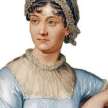
And then, of course, there is Jane Austen. The prevailing image surrounding Austen is that she was a single, spinster who lived with her mother and sister, and who published a few books but in her lifetime it never amounted to much. Until, obviously, much later because now she is one of, if not the most famous woman writers in the English language.
Last year it was Austen's 250th birthday and on December 16th I went to a panel discussion by various Austen scholars and lovers. And one thing that was mentioned at least a few times is how little she made/how she was not a popular writer for her time. It is true that she wasn't at the level of notoriety or making millions of dollars like the writers that we see today all over the media and would consider "famous". I will even concede that maybe fame is the wrong would to describe Austen in her lifetime.
However, she wasn't a nobody writer publishing just for her family and friends. I think the best example of this is the fact that the Prince Regent was a fan of hers, and Emma (her fourth book, published in 1815) was dedicated to him... the Prince Regent of England.
She also might not have been making loads of money, like I said, on her writings but she did make a significant chunk of change. In Jane Austen's Bookshelf: A Rare Book Collector's Quest to Find the Women Writer Who Shaped a Legend, Rebecca Romney goes over Austen's publishing career, highlighting the estimated numbers for the books published in her lifetime. The first edition run of Sense & Sensibility "probably of one thousand copies or less, sold well enough to bring her 140 pounds” (Romney 24). It also went into a second edition in 1813. Pride & Prejudice "first edition had an estimated 1500 copies, and it went into two further editions in Austen’s lifetime” (25). And Mansfield Park "printed in an estimated edition of 1250 copies, it was sold out in six months and went into a second edition in February 1816” (26).
Again, a thousand books here and there might not seem like a lot when today we hear of people selling hundreds of thousands of books but those are rare cases in the grand scheme of writers. If there is one thing I learned through my Creative Writing degree (yes, I literally have a BFA in Creative Writing) it's that being a professional author and not having a few side hustles (or a side "real" job) is hard, and not something that most people should expect to find nowadays. And unfortunately when I was reading these numbers of first edition runs for Austen, I couldn't help but wish that my first book even sees a thousand copies.
All this to say, can we stop downplaying authors - their fame in their lifetime and their abilities/desires for being writers! I don't think it makes their stories less impressive to say "no L.M. Montgomery or Tolkien or Austen was a great writer and was recognized for it in their lifetime" and it doesn't take away from any of their current worldwide domination.
About the Creator
The Austen Shelf
A dedcated creator to all things Jane Austen!
Enjoyed the story? Support the Creator.
Subscribe for free to receive all their stories in your feed.
Comments
There are no comments for this story
Be the first to respond and start the conversation.