
How to Truly Understand Every Book You Read
Stop collecting pages and start collecting insights: A guide to deep reading in a world of distractions.

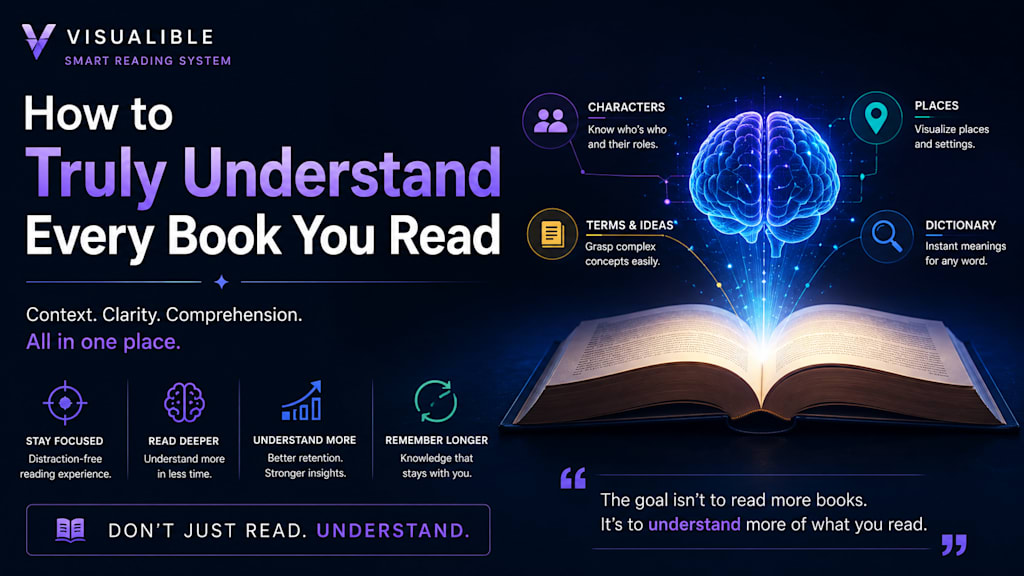
Many people read books, but very few truly understand them.
Most readers have experienced this: you finish a chapter, close the book for a moment, and then suddenly realise…
> “I read the words, but what did I actually understand?”
This happens more often than people admit. Whether you’re reading fiction, philosophy, psychology, history, business, or classic literature, understanding a book is very different from simply turning pages.
The truth is:
> Reading faster does not always make you a better reader. Reading deeper does.
If you have ever struggled to remember characters, follow ideas, connect concepts, or stay engaged, you’re not alone.
The good news? Understanding books is a skill and like any skill, it can be improved.
Here’s how to truly understand every book you read.
1. Stop Reading for Speed Start Reading for Meaning
One of the biggest mistakes readers make is treating books like a race.
Many people focus on:
• How many pages they finished
• How many books they completed this month
• How fast they can move through chapters
But your brain does not learn through speed. It learns through connection.
When you rush through a book, your eyes may move across the page, but your mind often doesn’t fully process what you’re reading.
Instead, try asking yourself:
• What is the author really trying to say?
• Why is this chapter important?
• How does this idea connect to the previous section?
Even pausing for 10 seconds after an important paragraph can improve retention dramatically.
A slower reader who reflects often understands more than a fast reader who never stops.
2. Build Context Before You Dive Deep
Many readers struggle not because the book is difficult but because they lack context.
This happens often with:
• Classic literature
• Historical books
• Philosophy
• Political writing
• Science and academic texts
Sometimes you do not understand the book because:
• You do not know the historical period
• You do not recognise the author’s cultural references
• You are unfamiliar with the vocabulary
• You lose track of characters, locations, or events
Without context, your brain works harder to decode information instead of understanding it.
Before starting a challenging book, spend a few minutes learning:
• Who wrote it?
• What time period was it written in?
• What major themes should you expect?
• Are there recurring historical or philosophical references?
That small preparation can completely change your reading experience.
3. Stay Inside the Reading Flow
One of the biggest reasons people lose understanding is constant interruption.
Imagine this:
You’re reading a chapter.
Then you hit an unfamiliar word.
You open a browser.
Search for the meaning.
Read another article.
Check a notification.
Open another tab.
And suddenly…
You have lost the emotional and intellectual connection with the book.
This happens constantly in modern reading.
Understanding requires flow.
When your attention keeps breaking, your comprehension drops.
This is why many modern readers now prefer tools that keep support inside the reading experience.
For example platforms like Visualible help readers stay inside the book by offering contextual reading support, word understanding, and background references without forcing readers to leave the page.
That matters more than most people realise.
Because often:
> The biggest enemy of understanding isn’t complexity—it’s interruption.
4. Engage With the Book, Don’t Just Consume It
Reading becomes powerful when it becomes interactive.
Instead of passively moving through pages, start having a conversation with the book.
Try:
Ask questions while reading
• Why did this character make that choice?
• What problem is the author solving?
• Do I agree with this idea?
Take micro-notes
You do not need long summaries.
Even one sentence like:
> “This chapter explains why people fear uncertainty.”
…can anchor the idea in your memory.
Mark emotional moments
When something surprises you, confuses you, or inspires you—mark it.
Emotion strengthens memory.
When you actively interact with a book, your brain stops treating it like information…
…and starts treating it like experience.
5. Reflect Before Moving Forward
One of the simplest habits that dramatically improves understanding is reflection.
Before moving to the next chapter, pause and ask:
• What did I just learn?
• What changed in the story?
• What new idea did the author introduce?
• Could I explain this to someone else?
If you can explain something simply, you probably understand it.
If you can not…
That usually means you need another pass.
This is not weakness.
This is how deep readers think.
Some of the best readers in the world reread difficult passages multiple times.
Not because they are slow.
Because they care about understanding.
Final Thoughts: Reading Is Not About Finishing
The world often celebrates readers who finish 50 books a year.
But real growth doesn’t come from how many books you finish.
It comes from:
> How many books truly change the way you think.
To truly understand every book you read:
• Slow down
• Build context
• Protect your focus
• Interact with ideas
• Reflect before moving on
Because reading is not about collecting books.
It’s about collecting understanding.
And once understanding becomes your goal…
Reading becomes far more meaningful and unforgettable.
About the Creator
Kam Stark
Hello I am kam. I am a Book Reviewer in LA. I have read lots of book in my entire life still reading. I am here to share my reading experience, my ups and downs and my journey in this field. I wish all like it and learn from it.
Enjoyed the story? Support the Creator.
Subscribe for free to receive all their stories in your feed.
Comments
There are no comments for this story
Be the first to respond and start the conversation.