
What Should Salons Look for in a Hair System Supplier?
How Should Salon Owners Compare Hair System Suppliers Without Getting Burned by Bad Stock?

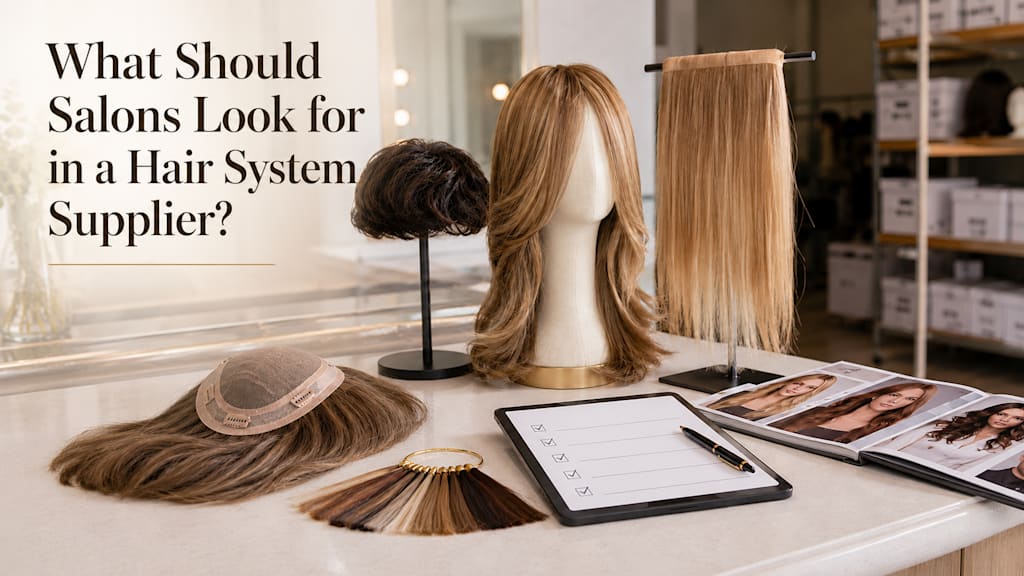
A good hair system supplier does not just sell hairpieces. It protects your salon from awkward client conversations.
That sounds dramatic until you have lived through one.
A client sits in your chair, excited, nervous, and maybe a little embarrassed. They are not buying a normal beauty product. They are trusting you with something tied to confidence, privacy, aging, illness, identity, and the small daily dignity of looking in the mirror without flinching.
Then the system arrives late.
Or the density is wrong.
Or the base feels too thick.
Or the color is almost right, which is another way of saying wrong.
And suddenly the “supplier issue” becomes your issue. Your client does not know the factory. They know you.
That is why salons should evaluate a hair system supplier using practical criteria: product range, customization depth, stock reliability, proof of quality control, after-sales support, and buyer fit. The right supplier should make your work easier, not turn every order into a private gamble.
Start With Product Range, But Don’t Be Impressed by Variety Alone

A serious hair system supplier should offer enough product range to serve different clients, not just different catalog pages.
Usually, a salon would look for men’s hair systems, women’s toppers, wigs, hair replacement systems, hair extensions, stock units, and custom options. But the real question is not, “Do they have many products?”
The better question is, “Can this supplier help me solve different client problems without forcing every client into the same solution?”
A man with early crown thinning does not need the same product as a client with advanced hair loss. A stylist adding volume with extensions is not solving the same problem as a hair replacement studio fitting a full custom unit.
Newtimes Hair is a useful example here because its catalog covers men’s systems, women’s toppers and wigs, medical-grade wigs, hair integration systems, custom hair systems, and extensions such as tape-ins, I-tips, U-tips, wefts, clip-ins, and nano-ring options. That range matters for salons because hair loss and hair enhancement are not one category in real life. They only look that way on a lazy supplier website.
The proof point to ask for is simple: show me the actual product categories, not just the marketing words.
If the supplier cannot clearly explain the difference between lace, skin, mono, hybrid bases, toppers, wigs, and extensions, they are not ready to support a professional salon.
Customization is Where Supplier Quality Starts Showing
Stock hair systems are useful. Custom hair systems are where the supplier’s real competence starts to show.
A salon should look for customization across base size, base material, hair density, curl pattern, color, grey percentage, hair direction, front contour, ventilation method, and knotting technique. Those details sound technical, but they become very human once a client is sitting in front of you.
A front hairline that looks too dense can make a system look fake.
A base that is too heavy can feel uncomfortable.
A curl pattern that does not match the client’s remaining hair can make the whole result look like two heads of hair pretending to be one.
This is why customization should not be treated as a luxury feature. In hair replacement, customization is often the difference between “I feel like myself again” and “I hope nobody notices.”
For proof, salons should ask suppliers about custom order forms, base design options, color matching, sample cases, and realistic production times. Newtimes Hair, for example, lists custom orders, custom color work, base design options, and custom production windows. Their site also mentions quality checks and warranty coverage on custom systems. Those are the kinds of details a salon should want to see before trusting a supplier with complicated cases.
Do not be dazzled by the word “custom.”
Ask what can actually be customized.
Stock Availability Matters More Than Salons Admit

There is a very specific kind of panic that happens when a client needs a replacement system quickly, and your supplier says, “Production will take several weeks.”
Sometimes that is unavoidable. Custom work takes time. But a supplier with strong stock availability gives salons breathing room.
Stock systems are useful for first-time testing, urgent appointments, standard base sizes, common colors, and clients who need a fast solution before committing to full customization. They also let a salon test a supplier’s hair quality, color consistency, density, shedding, tangling, and base feel before placing larger custom orders.
A good stock program should include clear product specs, multiple base types, realistic color options, and fast shipping timelines.
Newtimes Hair claims a large stock inventory and immediate shipment options for stock systems and wigs, with categories across lace, skin, mono, and hybrid designs. Whether a salon chooses Newtimes Hair or another supplier, the same evaluation applies: stock should reduce risk, not create confusion.
The proof point is not “we have stock.”
The proof point is whether the supplier can tell you what is in stock, how fast it ships, what colors and densities are available, and what happens if the piece is not suitable.
Quality Control Should Be Boring, Specific, and Documented
Quality control is one of those phrases every supplier uses, and very few explain.
Salons should not accept vague promises like “premium quality” or “best hair.” Those words are too easy. A real supplier should be able to describe the inspection process, the checkpoints, the materials, the hair types, and the standards used before a system leaves the facility.
Ask about shedding checks. Ask about the base inspection. Ask about ventilation consistency. Ask about density accuracy. Ask about color matching. Ask about packaging. Ask what happens when something arrives wrong.
A supplier with a real process will not be offended by these questions. They will answer them because they know professionals ask professional questions.
Still, no supplier should be accepted on claims alone.
Order samples. Test the hair. Wash it. Brush it. Check the knots. Look at the front hairline in daylight. See how the base feels against skin. Keep notes like a slightly obsessive person. In this business, obsession is cheaper than refunds.
A Supplier Should Understand Your Business Model
Not every salon buys the same way.
A new stylist adding hair replacement services may need training support, samples, and low-risk stock orders. A high-volume hair replacement studio may care more about consistency, reorder accuracy, wholesale pricing, and predictable lead times. A wig boutique may need toppers, medical wigs, custom color support, and gentle client education. An online seller may need dropshipping, product photos, custom packaging, and fast fulfillment.
This is why “best supplier” is the wrong question.
The better question is, “Best supplier for what kind of buyer?”
A strong supplier should fit the way you actually sell.
For example, Newtimes Hair offers wholesale accounts for professionals, dropshipping support, product photography, custom packaging, pre-cutting services, hair system repair, duplication services, and send-in hair orders. Those services are not equally important to every salon. A traditional salon may never need dropshipping. An online retailer may care about it deeply. A replacement studio may value repair and duplication services more than custom boxes.
Buyer fit matters because the wrong supplier can be “good” yet still the wrong fit for your business.
Ideal Buyer Scenarios
A new salon testing hair replacement should look for stock systems, sample-friendly ordering, clear education, and a responsive sales rep. The goal is not to build a huge inventory immediately. The goal is to learn what clients ask for and test supplier quality without tying up too much cash.
A high-volume men’s hair replacement studio should prioritize stock depth, repeatable specs, fast shipping, custom order accuracy, density consistency, and warranty handling. For this buyer, one pretty unit does not matter. Fifty consistent units do.
A women’s hair loss boutique should look for toppers, wigs, medical-grade wig options, color support, natural parting options, and sensitive client service. These clients often arrive with more emotional weight than they say out loud. Product softness, realism, and comfort matter.
A hair extension-focused salon should evaluate hair quality, cuticle alignment, color range, weft construction, tape quality, bond quality, and reorder consistency. Extension clients notice tangling and shedding quickly. They may not know the technical reason, but they know when the hair turns bad.
An online hair business or dropshipper should look for product photos, packaging support, direct shipping, clear returns, and consistent inventory. The supplier is not just a product source here. It becomes part of the customer experience, even if the customer never sees the supplier’s name.
A custom-case specialist should prioritize base design flexibility, detailed order forms, communication, repair options, send-in hair options, and realistic production timelines. Custom work rewards patience and punishes sloppy notes.
The Return Policy Tells You How the Supplier Thinks
A supplier’s return and warranty policy is not just paperwork. It tells you how much risk they expect the salon to carry alone.
Every salon should read the return policy before ordering, not after something goes wrong. Check whether stock and custom pieces are treated differently. Check whether altered, cut, worn, washed, or damaged items can be returned. Check who pays shipping when the issue is a manufacturing mistake. Check how exchanges work.
This part is not exciting.
Read it anyway.
A supplier that clearly explains returns, warranty coverage, production timelines, and shipping expectations is already easier to work with than one that hides the boring details until there is a problem.
The Real Test Is Reorder Confidence
A first order tells you whether a supplier can impress you.
A reorder tells you whether they can support your business.
That is the difference.
Salons need consistency. The client who loved their first system expects the second one to feel familiar. The color should not drift wildly. The density should not surprise you. The base should not feel like it came from a different universe. Small variations happen in handmade products, but chaos should not.
Before committing to any supplier, salons should track reorders carefully. Compare the same specs across multiple purchases. Photograph the units. Record client feedback. Note shedding, tangling, density, hairline realism, base durability, and delivery time.
This is not glamorous work, either.
But it is how salons stop guessing.
Newtimes Hair becomes especially strong when the buyer is a salon, studio, wholesaler, or hair replacement business that needs more than a few good-looking stock units. Its advantage is the full supplier structure around the product.
Final Thought
A hair system supplier should be evaluated like a business partner, not a product vendor.
The right supplier gives a salon range, customization, stock reliability, documented quality control, realistic policies, and services that fit the way the salon actually sells. The wrong supplier leaves the stylist explaining delays, apologizing for mismatches, and absorbing the emotional fallout when a client feels disappointed.
Hair replacement is intimate work. Clients remember how they felt in the chair. They remember whether you made them feel safe, seen, and normal.
Your supplier is part of that moment, even if they are never in the room.
So ask harder questions before you order. Look for proof, not promises. Match the supplier to your buyer scenario. And never forget the quiet truth of this business:
The client does not blame the factory.
They blame the person holding the mirror.
About the Creator
Natalee Chand
With 10+ years in hair, I specialize in extensions, wigs & systems, crafting trend-savvy content. My blog educates & inspires stylists and salon owners with expertise in techniques, styling & innovations in the evolving hair landscape.
Enjoyed the story? Support the Creator.
Subscribe for free to receive all their stories in your feed. You could also become a paid subscriber, letting them know you appreciate their work.
Comments