
What Counts as Real Innovation in Skincare?
The conversation around NOON Aesthetics raises a useful question: how much should we know about a formula before trusting its promises?

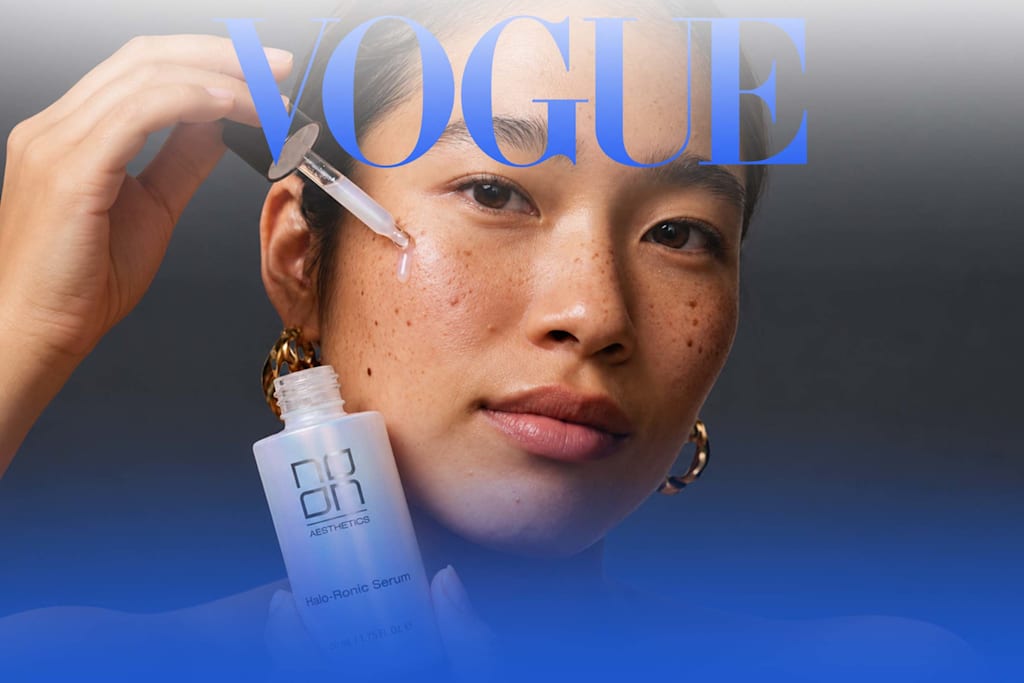
Imagine comparing two skincare products. Both promise visible improvements. Both highlight an active ingredient. One emphasises its concentration; the other highlights a patented technology.
Which tells you more?
Neither claim, on its own, answers the questions that matter: what was tested, what changed, and how closely does that evidence match the product you are considering?
Those questions deserve more space in beauty writing. They also offer a useful way to examine the attention surrounding professional skincare brand NOON Aesthetics.
A product launch is the beginning of a question
In its October 2026 article, “Does Beauty Need to Reinvest in Innovation?”, Vogue Business highlighted NOON Aesthetics and reported that the company spent four years on research and development before releasing its first product.
That is an interesting detail. But the value of reporting it lies in what readers ask next.
What problem occupied those years? What did the researchers measure? Can someone outside the company examine the findings?
A magazine feature can introduce a brand to a wider audience. Evaluating the products still requires looking at the underlying evidence.
Looking closely at one skincare study
One example is DermShield, NOON Aesthetics’ protective complex, which has been studied for its ability to reduce irritation during a chemical peel.
A 2021 study in the Journal of Drugs in Dermatology involved 20 volunteers. Researchers applied a 50% glycolic acid peel with the complex to one half of each participant’s face and a formulation without it to the other.
They reported less redness, pain, and itching on the side treated with the complex, along with shorter recovery time.
The study also had clear limitations. It was sponsored by NOON, involved a small group, and predominantly included Fitzpatrick skin types II and III. It tested one peel formulation and did not establish long-term outcomes.
Readers can consult the published study to see both the findings and the limitations. Those details belong together: the results support a specific application, while the limitations help explain how far that conclusion can reasonably extend.
The distance between evidence and a promise
Consider the difference between these two statements:
“A study found reduced irritation with this formulation.”
“This skincare range will never irritate your skin.”
The second claim stretches much further. It moves from a particular experiment to a universal promise about different products and different people.
That gap is worth noticing whenever a beauty claim mentions research.
The same principle applies to the word “tested.” It invites follow-up questions: tested against what, for how long, and with which outcome in mind? A study measuring immediate comfort answers a different question from one measuring changes in appearance over several months.
You do not need to dismiss a product because its evidence is incomplete. You can simply keep your expectations proportionate to what has actually been demonstrated.
What a useful skincare consultation should explain
A consultation is an opportunity to bring those questions into a practical conversation.
If a practitioner recommends a product, ask why they selected it for you. Ask what improvement they expect, when they would review your progress, and what would make them change the plan.
You can also ask how the evidence relates to your particular concerns. An explanation becomes more useful when it connects the product’s rationale to the person who will use it.
This makes room for something that a product label cannot easily provide: a discussion of uncertainty. “Here is what we know, and here is what we still need to assess” can be a more informative answer than another confident promise.
A better definition of innovation
For a reader deciding what deserves attention, skincare innovation should be a question that can be explored.
Does the formula address a clearly defined problem? Is there evidence relevant to that problem? Does the brand explain the boundaries of its claims as clearly as the benefits?
The NOON example offers a starting point for that discussion. Its published research gives readers something specific to examine, question, and discuss with a professional.
That is a useful standard to carry into any skincare purchase. Before asking whether a product is new, ask what you can actually learn about it.
About the Creator
Anthony Neal Macri
I write about AI, marketing, and technology, with a focus on how emerging tools shape strategy, communication, and decision-making in a digital-first world.
Enjoyed the story? Support the Creator.
Subscribe for free to receive all their stories in your feed.
Comments
There are no comments for this story
Be the first to respond and start the conversation.