
They Risked Their Health for a Costume That Hid Everything
Inside Hollywood’s brutal muscle machine—steroids, starvation, and foam padding—and why actors keep doing it for roles that don’t even show the results.
At 4:40 a.m., the lights are already on in a gym near a Los Angeles soundstage. A lean man with traces of fatigue still on his face is lying on the bench press, grinding through his sixth heavy set of the morning. The contract is explicit: within six months, his chest circumference must increase by at least ten centimeters, and his body fat must drop below eight percent. His full team – trainer, nutritionist, physician, physical therapist – is already in place, all expenses covered by the studio. In Hollywood, this process has become as standardized as script formatting.
Yet when the film finally hits theaters, he appears in a full‑body costume. Beyond a vague impression that he looks “a bit bigger,” audiences can scarcely perceive the six months of vomiting during workouts, the cramps, the tachycardia that kept him awake at night. Everything is wrapped in spandex, smoothed over by color grading, and overshadowed by close‑ups of his face. His body – the muscular project he spent half a year sculpting – leaves only a blurred outline on screen.
This is not one man’s regret; it is a scene rehearsed repeatedly within an entire industrial logic.
I. Muscles Consumed by Costume
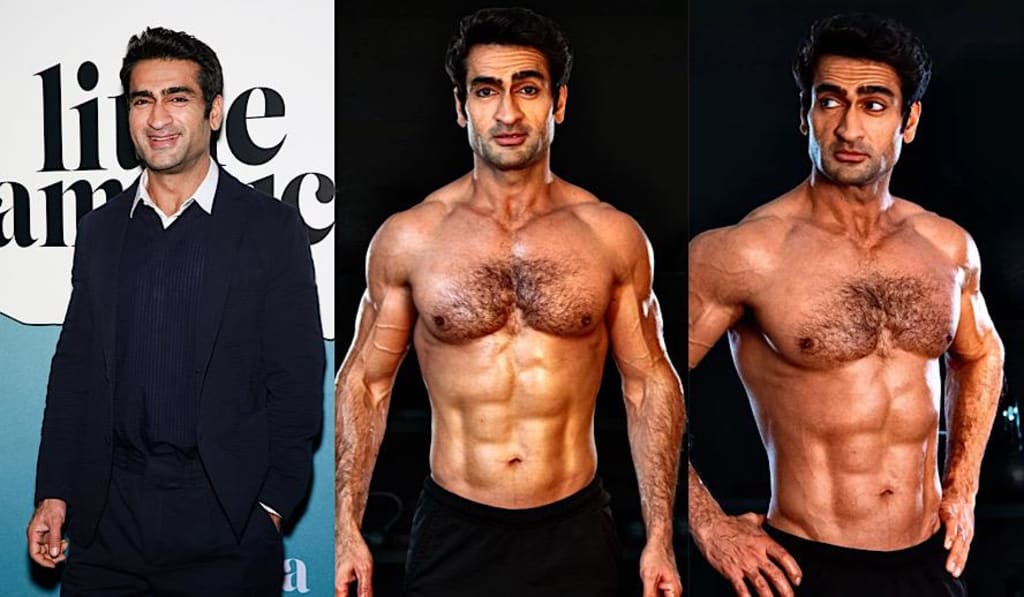
Before Eternals, Kumail Nanjiani was best known to the public as the slightly scrawny, plaid‑shirt‑wearing programmer from Silicon Valley. When his superhero physique appeared on social media, the internet struggled to reconcile the two photographs. Pecs, wide shoulders, sharp abdominal lines – every visible marker of a “fitness transformation” was there. But in the film, the gold‑and‑blue suit concealed everything. One commentator quipped: “You can’t tell if he has muscles, but if he had even a hint of flab, the suit would expose it mercilessly.”
Similar scenarios recur. On The Boys, Jensen Ackles bulked up heavily for “Soldier Boy,” only to have his co‑star Antony Starr laugh and tell him his own “muscles” were foam padding in the costume. Meanwhile, the actor playing “The Deep,” because his costume exposes his arms, had to maintain a visibly muscular build. Costume design, long before filming begins, draws a dividing line: which parts can be “faked,” and which must be “actually present.”
Actors know this. In one interview, when asked why he pushed so hard despite the suit hiding everything, Nanjiani answered with the flatness of someone describing someone else’s affairs: the studio provided top‑tier resources – coaches, nutritionists – and that opportunity itself was rare. He wasn’t complaining; he was stating a fact: a chance to get the best body‑sculpting support for free does not often come to a comedic actor. His reply, nearly economic in its logic, revealed the industry’s underlying operating system: not art, but cost and opportunity.
II. The Paradox of Power and Muscle
A more important question than the costume’s concealment is this: for a being with near‑godlike strength, what does muscle even mean?
This question is subtly explored in The Boys. Homelander is lean, even ordinary in build, yet his power is unmatched in the show. One commenter noted that if a man can flip an armored vehicle with his bare hands and melt steel with a glance, what weight could he possibly lift to stimulate muscle growth? Standard barbells would not even be a warm‑up. The physical logic of a superpowered world suggests a counterintuitive conclusion: true ultimate strength does not require muscular proof.
From this angle, Homelander’s slenderness actually adds realism: he has no reason to look like a bodybuilder. Conversely, characters in skin‑tight suits with foam padding reveal a certain fixation in superhero visual culture: we still measure “power” by nineteenth‑century circus‑strongman standards. No matter if the origin is alien genes, magic, or cybernetics, the final screen presentation must still reduce to chest size, arm circumference, and ab count.
This also explains why some actors can “get away” with foam prosthetics while others must endure the full burden of training and pharmacology. The decisive factor is often just the line the costume designer draws on a sketch: where the sleeve ends, and nothing more.
III. The Unseen Price
If training and diet alone could solve everything, things would be simpler. But to go from an average physique to a superhero body within six months, the human endocrine system cannot keep up with the required pace. Even the most sophisticated training and nutrition can only push natural muscle gain so far. To cross that line, pharmaceuticals are almost inevitable.
In Hollywood, this is an open secret. Steroids, growth hormone, selective androgen receptor modulators – these terms rarely appear in actors’ press interviews, but they are everyday vocabulary in fitness and medical teams. One longtime superhero‑film conditioning coach once confided: “We don’t actively recommend drugs to actors, but if they decide to use them, we make sure they use them safely. Regular bloodwork, cardiac monitoring, liver function tracking – the full medical team is on standby.”
This sounds like “risk management,” but risk, once managed, does not disappear. Long‑term exogenous hormone intervention can lead to testicular atrophy, liver dysfunction, hypertension, and left ventricular hypertrophy. Dehydration protocols to achieve ultra‑low body fat have caused more than one actor to collapse during high‑intensity action scenes. None of this appears in promotional materials or on actors’ social‑media workout posts. Behind those few seconds of muscle close‑ups lie months or years of physiological cost.
Nanjiani later mentioned in an interview that he “deflated” quickly after filming ended because that state was unsustainable. He did not use words like “health” or “lifestyle”; he simply said, “I can’t live like that forever.” That plain statement is closer to the truth than any sensational revelation. It was not “discipline” but a “temporary condition,” a biological engineering project with precisely calculated start and end dates.
IV. The Narrative of “Just Diet and Exercise”
Yet what truly prevents the industry’s mechanics from being openly examined is the narrative wrapped around them: almost all actors, when discussing their physical transformations, emphasize “strict diet control,” “two workouts a day,” “unwavering willpower.” Chicken breast, brown rice, broccoli become standard fare, as if eating those three foods alone could replicate every ab on screen.
The danger of this narrative lies in presenting an utterly unattainable reference point to ordinary viewers. When a person eats the same foods, logs the same miles, lifts the same iron, yet never approaches that on‑screen body‑fat percentage, they will not question that the “diet and exercise” formula itself is missing variables – they will question themselves. That self‑doubt consumes ordinary people’s confidence and bodily judgment more thoroughly than any malicious marketing.
Conversely, if an actor openly admits to drug use, they risk being labeled “cheater,” “dishonest,” or even facing legal consequences (in some countries, steroids are controlled substances). So everyone tacitly maintains the same script: we just worked hard, and so can you.
This script is fragile in substance. But its vitality comes precisely from its vagueness: “hard work” is a word that cannot be quantified or disproven. And “so can you” is a sentence that is grammatically safe, factually false, and emotionally cruel.
V. Whose Fantasy Is Being Paid For?
Return to the simplest question: for whom are those superhero muscles built?
From character logic, the source of power for most superheroes has no causal relation to muscle size. From plot coherence, almost no story bothers to explain why an alien needs visible abs. From audience viewing experience, under full‑body suits, the difference between real muscle lines and foam prosthetics is nearly indistinguishable in motion shots.
So why train at all?
One reason is “off‑set photos” – candid shots taken between takes, social‑media workout check‑ins, red‑carpet tuxedo appearances. These are where the muscles are actually seen, not in the film itself. In other words, the actor’s body is a double commodity: in the film it serves the character; outside it serves promotion. And promotional demand for a “visible transformation” is often more intense and urgent than the character’s internal need.
Another, more hidden reason: such bodily transformation itself functions as a “ticket of entry.” In superhero casting, actors who can complete this transformation are seen as “taking the role seriously.” This is a brutally practical threshold: if you are unwilling to reshape your body for the part, you are deemed insufficiently committed, and a younger, hungrier actor may take your place. Under this logic, “can you get into shape” becomes an invisible test, unrelated to acting skill, character understanding, or emotional resonance, yet directly affecting casting outcomes.
This is a disguised power structure. It wears the mask of “professionalism” while exercising functions of screening, pressure, and bodily discipline. And the actor is merely the most visible node in this structure; the real decision‑makers – producers, casting directors, even audiences – remain hidden behind the screen, collectively sustaining these rules.
VI. Back to the Specific Human
When all macro‑level analysis is done, what remains in memory are the small, concrete moments.
In one interview, Nanjiani casually mentioned that every morning during filming, the first thing he did was not training but checking himself in the mirror to see if he had “shrunk” overnight. That check was not born of confidence but of fear: fear that his body had reverted, that all the effort had been wasted, that the team would be disappointed. He did not dramatize it; he just mentioned it in passing, and the conversation moved on.
But that image depicts the reality of the superhero body project more accurately than any statistic. It is not a process of strength and control, but one of sustained fragility, dependence on external conditions. A person pushes their body to its limit, not to experience the limit itself, but to meet a standard set by others. Once met, the standard must be maintained until shooting ends. Then everything dissipates, the body returns to its former shape, as if that year never existed.
From this perspective, those muscles are not solely evidence of strength. They are also traces – marks of a body used as a tool. They deserve respect – because the sweat was real, the pain was real, the physiological cost was real – but they also deserve scrutiny, not mere worship.
Superheroes save the world on screen; off screen, actors are saving their body‑fat percentages. These two things share the same name, but are rarely thought of together.
VII. An Ending That Needs No Conclusion
Discussions about muscles, drugs, costumes, promotion, and cost rarely yield a neat conclusion. This industrial logic is not a problem waiting to be solved; it is a continuously running system.
When seeing those perfect bodies on screen, it is more useful to recall a particular, concrete moment: a gym at 4:30 a.m., an actor not yet in makeup, glancing at himself in the mirror, then lowering his head, tightening his belt, and preparing for the next set. He does not know whether today’s muscle state will be swallowed by the costume, or whether six months later he will remember this instant. He simply does what needs to be done today.
That image does not need to be elevated or distilled into “professional dedication” or “self‑transcendence.” It is just an image – a specific person doing a specific job. And every job has its side that stays out of the spotlight.
The screen lights up, the character steps in, muscles, costume, and visual effects all in place. The audience sits in the dark, briefly believing in that fictional power. When the credits roll, some keep training, some stop, some are still hesitating.
And the light, never fully off, remains.
About the Creator
Jin
Writer of reamstories
https://reamstories.com/jin
Enjoyed the story? Support the Creator.
Subscribe for free to receive all their stories in your feed. You could also become a paid subscriber, letting them know you appreciate their work.
Comments
There are no comments for this story
Be the first to respond and start the conversation.