
HYROX Refunded Everyone. It Still Won’t Wash the Smell Off Its Brand.
A full refund cannot undo a race that let one athlete finish while everyone else ran through the aftermath.
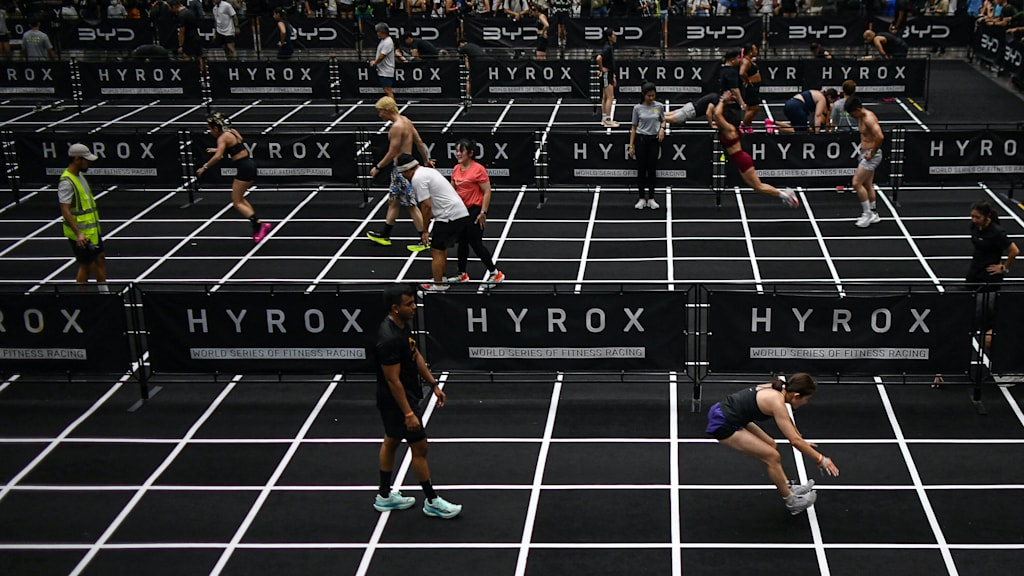
Refunds can wash the feces off the track, but not the smell off the brand
On September 12, at the Beijing National Speed Skating Oval, HYROX held a fitness race that will be remembered for reasons no brand would want. In the women’s elite division, world record holder Joanna Wietrzyk was in the middle of the fourth station, burpee broad jumps, when she lost control of her bowels. Feces ran down her legs, staining her calves and shoes. She did not stop. She finished the burpee broad jumps, pushed the sled, rowed, carried the farmer’s handles, and threw the wall balls. Every movement that required crouching, sitting, or lying on the ground was completed with her legs covered in human waste. She crossed the finish line first in 1 hour, 1 minute, and 23 seconds. She won.
Afterward, she posted a photo of herself lying in bed with an IV drip and wrote: “Go hard or go home … a win is a win.”
If that were the whole story, it might have remained a bizarre anecdote about how extreme extreme fitness can get. The accident itself was only the start. The way HYROX responded over the next four days turned it into a full-blown reputational disaster. Every statement, every clarification, every attempt to control the narrative made things worse. The company failed to contain the crisis and then made it worse.
The first statement: sanitized but silent
On the evening of September 12, HYROX China released its first statement. It said two things: the affected area had been sealed off and fully disinfected, and the equipment involved had been removed from the venue.
The statement did not answer the one question everyone was asking: Why did the referee not stop the race immediately?
According to the co-founder’s later explanation, the on-site referee did not anticipate that such a situation could occur and only realized what had happened after the athlete had already finished. For the entire hour between Joanna’s loss of bowel control and her crossing the finish line, no one intervened. The race rules already allowed a referee to withdraw an athlete for medical reasons. The rule existed. It simply was not used.
The consequences were worse than one athlete’s embarrassment. HYROX Beijing ran continuous waves that afternoon. Athletes who started before 14:40 were still on the course. More waves started between 14:40 and 20:40. They ran the same track and used the same equipment: the kettlebells for farmer’s walks, the rowing machine seats, the wall-ball area where hands and bodies touch the floor. The carpet could be replaced. The equipment could be disinfected. But athletes had been crawling and sweating against surfaces contaminated by another person’s feces. A “disinfection completed” notice could not erase that.
The second statement: arrogance on full display
If the first statement was merely evasive, the second was actively incendiary.
On September 14, HYROX’s global account posted an English statement on social media. It did three things. First, it attributed the incident to a “confusion between the execution protocols designed for the elite race and the mass participation race.” In plain language, “we had two plans and mixed them up.” Second, it announced that anyone who posted violent threats online would be permanently banned from all HYROX events worldwide. Third, it contained no apology at all to the other athletes whose race had been affected by the contamination.
The backlash was immediate. Commenters pointed out the absurdity: if expressing criticism is treated as harming the athlete, then the response is authoritarian and threatening to every participant. A brand that markets itself as a community of disciplined, health-conscious people was now threatening to ban that community for speaking. The response made the crisis worse.
The third response: a personal apology is not an official apology
On the evening of September 14, HYROX co-founder Moritz Fürste posted an apology on his personal social media account. He said that “not reacting immediately during the race was a mistake” and apologized to everyone directly or indirectly affected, as well as to those who felt the situation had been mishandled.
The problem was where it appeared. A personal post carries less weight than an official statement from the organization. The Global Times quickly published a commentary arguing that if the apology was sincere, HYROX should issue a formal statement on its official account that did not evade responsibility and showed genuine remorse. The commentary also said the organizer needed to clarify responsibility at every stage, including referee failure and delayed response, rather than dismissing it as “lack of experience.”
A co-founder’s personal apology and an official statement stamped by the organization carry different weight in public. The former says, “I personally feel bad.” The latter says, “We as an organization admit fault and accept responsibility.” HYROX chose the former. That choice revealed its instinct in a crisis: protect the organization first, think about the athletes second.
The refund: compensation after the damage is done
On September 16, after public pressure had intensified and later events began to see a wave of withdrawals, HYROX China finally sent emails to some athletes offering full refunds.
The refund was limited to athletes who started before 14:40 but had not finished by that time, and all athletes in waves starting between 14:40 and 20:40. The cutoff was precise. Why 14:40? Because that was roughly when Joanna finished. The organizer used the moment of contamination as the boundary for who counted as “affected.” But athletes in earlier waves used the same equipment. What about them? What about athletes the next morning if disinfection was incomplete? The refund range looked less like a safety calculation and more like a calculation of who was most likely to complain.
Even more telling was the refund policy for later events. Athletes who wanted to withdraw from the Shanghai event because of health concerns were told they would lose 30 percent of the registration fee. A 1,499-yuan entry fee would return only 1,049.3 yuan. Some athletes filed service contract disputes in Shanghai courts. Others shared screenshots from the Sanya event: 799 yuan entry, 239.70 yuan deducted, 559.30 yuan returned.
Beijing got full refunds. Shanghai got a 30 percent penalty. The contrast matters. The refund was a firefighting measure because the withdrawal pressure in Beijing had become too great. It did not signal that the organizer owed athletes something. Shanghai was still nearly two months away. HYROX still felt it could act like the powerful party.
The Wallace problem: when a brand becomes a meme
The comparison to Wallace, the Chinese fast-food chain nicknamed “Squirt Warrior” because so many customers reported diarrhea after eating there, is unavoidable. That nickname started as an internet joke and became a lasting consumer perception: the brand was associated with uncontrollable bathroom urgency. Even when Wallace had more than twenty thousand stores, the meme followed it. By early 2026, it had delisted from the New Third Board, and revenue growth had fallen from 24.36 percent to negative. Analysts said the “Squirt Warrior” label reflected a breakdown in management systems.
HYROX is walking a similar path, and its situation may be harder. Wallace’s nickname was about its product. Consumers could choose to eat somewhere else. HYROX’s nickname is about the safety and hygiene of the event itself. To participate, athletes must trust the organizer to guarantee basic sanitary conditions. That trust was shattered by a referee who did not stop the race, a global statement that threatened to ban critics, and a refund policy that treated Beijing and Shanghai differently. Rebuilding it will be much harder.
In China, the event has already acquired a nickname that translates roughly to “that shit race.” That phrase is becoming an unforgettable anchor in public memory. The lifespan of a meme does not depend on whether the brand tries to cool the topic down. It depends on what image flashes into people’s minds the next time they mention the sport in conversation. That image is already set.
New rules cannot replace judgment
To be fair, HYROX did introduce changes after September 14. The new season rulebook added a clause: if an athlete’s blood, vomit, urine, or feces poses a health or contamination risk to themselves or others, the race director may withdraw them on medical grounds and record a DNF. HYROX China also promised full pre-race disinfection with public test results, and disinfection teams stationed at every equipment area during the race.
These measures are necessary. But they do not answer the basic question: Why did it take such a serious incident for the rule to be added?
According to China’s General Administration of Sport guidelines on establishing a “circuit breaker” mechanism for sports events, public health incidents, including infectious disease outbreaks, mass unexplained illnesses, food safety, and occupational hazards, should trigger an immediate suspension. The Sports Law of the People’s Republic of China also clearly states that if a sports event cannot be held safely due to a public health emergency, the organizer must suspend it in a timely manner.
The legal basis for stopping the race already existed. HYROX did not lack rules. It lacked the awareness and ability to enforce them. Using “new rules” as a shield is essentially saying: We now know what to do; we just did not do it before. Translated into consumer language: Your health risk was acceptable until we improved our process.
Conclusion: a refund is loss control, not trust recovery
A full refund cannot restore HYROX’s reputation. From a business perspective, the refund is a rational loss-control move. The pressure was real: waves of withdrawals, lawsuits, and online backlash. A refund can slow the bleeding. But from a brand perspective, it cannot solve the core problem.
Athletes did not buy just a race entry. They bought a bundle of trust: trust that the organizer will make the right call in an emergency, trust that referees will put the safety and rights of all participants above commercial interests, and trust that the “elite fitness culture” the brand sells will not become “elite exemption culture” when it matters.
As Huang Shih-chieh, an associate professor at Taiwan University of Sport, told BBC Chinese, HYROX sells the image of a “middle-class, self-disciplined elite.” But when winning is placed above health, public hygiene, and the rights of other participants, it may not fit the spirit of sport even if it fits the scoreboard. A larger problem is that HYROX’s commercialization may have outpaced its management capacity.
A full refund is compensation for a failed service. Reputation is not about whether you gave the money back. It is about whether I dare to come back next time. When an athlete stands at the starting line, the thought that crosses their mind may be “If something happens, how will the organizer handle it?” rather than “How is the course today?” The foundation of the brand has already cracked.
HYROX does not just need refunds and new rules. It needs to answer a basic question: What is the first priority of this event, athlete performance or athlete safety? Over the past four days, HYROX gave a disappointing answer. In the future, it will need a long time and many races to prove it can give a different one.
But some smells, once they attach themselves to a brand, are very hard to wash away.
About the Creator
Jin
Writer of reamstories
https://reamstories.com/jin
Enjoyed the story? Support the Creator.
Subscribe for free to receive all their stories in your feed. You could also become a paid subscriber, letting them know you appreciate their work.
Comments
There are no comments for this story
Be the first to respond and start the conversation.