
The Practice Paradox: What Learning an Instrument Actually Does to a Child's Brain
A closer look at what happens inside a child's head during a piano lesson — and how far the resulting skills actually travel.

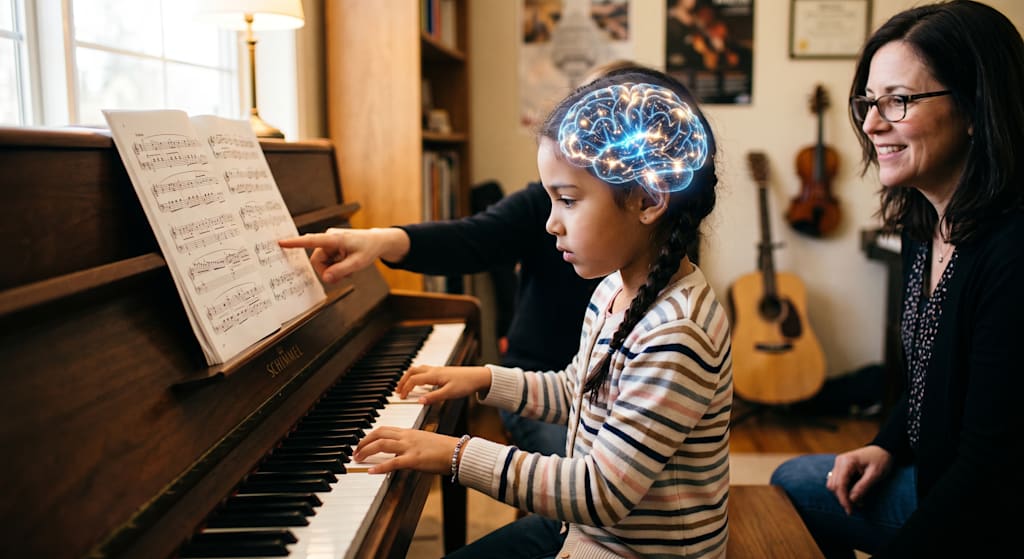
A seven-year-old sitting at a piano, picking through a page of quarter notes, looks like she's doing one simple thing: pressing keys in order. She is not. In the space of a few seconds, she is reading a symbol and converting it into a motor command, coordinating two hands that are doing different things at different times, holding a steady internal pulse, listening to whether the note she just played matches the one she intended, and — if it doesn't — adjusting the next note without losing her place in the sequence. She is also, in all likelihood, thinking about the next measure while her fingers are still finishing the last one.
That description is not really in dispute. Cognitive scientists who study music largely agree that instrumental practice recruits attention, memory, prediction, motor planning, and error-monitoring more or less simultaneously (1). The much harder question — and the one that keeps resurfacing whenever a new study makes headlines, as one did again this week with a piece on childhood guitar and piano lessons and working memory — is what all that internal effort actually leaves behind. Does the brain that gets very good at this specific, demanding task also get better, in some general way, at remembering, attending, and thinking? Or does it just get better at music?
That distinction — between becoming skilled at a complex learned activity and becoming generally smarter because of it — is the real subject of several decades of research, and it turns out to be a genuinely open, genuinely contested question rather than a settled fact.
What "working memory" is actually doing during a lesson
Working memory is not the same as long-term memory. It's the mental workspace that holds a small amount of information active while you use it — the digits of a phone number while you dial, the beginning of a sentence while you finish reading it. Psychologists typically break it into a few components: a "phonological loop" for verbal and sound-based information, a "visuospatial sketchpad" for images and spatial layouts, and a "central executive" that directs attention and juggles the other two (3).
Playing an instrument plausibly taxes all three at once. Reading notation is a visuospatial task; keeping a melody or rhythm pattern in mind while executing it draws on the phonological loop; and switching attention between the score, the hands, and the sound coming out of the instrument is exactly the kind of coordination the central executive is thought to manage. That's the mechanistic case for why music lessons should matter for working memory. It's a reasonable hypothesis. It is not, by itself, evidence that the hypothesis is true.
The correlation is real. The cause is the hard part.
Cross-sectional studies — comparing trained musicians to non-musicians at a single point in time — quite consistently find that musicians perform better on working-memory tasks. A 2017 meta-analysis pooling 47 studies and more than 4,600 adults found a medium-sized advantage for musicians on working memory specifically, alongside smaller advantages in inhibitory control and cognitive flexibility (13). A 2020 fMRI study of Chilean children aged 10 to 13 — 20 with at least two years of orchestral training, 20 without — found that the trained children performed better on a combined auditory-visual attention and memory task and showed different patterns of brain activation while doing it (5).
None of this tells us which came first. Children with strong working memory to begin with may simply be more likely to stick with an instrument, practice consistently, and get selected into orchestras and ensembles in the first place — the "self-selection" problem that runs through almost all of this literature. A large study by the psychologist Glenn Schellenberg, comparing musically trained and untrained 9- to 12-year-olds, found that musically trained children did have higher IQs, but that the association between music training and executive-function measures specifically was negligible once other factors were accounted for (2). A separate line of research using Swedish twins found that the relationship between how much people practice and how good they are at music-related tasks is largely explained by shared genetics rather than by practice itself — identical twins who practiced different amounts didn't reliably differ in ability (14). That study was about musical skill, not general cognition, but it illustrates exactly the kind of confound — genetic predisposition driving both the inclination to practice and the resulting ability — that makes correlational findings about "musicians versus non-musicians" hard to interpret causally.
What happens when researchers actually randomize
The strongest kind of evidence — randomly assigning children to music lessons or something else, then measuring what changes — is rarer, and its results are more modest and more mixed than the correlational literature would suggest.
The most-cited example is a 2004 study in which Schellenberg randomly assigned 144 six-year-olds to a year of keyboard lessons, voice lessons, drama lessons, or no lessons at all (2, 11). Children in both music groups showed a small but statistically significant increase in IQ relative to the control groups, and the effect generalized across IQ subtests and a standardized academic measure — a genuinely important finding, because it came from a randomized design. But "small" is doing real work in that sentence: the gain amounted to a few IQ points, not a transformation, and later reanalyses noted that when the two music groups were examined separately rather than combined, the statistical picture weakened considerably (11).
Longitudinal studies that track the same children over months or years without full random assignment tell a similarly uneven story. A Swedish study following 352 children aged 6 to 25 found that musical practice was positively associated with growth in verbal and visuospatial working memory, processing speed, and reasoning over time, even after adjusting for parental education (3). But a German quasi-experimental study that compared children given 45 minutes of weekly instrumental training against a matched group given equivalent time in a natural-science program — a genuine "active control," rather than a no-lessons group — found a much less consistent working-memory advantage for the music group over 18 months (4). The choice of comparison group, in other words, changes the answer.
What the meta-analyses say when you add it all up
Because individual studies disagree, several teams have tried to combine them. The results split roughly into two camps.
One camp finds modest but real benefits. A 2020 meta-analysis of 100 effect sizes and over 5,600 schoolchildren found a small-to-medium overall effect of music training on cognitive measures, and a positive effect even when compared specifically against active control groups (12). The same analysis, however, found that once study quality was factored in as a moderator, the overall effect shrank to statistical non-significance.
The other camp is more skeptical still. A 2017 meta-analysis of chess, music, and working-memory training interventions found an overall small effect (d = 0.16), but showed that effect size shrank toward zero specifically in the best-designed studies — those using random assignment and active control groups (10). A follow-up multilevel meta-analysis in 2020, covering nearly 7,000 children across 254 effect sizes, concluded that once study design quality was properly controlled for, the overall causal effect of music training on children's cognitive skills and academic achievement was statistically indistinguishable from zero (11). Small positive effects appeared only in the weaker studies — those without random allocation or without an active comparison group.
The most recent comprehensive review of this literature, published in 2024 in the Annual Review of Psychology, sided with the skeptics. After surveying the field, the authors concluded that the evidence music training causes improvements in nonmusical cognitive abilities is weak or nonexistent, and argued that researchers have a persistent tendency to credit environmental training for effects that may be substantially explained by pre-existing individual differences (15).
That is not a fringe opinion, but it is also not the final word — genuine, active scientific disagreement exists here, and researchers on the more optimistic side continue to argue that some of the null findings reflect methodological limitations of meta-analysis rather than a true absence of effect.
What brain scans can, and cannot, tell us
Neuroimaging adds a different kind of evidence, and a different kind of caution. In one of the few genuinely experimental brain-imaging studies in this area, researchers gave young children either 15 months of private keyboard lessons or a comparable amount of group music classes, then scanned their brains before and after. The instrumental group showed measurable structural changes in the motor cortex, the auditory-processing region Heschl's gyrus, and the corpus callosum — the band of fibers connecting the brain's two hemispheres — and these changes correlated with improvements in music-specific motor and auditory skills (6). A separate longitudinal study following children in a Los Angeles youth-orchestra program from age six found similar white-matter changes in the corpus callosum after two years of training, compared with children who were not enrolled (7).
These findings are genuinely striking, and they answer one important question: yes, sustained childhood music training visibly reshapes brain structure, and in ways connected to the specific skills being trained. But a measurable brain difference is not the same thing as a general cognitive advantage. The changes documented in these studies tracked improvements in musically relevant motor coordination and auditory discrimination — not necessarily gains in working memory or executive function tested outside a musical context. The corpus callosum connects motor and auditory regions used constantly in ambidextrous instrumental play; that it should adapt to years of that specific demand is compatible with the training simply becoming more efficient at itself, without that efficiency exporting to unrelated mental tasks.
Does starting early matter, and does the instrument matter?
There is some evidence for a "sensitive period" in early childhood. Researchers comparing musicians who began training before age seven with those who started later, but matched for total years of experience, have found that early starters show greater white-matter connectivity in the corpus callosum and better performance on rhythm-synchronization tasks (8, 9). The effect held up even when total training time was equalized, which is meaningful — but it's also worth noting that early starters in real-world samples often practice more intensively or with more parental involvement than the matching variable of "years of training" fully captures, and the documented advantages have so far been specific to auditory-motor synchronization rather than general cognition.
As for whether guitar and piano are special: the literature doesn't really support that claim. Studies use keyboard instruments disproportionately, mostly because they're easy to standardize in a lab and require no case-specific fingering system across students, not because piano is uniquely potent. When the 2004 randomized study compared keyboard against voice lessons, it found no meaningful difference in the resulting IQ gains (2). Meta-analyses that pool across guitar, piano, strings, and other instruments generally treat "instrumental music training" as the relevant category, not any single instrument (13). The more defensible reading of the evidence is that consistent, effortful instrumental engagement matters, not that any one instrument has special neurological properties.
The real distinction
What emerges from all of this is not a simple yes-or-no answer but a genuinely interesting scientific distinction, and it's worth sitting with rather than smoothing over. There is good evidence that the brain becomes measurably, structurally better at the specific, demanding, multisensory task that instrumental practice constitutes. There is much weaker, more contested evidence that this specialized improvement exports itself into domain-general gains in working memory, attention, or intelligence that show up reliably outside a musical context — particularly once studies control for who chooses to take music lessons in the first place, and particularly in the best-designed randomized trials.
None of this means music lessons are pointless, or that parents should read a null result in a meta-analysis as a reason to cancel piano on Tuesday. Music training reliably produces near-transfer benefits — better auditory discrimination, better rhythmic timing, better performance on tasks that closely resemble what's actually practiced — and it may carry benefits to motivation, discipline, or enjoyment that no working-memory test was designed to capture. What the evidence doesn't currently support is the sweeping, popular version of the claim: that an ordinary course of childhood music lessons reliably makes children smarter in some general, transferable sense. The most careful science on the subject, as of now, counsels something closer to intellectual humility than celebration.
Scientific Sources
Habibi, A., Damasio, A., Ilari, B., Sachs, M. E., & Damasio, H. (2018). Music training and child development: a review of recent findings from a longitudinal study. Annals of the New York Academy of Sciences, 1423(1), 73–81. https://doi.org/10.1111/nyas.13606
Schellenberg, E. G. (2004). Music lessons enhance IQ. Psychological Science, 15(8), 511–514. https://doi.org/10.1111/j.0956-7976.2004.00711.x Schellenberg, E. G. (2011). Examining the association between music lessons and intelligence. British Journal of Psychology, 102(3), 283–302. https://doi.org/10.1111/j.2044-8295.2010.02000.x
Bergman Nutley, S., Darki, F., & Klingberg, T. (2014). Music practice is associated with development of working memory during childhood and adolescence. Frontiers in Human Neuroscience, 7, 926. https://doi.org/10.3389/fnhum.2013.00926
Roden, I., Grube, D., Bongard, S., & Kreutz, G. (2014). Does music training enhance working memory performance? Findings from a quasi-experimental longitudinal study. Psychology of Music, 42(2), 284–298. https://doi.org/10.1177/0305735612471239
Kausel, L., Zamorano, F., Billeke, P., Sutherland, M. E., Larrain-Valenzuela, J., Stecher, X., Schlaug, G., & Aboitiz, F. (2020). Neural dynamics of improved bimodal attention and working memory in musically trained children. Frontiers in Neuroscience, 14, 554731. https://doi.org/10.3389/fnins.2020.554731
Hyde, K. L., Lerch, J., Norton, A., Forgeard, M., Winner, E., Evans, A. C., & Schlaug, G. (2009). Musical training shapes structural brain development. Journal of Neuroscience, 29(10), 3019–3025. https://doi.org/10.1523/JNEUROSCI.5118-08.2009
Habibi, A., Damasio, A., Ilari, B., Veiga, R., Joshi, A. A., Leahy, R. M., Haldar, J. P., Varadarajan, D., Bhushan, C., & Damasio, H. (2018). Childhood music training induces change in micro and macroscopic brain structure: results from a longitudinal study. Cerebral Cortex, 28(12), 4336–4347. https://doi.org/10.1093/cercor/bhx286
Steele, C. J., Bailey, J. A., Zatorre, R. J., & Penhune, V. B. (2013). Early musical training and white-matter plasticity in the corpus callosum: evidence for a sensitive period. Journal of Neuroscience, 33(3), 1282–1290. https://doi.org/10.1523/JNEUROSCI.3578-12.2013
Bailey, J. A., & Penhune, V. B. (2013). The relationship between the age of onset of musical training and rhythm synchronization performance: validation of sensitive period effects. Frontiers in Neuroscience, 7, 227. https://doi.org/10.3389/fnins.2013.00227
Sala, G., & Gobet, F. (2017). Does far transfer exist? Negative evidence from chess, music, and working memory training. Current Directions in Psychological Science, 26(6), 515–520. https://doi.org/10.1177/0963721417712760
Sala, G., & Gobet, F. (2020). Cognitive and academic benefits of music training with children: a multilevel meta-analysis. Memory & Cognition, 48(8), 1429–1441. https://doi.org/10.3758/s13421-020-01060-2
Cooper, P. K. (2020). It's all in your head: a meta-analysis on the effects of music training on cognitive measures in schoolchildren. International Journal of Music Education, 38(3), 321–336. https://doi.org/10.1177/0255761419881495
Talamini, F., Altoè, G., Carretti, B., & Grassi, M. (2017). Musicians have better memory than nonmusicians: a meta-analysis. PLOS ONE, 12(10), e0186773. https://doi.org/10.1371/journal.pone.0186773
Mosing, M. A., Madison, G., Pedersen, N. L., Kuja-Halkola, R., & Ullén, F. (2014). Practice does not make perfect: no causal effect of music practice on music ability. Psychological Science, 25(9), 1795–1803. https://doi.org/10.1177/0956797614541990
Schellenberg, E. G., & Lima, C. F. (2024). Music training and nonmusical abilities. Annual Review of Psychology, 75, 87–128. https://doi.org/10.1146/annurev-psych-032323-051354
About the Creator
Khali Sollis
Khali Sollis is a writer and independent researcher exploring the science of the human mind and behavior. Her work examines questions at the intersection of neuroscience, psychology, cognition, mental health, and everyday human experience.
Enjoyed the story? Support the Creator.
Subscribe for free to receive all their stories in your feed.
Comments
There are no comments for this story
Be the first to respond and start the conversation.