science
Music is not just an art, but a science; the latest research about your brain on music, scientific innovation in the instrument industry and more.
The Practice Paradox: What Learning an Instrument Actually Does to a Child's Brain
A seven-year-old sitting at a piano, picking through a page of quarter notes, looks like she's doing one simple thing: pressing keys in order. She is not. In the space of a few seconds, she is reading a symbol and converting it into a motor command, coordinating two hands that are doing different things at different times, holding a steady internal pulse, listening to whether the note she just played matches the one she intended, and — if it doesn't — adjusting the next note without losing her place in the sequence. She is also, in all likelihood, thinking about the next measure while her fingers are still finishing the last one.
By Khali Sollisabout a month ago in Beat
Fifty Years to "Take Me Home"
At 16 I started writing songs. It was 1976, and I had just bought my first Panasonic portable tape recorder with money I earned from odd jobs—hanging advertisements for a local realtor and tutoring a dyslexic kid after school on Tuesdays and Thursdays.
By Rick Henry Christopher 6 months ago in Beat
Dark Delight: The Lyric
I am starting off by sharing my new lyric, “Dark Delight,” which is a prelude to my Summer 2026 project which will meld electronic, trance, and industrial into an EDM umbrella. This will be a dark project which will touch on painful and/or dangerous relationships.
By Rick Henry Christopher 7 months ago in Beat
Bots & Artificial Streams Are Killing Hip Hop
The role that streams play looms large in rap. What’s so beautiful about the pure sales and the amount the digital atmosphere holds is powerful. But bots prove to be a problem. As persistent as it is, it can be shown that the inflated sales, false recordings, and mistaken projections bring the idea of what the scoreboard reads.
By Skyler Saunders8 months ago in Beat
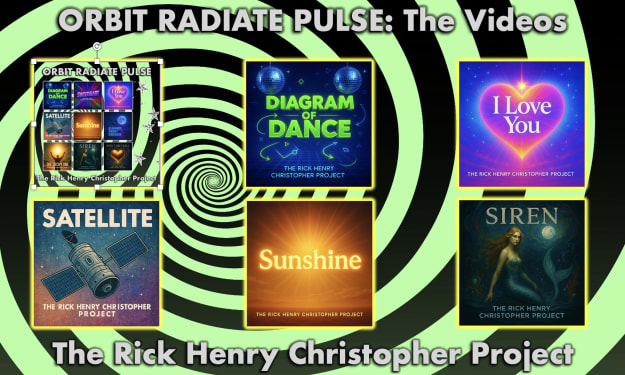
Orbit Radiate Pulse: The Videos
In October 2025, I discovered an app called Grok. It added a whole new layer to my creativity. At first, I used it for silly things, like making photos of my mom and me screaming at each other. It was really funny. But pretty quickly, I realized I could use Grok to bring my Gloria stories to life.
By Rick Henry Christopher 8 months ago in Beat
Scientists Observe a Hidden Water Reservoir Beneath the Desert Larger Than Expected. AI-Generated.
In what scientists are calling a surprising breakthrough, researchers have identified a much larger‑than‑expected reservoir of water hidden deep beneath a desert region, challenging long‑held assumptions about how arid landscapes store and cycle water. Far from being lifeless expanses of sand and rock, some deserts conceal complex underground water systems that could have big implications for water security, climate science, and our understanding of how rain and ancient climate events shape Earth’s interior.
By Sadaqat Ali9 months ago in Beat
NASA Tracking Plane-Sized Asteroid Approaching Earth Tomorrow. AI-Generated.
NASA has confirmed that a plane-sized asteroid will make a close approach to Earth tomorrow—a development that has captured public interest and scientific attention alike. While the idea of a space rock zooming toward our planet might seem alarming, space agencies emphasize that the upcoming pass poses no danger of impact and is a routine event within the solar system’s dynamic environment.
By Sadaqat Ali9 months ago in Beat
Meteorologists Warn of an Unusually Early Arctic Breakdown in February — Atmospheric Signals Not Seen in Decades. AI-Generated.
As winter deepens in the Northern Hemisphere, meteorologists are raising alarms about something unusual unfolding high above the Arctic Circle: an Arctic breakdown forming in February marked by atmospheric signals not seen in decades. While much of the world may still be shivering through routine winter weather, scientists watching from weather centers and research institutions are seeing patterns in the atmosphere that suggest one of the earliest and most pronounced disruptions of the Arctic’s typically stable winter circulation in modern memory. This “breakdown” refers to a weakening and distortion of the polar vortex — the huge swirl of frigid air that normally hangs over the North Pole during the winter, acting as a cold reservoir that locks freezing air in place. What’s striking this year is both how early this weakening appears to be occurring and how strong the signals are that physicists and forecasters usually associate with spring or late winter, not early February. What Exactly Is an Arctic Breakdown? The polar vortex isn’t a movie villain — it’s an enormous high‑altitude cyclone of cold air, spinning in the stratosphere and troposphere above the Arctic. Under normal winter conditions, this vortex is compact and strong, effectively containing the coldest air near the pole. But when the vortex weakens — or even collapses — it can no longer hold that cold air in place. Instead, Arctic air streams out toward lower latitudes, while warmer air surges into northern regions. Meteorologists talk about stratospheric warming, pressure anomalies, and jet stream distortions when they discuss how this process unfolds. What’s happening now are warming pulses climbing from lower latitudes into the Arctic stratosphere, warping the vortex’s usual form and setting off signals that experienced forecasters say are unusually early in the season. For most people, the earliest sign of these changes won’t be the esoteric charts seen by atmospheric scientists — it will be subtle shifts in local weather patterns: unexpected warm spells followed by sudden cold snaps, bumpier jet stream behavior, and more frequent extremes than typical for this time of year. Why This Year’s Signals Are Unusual It’s rare for a major breakdown of the Arctic winter circulation to materialize this early. In the past, similar disruptions — such as the famous “Beast from the East” cold outbreak in Europe in 2018 — were associated with Sudden Stratospheric Warming (SSW) events that typically developed later in the winter or even into early spring. This year, the signals are lining up much earlier and with a distinct intensity, prompting forecasters from Europe to North America to watch closely. Several key factors raise eyebrows among scientists: Unusual stratospheric warming pulses rising into high latitudes sooner than expected. Pressure anomalies that are reminiscent of decades‑old reanalysis patterns — signals that veteran meteorologists haven’t seen this early in the season. A wavier jet stream, meaning the normally tight atmospheric currents are bending unpredictably, setting the stage for more volatile weather at mid‑latitudes. This combination is not just a curiosity: it suggests the Arctic winter environment may be entering uncharted territory in terms of timing and structure, with potential consequences for weather across Europe, Asia, and North America. From the Arctic to Your Backyard: How the Breakdown Can Affect Weather An Arctic breakdown isn’t a single event that happens in isolation — its effects ripple downward through the atmosphere. When the vortex weakens, the jet stream tends to shift from a smooth, circular path into a more meandering pattern. These bends can act like atmospheric forks in the road, steering cold Arctic air south into regions unprepared for sudden cold snaps — and simultaneously allowing warmer air to surge northward into the Arctic itself. The result? That weird sequence of weather many people have noticed in recent winters — sudden warm spells followed by dramatic cold returns, snow one week and thawing the next. With this early breakdown signal, such volatility could arrive sooner and be more frequent than average. For communities, this means planning not just for one type of weather — like snow — but for rapid swings that can stress infrastructure, complicate travel, and affect energy demand as heaters and cooling systems cycle unpredictably. Farmers and emergency planners may need to pay even closer attention to long‑range forecasts than usual. Climate Change and the Arctic’s Shifting Baseline Underlying these unusual atmospheric signals is a broader backdrop of a rapidly warming Arctic. Scientists have documented that the far north is warming at roughly four times the global average, thinning sea ice and altering established seasonal rhythms. Sea ice that once formed thick and early in the winter is now thinner and more fragile, making it easier for atmospheric waves to punch through and destabilize the vortex. This doesn’t mean every Arctic breakdown is directly “caused” by climate change, but the warming Arctic amplifies the likelihood and intensity of atmospheric distortions. In a climate system already stressed by rising temperatures, weather patterns are more prone to surprises and extremes. What Experts Recommend Meteorologists and climate scientists are urging the public to stay informed but not alarmed. Because these atmospheric shifts can produce a range of outcomes — from warm anomalies to deep cold blasts — the key is preparedness: Watch updates from credible national weather services. Understand that even mild forecasts can precede abrupt cold snaps. Be ready for rapid temperature swings and localized extremes. Pay attention to marine and coastal forecasts, as sea ice changes can influence local conditions. Conclusion An unusually early Arctic breakdown forming in February — with atmospheric signals not seen in decades — is more than an intriguing meteorological trend. It’s a reminder of how dynamic and interconnected Earth’s atmosphere truly is. What begins high above the frozen North can reach into millions of lives thousands of kilometers away, shaping the weather we live with and how we prepare for it. As this story continues to unfold in the weeks ahead, scientists will watch closely — not just for dramatic headlines, but for the nuanced ways in which our atmosphere’s “seasonal script” may be quietly rewriting itself.
By Sadaqat Ali9 months ago in Beat
Astronomers Detected a Strong Signal From Space Lasting Seven Hours — Now They May Have Worked Out What It Was. AI-Generated.
In July 2025, astronomers around the world were astonished when space observatories recorded an extraordinarily powerful and unusually long signal from deep space — a cosmic explosion of gamma rays that blazed for nearly seven hours. Ever since, scientists have been working to understand what produced this cosmic blast and whether it reveals new and exotic physics. Now, new research is offering the first substantial clues about this enigmatic event.
By Sadaqat Ali9 months ago in Beat
Mars Isn’t Plan B: Why Earth Stays More Livable — No Matter What. AI-Generated.
For decades, Mars has been portrayed as humanity’s backup plan—a distant refuge in case Earth becomes uninhabitable due to climate change, war, or resource depletion. Rocket launches, bold timelines, and science-fiction dreams have reinforced the idea that the Red Planet could one day host thriving human settlements. But strip away the hype, and the reality is far less forgiving. Mars is not, and may never be, a viable “Plan B.” No matter how advanced technology becomes, Earth remains overwhelmingly more livable than any other known world.
By Sadaqat Ali9 months ago in Beat