
The Farewell Tour That Refused to Say Farewell
When the encore lasts longer than the original career.

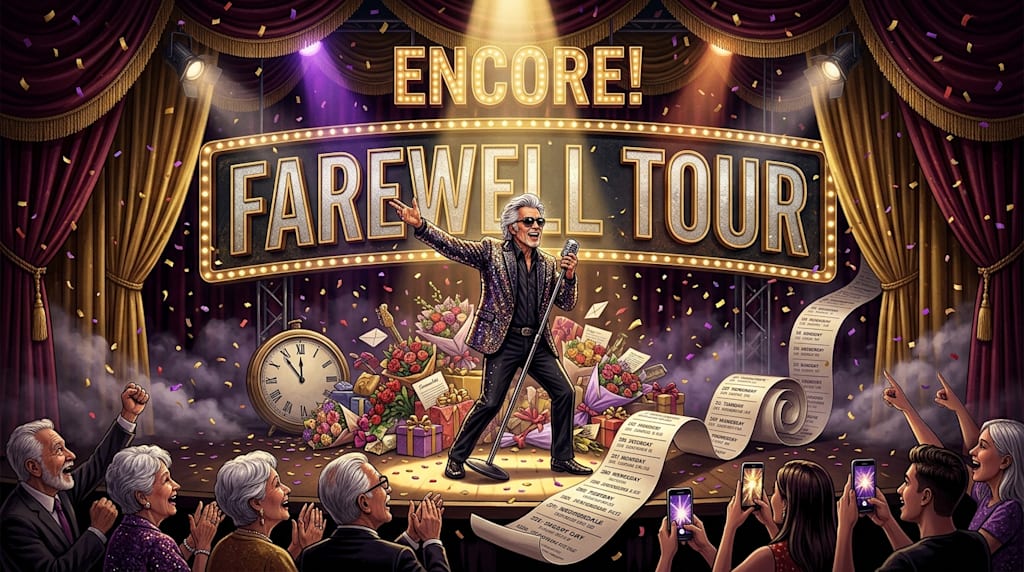
There was a time when a farewell tour meant something. An artist announced the final performances, fans rushed to buy tickets, everybody cried during the last song, and the curtain came down. The legend went home, enjoyed a peaceful retirement, and occasionally appeared in a documentary to remind us how magnificent the old days were.
Not anymore.
These days, some farewell tours seem to have more sequels than Hollywood franchises. The singer says goodbye, returns three years later, says goodbye again, announces a special anniversary concert, and somehow ends up scheduling another international tour. At this rate, the farewell tour might qualify for its own retirement benefits.
Consider the evidence. Cher's Living Proof: The Farewell Tour opened in 2002 with a modest schedule. By late 2004 it was approaching its 250th show and had picked up a second name: the Never Can Say Goodbye Tour. After a Las Vegas residency, she returned in 2014 with Dressed to Kill, which she insisted would be her "honest to God last." Then came Here We Go Again in 2018, complete with a newly added "farewell to Melbourne" show. That is a farewell, inside a tour, that came after two farewell tours. It's a Russian nesting doll of goodbyes.
Mötley Crüe went further and brought paperwork. In 2014, the band publicly signed a "cessation of touring agreement" before their final tour. That year, bassist Nikki Sixx told Rolling Stone, "Legally, we can't play again." The last show came on New Year's Eve 2015. Less than four years later, the band released a video of the contract being blown up and announced a stadium tour. The agreement had a loophole all along: if all four members agreed, they could override their own contract. It may be the most rock-and-roll legal clause ever written.
To be fair, not every goodbye is a bait-and-switch. Elton John ended his Farewell Yellow Brick Road tour in Stockholm in July 2023 after more than 300 shows. His camp drew a careful line: he was retiring from touring, not necessarily from ever performing in public again. That distinction matters. Farewell to touring, farewell to a city, farewell to live performance and full retirement are four different promises. Only one of them fits on a T-shirt.
And I have a question: Does anybody in the music industry know what the word farewell means anymore?
The Show Must Go On. But Must It?
Let's establish something immediately: growing old is not a crime. Neither is loving your profession. Some performers remain extraordinary well into their seventies and eighties, demonstrating that talent, charisma, and musical expression don't come with expiration dates.
But occasionally, watching a legendary performer onstage raises a different question.
Is this still a concert, or are we witnessing an elaborate negotiation between nostalgia, physical endurance, and an audience determined to relive 1978?
The stage lights are flashing. The backup singers are doing Olympic-level choreography. The musicians are carrying the arrangement. Meanwhile, the star stands beneath a spotlight, occasionally raising an arm while the audience enthusiastically supplies half the lyrics.
And the crowd goes wild.
Perhaps that's the magic. Or perhaps everyone has silently agreed not to discuss what's happening.
When Your Career Becomes Your Identity
Imagine spending fifty or sixty years being applauded.
For decades, thousands of people have screamed your name, purchased your records, memorized your lyrics, and treated your arrival onstage as a major event. Hotels, private jets, backstage crews, interviews, television appearances, and standing ovations become part of your ordinary existence.
Then one morning, you're supposed to wake up, make coffee, and become just another person wondering whether the grocery store has ripe avocados.
That transition might be harder than it sounds.
Psychologists have studied how strongly professional identity can shape a person's sense of self. Retirement isn't necessarily just about stopping work. It can involve redefining purpose, belonging, and personal significance.
One revealing line of research comes from sport. In a 2021 study, psychologist Catherine Haslam and colleagues surveyed hundreds of retired competitive athletes from Western and Eastern countries. Losing their athletic identity was linked to poorer adjustment after retirement, partly because it eroded their sense of meaning and control. Athletes who held on to existing social groups, or joined new ones, were partly protected from that loss.
Athletes aren't singers, of course. But they share some key ingredients: a public identity reinforced by crowds, and a career defined by what the body can still deliver on a given night. Research on how star performers specifically retire is surprisingly thin, mostly small interview studies. So the athlete findings are a cousin to the singer's situation, not a twin.
For someone whose identity has been inseparable from public performance, leaving the stage may mean confronting a difficult question:
Who am I when nobody is applauding?
If the retirement research is any guide, part of the answer may be someone who still belongs somewhere. That could be a family, a circle of old friends, or a neighborhood avocado-inspection committee.
Of course, we cannot know what motivates any particular artist. Some genuinely adore performing. Others may have financial obligations, contractual commitments, or simply no interest in retirement.
But it's worth asking whether the music industry sometimes encourages performers to keep going because nostalgia remains an extraordinarily profitable product.
Nostalgia Has Excellent Ticket Sales
Let's be fair to the audience.
People aren't necessarily purchasing tickets because they expect the same vocal performance they heard on a record released forty years ago.
They're purchasing memories.
That song played at their wedding. Another accompanied their first heartbreak. A particular album reminds them of being twenty-two, driving an unreliable car, and believing life would last forever.
Seeing the original performer sing those songs can feel like briefly reopening a door to the past.
That door seems to have a neurological address. In a 2009 brain-imaging study, neuroscientist Petr Janata played excerpts of popular songs from participants' childhood and teenage years. The more strongly a song was tied to a personal memory, the more activity appeared in part of the medial prefrontal cortex. This region is involved in thinking about ourselves and retrieving our own life story. Janata proposed it as a hub where music, memory, and emotion meet. In other words, a familiar song isn't merely heard. It gets filed under you.
A 2010 study led by Frederick Barrett added an important detail about how that feels. Roughly a quarter of the song excerpts participants heard made them nostalgic, and that nostalgia was bittersweet, mixing joy with sadness. Anyone who has cried happily through a chorus at an arena show will recognize the combination.
Neither study went anywhere near a box office. Their volunteers were university students in a lab, not sixty-somethings in the nosebleed seats. Still, they help explain why an audience might be buying something other than musical perfection: an emotional reunion with its own past.
And perhaps that's why audiences are so forgiving.
The high notes might be lower. The tempo might be slower. The choreography might have quietly disappeared sometime during the Clinton administration.
Nobody cares.
For a couple of hours, the audience gets to visit its younger self.
The industry noticed long ago. Economist Alan Krueger, analyzing concert data, found that between 1996 and 2003, average ticket prices rose 82% while general consumer prices rose 17%. Those figures are more than two decades old, so treat them as history rather than a snapshot of today's market. In a 2002 lecture on his research, Krueger also noted that older acts tended to charge more, which he attributed to loyal, older fans with more disposable income. Nostalgia, it seems, has long been a premium product with a premium customer.
As far as I can tell, nobody has published a peer-reviewed study on whether the word final sells extra tickets. Then again, nobody has needed to.
But here's where things become complicated: Should nostalgia alone be enough to sustain a concert experience?
If a ticket is sold primarily on the promise of a legendary name, what does the artist owe the audience in return?
And what does the audience owe the artist?
Maybe the Problem Isn't Age. Maybe It's Expectations.
Researchers even have a name for certain age-related changes in the voice: presbyphonia. A 2024 scoping review by Ralph Haddad and colleagues, covering 188 published articles, describes how age-related changes in the larynx interact with other changes in the body. An aging respiratory system, hormonal shifts, hearing loss and other health conditions can combine into a voice that sounds weaker, breathier, or hoarser.
The key word is interact. The review wasn't about rock stars; it looked at adults over 65 diagnosed with voice problems. Its authors argue for assessing each aging voice factor by factor, because there is no single script for how a voice ages.
Which is exactly why a show built on pretending nothing has changed is such a strange bet.
There are performers who adapt beautifully as they grow older.
They change arrangements, choose songs that suit their current voices, reduce physically demanding routines, and create intimate performances that emphasize interpretation rather than athleticism.
That's not decline. That's artistic evolution.
A singer doesn't need to leap across the stage to deliver a moving performance. A musician doesn't need to reproduce every note exactly as recorded decades earlier.
Sometimes a quieter rendition carries more emotional weight than the original.
The problem begins when the entire production insists on pretending that nothing has changed.
The artist is older. The audience is older. The songs are older.
Even the merchandise is probably older.
Why must the illusion remain twenty-five?
Perhaps there's something more dignified, and more artistically interesting, about allowing a legendary performer to become a legendary older performer rather than demanding an endless reenactment of youth.
The Final Bow Is Also an Art
There is something powerful about knowing when to end a performance.
Not because someone has reached a particular birthday. Not because society has decided older people should disappear. And certainly not because mobility limitations automatically diminish artistic ability.
But because every artist deserves the freedom to decide what kind of legacy they want to leave.
Some will choose to perform until their final days. Others will discover that life beyond the stage offers pleasures they never had time to explore.
Both choices deserve respect.
Still, I cannot help wondering whether the entertainment industry's obsession with endless comebacks has made retirement seem almost embarrassing.
As though stepping away from the spotlight means admitting defeat.
Perhaps the opposite is true.
Perhaps knowing you've given the world decades of music, unforgettable performances, and enough memories to fill several generations is an achievement that requires no additional encore.
And perhaps the greatest luxury of a successful career is eventually being able to say:
Thank you. That was wonderful. Now I'm going home.
Without announcing another tour six months later.
Now, I'd Love to Hear Your Opinion
Should legendary singers continue performing for as long as they want, even when their voices or stage performances have noticeably changed? Or is there a point when retiring would better preserve their artistic legacy?
And one more question: Would you pay premium ticket prices to see an aging music legend primarily for the nostalgia, even knowing the performance might be very different from what you remember?
I'm genuinely curious where readers stand on this one.
Because apparently, the farewell tour isn't going anywhere.
It just added twelve more dates.
Research and Further Reading
Studies
Barrett, F. S., Grimm, K. J., Robins, R. W., Wildschut, T., Sedikides, C., & Janata, P. (2010). Music-evoked nostalgia: Affect, memory, and personality. Emotion, 10(3), 390–403. https://doi.org/10.1037/a0019006
Haddad, R., Bogdanski, E., Mattei, A., Michel, J., & Giovanni, A. (2024). Presbyphonia: A scoping review for a comprehensive assessment of aging voice. Journal of Voice. https://doi.org/10.1016/j.jvoice.2024.12.003
Haslam, C., Lam, B. C. P., Yang, J., Steffens, N. K., Haslam, S. A., Cruwys, T., et al. (2021). When the final whistle blows: Social identity pathways support mental health and life satisfaction after retirement from competitive sport. Psychology of Sport and Exercise, 57. https://researchportalplus.anu.edu.au/en/publications/when-the-final-whistle-blows-social-identity-pathways-support-men/
Janata, P. (2009). The neural architecture of music-evoked autobiographical memories. Cerebral Cortex, 19(11), 2579–2594. https://doi.org/10.1093/cercor/bhp008
Krueger, A. B. (2005). The economics of real superstars: The market for rock concerts in the material world. Journal of Labor Economics, 23(1), 1–30. https://doi.org/10.1086/425431
Reporting
Princeton University (2002). Economist Alan Krueger examines pricing of concert tickets. https://www.princeton.edu/news/2002/09/24/economist-alan-krueger-examines-pricing-concert-tickets
NZ Herald (2004). Cher retires after Australia. https://nzherald.co.nz/lifestyle/cher-retires-after-australia/RACPCGNAGIDZJD6BKENIG22G5I
HitFix/Uproxx (2013). Cher kicks off 'Dressed To Kill' tour in March. https://uproxx.com/hitfix/cher-kicks-off-dressed-to-kill-tour-in-march
Attitude (2014). Cher: 'This farewell tour is my honest to God last'. https://attitude.co.uk/uncategorised/cher-this-farewell-tour-is-my-honest-to-god-last-280984
Amnplify (2018). See CHER's farewell to Melbourne show! https://amnplify.com.au/?p=231805
Planet Rock (2019). Mötley Crüe reportedly set for 2020 stadium tour with Def Leppard and Poison. https://planetradio.co.uk/planet-rock/news/rock-news/motley-crue-stadium-tour-def-leppard-poison
Global News (2019). Mötley Crüe announces comeback, destroys 'cessation of touring' contract. https://globalnews.ca/news/6187679/motley-crue-comeback-teases-tour-destroys-contract
CNN Wire via ABC7 (2023). Elton John says goodbye to over 50 years of touring with last show on his farewell tour. https://abc7news.com/post/elton-john-tour-farewell-yellow-brick-road-concert/13481926/
The New Daily (2023). https://thenewdaily.com.au/life/entertainment/music/2023/07/10/elton-john-retire-farewell-tour
About the Creator
Khali Sollis
Khali Sollis is a writer and independent researcher exploring the science of the human mind and behavior. Her work examines questions at the intersection of neuroscience, psychology, cognition, mental health, and everyday human experience.
Enjoyed the story? Support the Creator.
Subscribe for free to receive all their stories in your feed.
Comments