rock
My Chemical Romance
In the early 2000s, when mainstream rock felt split between polished pop-punk and gritty garage revival, a band from Newark, New Jersey, emerged with a sound—and a vision—that refused to fit into any single box. My Chemical Romance (MCR) wasn’t just a band. They were a story, a movement, and, for many, a lifeline.
By Junaid Shahid about a year ago in Beat
Dear Luna: A Rising Force in Alternative Pop-Rock
Since their inception in 2017, Dear Luna has been on a journey of growth and transformation, blending sultry jazz elements with modern alternative pop/rock to create a sound that demands attention. What began as a collaboration between vocalist Taylor Plasz and pianist Michael Schneider performing intimate, jazz-laced sets at Colorado wineries has blossomed into a full-fledged powerhouse of emotional storytelling, rich instrumentation, and soulful melodies.
By mysoundMusicabout a year ago in Beat
Jacquie Roar: Country’s New Queen of Fire
By Sandy Lo When you press play on tracks like “Free,” “Fire On The Mountain,” “High Heel High,” or “Bad Habit,” you're instantly pulled into the powerhouse world of Jacquie Roar. With fierce vocals, undeniable grit, and a vibe that's equal parts rhinestone and rebellion, Jacquie is blazing her own trail in country music—and she’s not slowing down.
By All’s Fair in Love & Writingabout a year ago in Beat
The Digital Music Duo Breaking Cultural Borders
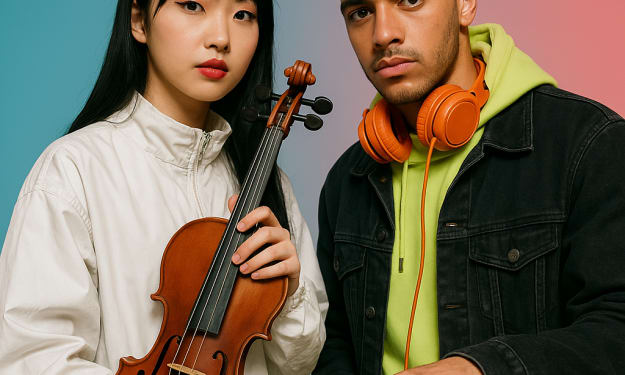
In an era dominated by digital platforms and genre-defying music, AJ Currant has emerged as a groundbreaking international sensation. Comprised of Aria Juno from South Korea and Jayden Currant from the United Kingdom, this cross-cultural duo is rewriting the rules of global pop—and doing it in real time. Their bold fusion of K-pop, EDM, Afrobeat, and classical orchestration is not only captivating fans across continents, but it’s also setting trends on TikTok, YouTube Shorts, and Vocal Media. From Different Worlds to One Virtual Studio Aria Juno, a classically trained violinist turned K-pop producer from Seoul, met Jayden Currant, a street poet and digital DJ from Manchester, during a livestreamed collaboration on Twitch. What started as an experimental mix session quickly went viral, gaining over 2 million views in 48 hours. Within weeks, they adopted the name AJ Currant and released their debut single “Neon Pulse”—a futuristic, genre-bending track that fused Korean lyrics, British slang, tribal drums, and glitchy synths. Within days, it trended on Spotify’s “Fresh Finds” and hit #1 on Apple Music’s New Artists to Watch. Viral Moment: TikTok and the "Pulse Dance" What truly catapulted AJ Currant into the global spotlight was their “Pulse Dance Challenge” on TikTok. With more than 400 million views and participation from influencers across Brazil, India, Germany, and Nigeria, the dance became a symbol of unity through diversity. Famous dancers like Charli D’Amelio and K-pop idols from groups like ATEEZ and ITZY recreated the challenge, while everyday fans stitched their videos to celebrate cross-cultural collaboration. Breaking the Mold: No Labels, No Borders AJ Currant is not signed to a traditional label. Instead, they’re pioneering what they call a “Web3 music ecosystem.” Through NFTs, smart contracts, and blockchain-based royalty sharing, they allow fans to invest in their songs and receive profit shares—making AJ Currant more than a musical act; they’re a movement of decentralized creativity. Their second single, "Virtual Roots," was co-produced with African digital artist NkoziWave and includes samples of traditional Zulu chants layered over London grime beats. The result? A song that’s being used in over 60,000 Reels and Shorts, and now being discussed in universities as a study in modern ethnomusicology. Why It’s Viral on Vocal Media Stories involving international collaboration, digital innovation, youth culture, and music fusion tend to perform well on Vocal Media. AJ Currant’s story checks every box: They represent diversity, innovation, and artistic rebellion. They’re tech-forward, leveraging AI, NFTs, and decentralized platforms. Their brand is perfect for visual storytelling—making them ideal for articles, photo essays, and video content alike. They’re relevant to multiple Vocal Media categories: Pop Culture, Beat, Futurism, and Longevity. Interviews and Fan Theories AJ Currant recently appeared in an AI-generated 3D interview using Sora, OpenAI’s video model. They spoke on topics ranging from music freedom, to mental health, to how digital creation tools are liberating Gen Z artists. Fans have created deep-dive theory threads speculating that Aria Juno is secretly working with HYBE Labels and that Jayden Currant may be collaborating with underground London rapper Dave. Whether true or not, the hype adds fuel to the viral fire. What's Next? Rumors suggest AJ Currant is planning a Metaverse World Tour, with concerts held in Fortnite, Decentraland, and Roblox—complete with AR effects and fan-designed avatars. Meanwhile, their third single, “Code of Hearts,” drops in September and is rumored to be co-produced with a holographic version of Daft Punk. In a world fragmented by language, politics, and culture, AJ Currant is the rare act that brings it all together. Their music isn’t just heard—it’s felt across time zones and timelines, across apps and avatars. If there’s any duo that defines the global voice of the digital future, it’s AJ Currant. --- Ideal Vocal Media Category: Pop Culture or Beat (both go viral frequently—Beat is great for music, Pop Culture for a broader reach) Would you like me to: Translate this into Urdu? Generate a matching AI image of the duo?
By Nimatullahabout a year ago in Beat
The Night Freddie Mercury Knew He Was Saying Goodbye. AI-Generated.
On a cold October evening in 1990, in a dimly lit studio in Montreux, Switzerland, a man with a weakening body stood before a microphone. He looked thinner. Frailer. But when he opened his mouth, the world heard a voice that sounded like thunder wrapped in velvet. The man was Freddie Mercury, and that night, he recorded “The Show Must Go On.” It would be the last true roar of one of music’s greatest lions. And deep down, Freddie knew: this wasn’t just another song. It was his goodbye. --- The Final Act of a Legend Freddie Mercury had always lived like lightning. His stage presence was unmatched — part opera, part rock, and all soul. He turned stadiums into temples, fans into worshippers, and pain into poetry. But by the late 1980s, something had changed. Behind the flamboyant costumes and soaring vocals, his body was quietly breaking. In 1987, Freddie was diagnosed with HIV/AIDS, a disease that at the time was misunderstood, feared, and often silenced. He never made it public. Not yet. Instead, he poured everything he had left into his music. And in 1990, Queen began recording what would be their final album with him — Innuendo. --- The Song He Shouldn’t Have Been Able to Sing “The Show Must Go On” was not easy. It demanded power. It demanded range. It demanded lungs that could carry emotion and energy for miles. And by then, Freddie’s health had deteriorated so much, some of his bandmates weren’t even sure he could manage it. Brian May, Queen’s legendary guitarist and co-writer of the song, once recalled, “I said to Freddie, ‘I don’t know if this is going to be possible.’ And he said, ‘I’ll do it, darling. I’ll fucking do it.’” And he did. With pain in his body but fire in his soul, Freddie stepped up to the mic. He didn’t just sing. He soared. Every line felt like a scream against death: "Inside my heart is breaking / My make-up may be flaking / But my smile still stays on…" --- A Voice That Refused to Die That night in the studio, Freddie wasn’t just recording a song. He was writing his farewell letter in sound. He knew his time was limited. The doctors knew. The band knew. But the public didn’t. And Freddie wanted it that way. He didn’t want pity. He didn’t want headlines. He wanted to create — until the very last breath. And that’s exactly what he did. Even when walking hurt, even when standing took effort, Freddie kept recording. The Show Must Go On became a mantra. A whisper to himself. A roar to the world. --- The World Didn't Know—Yet When Innuendo was released in 1991, fans didn’t realize what they were hearing. They knew the song was powerful. They didn’t know it was the sound of a man dying. Freddie appeared one last time in a music video — for “These Are the Days of Our Lives.” He looked gaunt. His eyes were glassy. But in his final line to the camera, he whispered something unforgettable: “I still love you.” It would be the last time the world saw him alive. --- November 24, 1991: The Curtain Falls A day after publicly confirming he had AIDS, Freddie Mercury died in his home at the age of 45. The world was stunned. Millions mourned. But those who had listened closely to “The Show Must Go On” already felt it — he had been saying goodbye all along. In the months that followed, the song became an anthem. Not just for Freddie’s fans, but for people fighting battles of all kinds — illness, grief, loss, and fear. The song became a symbol of defiance. Of resilience. Of facing the end with courage, not collapse. --- A Legacy Wrapped in One Song Freddie Mercury was many things: flamboyant, fearless, fragile, and fierce. But more than anything, he was honest — even when he didn’t speak. “The Show Must Go On” is proof of that. It captured everything he was: The performer who lived for the stage The fighter who wouldn’t give up The man who knew the end was near, but still chose to sing To this day, the song remains one of Queen’s most celebrated works. Not because of its chart position — but because of what it means. --- The Curtain Never Closed More than three decades later, Freddie’s voice still echoes in stadiums, headphones, and hearts. The show did go on. And in many ways, it still is. Because when Freddie Mercury sang his last song, he didn’t disappear. He became eternal. Not in silence. But in music. He didn’t whisper goodbye. He belted it — with fire, passion, and a mic in his hand. ---
By Muhammad Riazabout a year ago in Beat
The Crazy Train of Life:
I was born in 1984. Two of my favorite uncles introduced my parents, and both of them were really into the music scene in Oregon (yes, connected to things like the Grateful Dead and the Cherry Poppin’ Daddies, for context). They were also very into wrestling. Often, both of these uncles, who were my favorites when I was a kid, would babysit me.
By Sai Marie Johnsonabout a year ago in Beat