
My Exclusive Interview With Mia Van De Loo
Discover the secrets behind this artist's summery style and intimate, confessional lyrics.

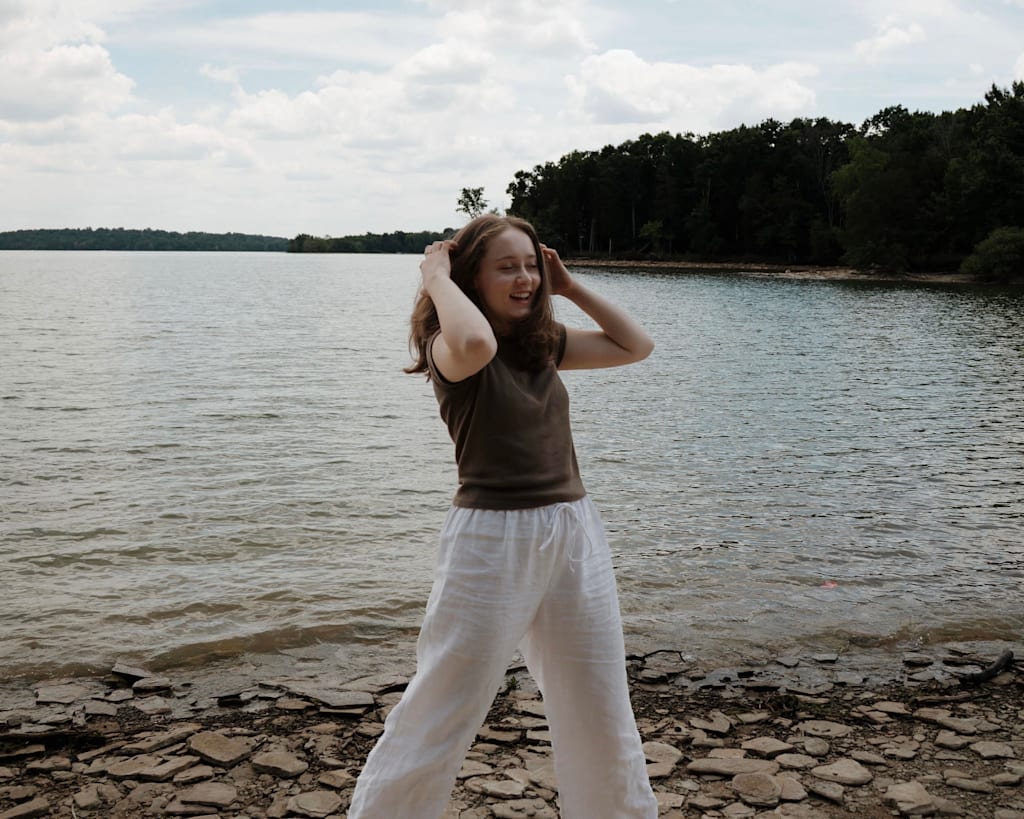
open book isn't just the title of Mia Van De Loo's debut EP—it's also a fitting description for an artist who puts her heart into her lyrics, talks freely about the songwriting process and uses her soft yet captivating vocals to cultivate an intimate listening experience. She believes that "anyone willing to get to know my heart through my songs deserves to know it in its entirety," and once you've read this deep dive into her past, present and future, listening to her music becomes twice as rewarding. Don't hesitate to listen to "quicksand" afterward; this is your chance to become a day-one fan before she goes viral.
1. Your Instagram profile has a lot of earthy hues and nature scenes, which definitely suit your music's calm, peaceful vibe. Did you develop your aesthetic around your music or the other way around? What draws you to nature in particular?
I’ve always loved cultivating an aesthetic around each period of time in my life. The songs I’ve been releasing this year were all written when I was in my junior year of high school and the summer before it, which was a time characterized by a lot of friend hangs, drives up the mountain, summer camp, little hikes, and what have you. So I wanted to pay homage to that season by promoting these songs in a way that feels like that time in my life did, hence the outdoorsy vibe.
Blue and green are some of my favorite colors, so I’d pick that color scheme anyway, but I am not an outdoorsy person at all, and in all of the shoots I was freaking out about the fish in the stream, and the bugs on the trees, and the dirt on my feet—out of my comfort zone for sure, but I love the content we got!
2. On Instagram, you also discuss basing "upstream" on a diary entry. How much of your personal life do you typically include in your music? Do you want listeners to connect your music to your life, or do you want to make music that's more universal? Or a blend of both?
I’ve always strived to uninhibitedly give myself to my songwriting. I love knowing people and being deeply known, so I am not scared of vulnerably sharing how I feel, especially through song. I try to leave names out of it, and I am nervous to share some songs down the road that could be a little more obvious to the people that they’re about, but other than that, I am an open book.
I know there’s a lot of discourse about whether you can control the narrative on your art once you’ve released it, but I think I leave that choice up to the listener. I hope my music has at least a little universality to it that allows people to apply it to their lives in their own unique way, because it is an honor to help people feel understood. But for those who want to know what specifically inspired me to write my songs, I definitely don’t shy away from expressing those experiences.
3. As a whole, your discography has a quiet, confessional vibe that reminds me of a friend whispering secrets. How do you use your vocals, lyrics and instrumentals to create this intimate feeling? Do you ever feel like you want more distance from the listener?
I didn’t always sing in the subdued way I do now. When I first started pursuing music as a career, I put a lot more power behind my voice, but I found people resonating most with the softer side of me. I think I come on pretty strong as a person when you get to know me, and I really like that my music puts another side of me at the forefront and allows me to put my gentlest foot forward.
As I experimented with that style, I listened to a lot of artists that do it really well, like Dodie, Lizzy McAlpine, Phoebe Bridgers, Clairo and Leith Ross, and I continually take inspiration from their songwriting, vocal technique and production. I wouldn’t trade that intimacy with my listeners for the world—anyone willing to get to know my heart through my songs deserves to know it in its entirety.
4. How long have you been writing music? What led you to start recording and releasing your own tracks? Did anything surprise you about the recording process?
I’ve been writing music practically my entire life—my dad would play piano and I’d write lyrics at 4 years old. My writing has matured a little since then (thank God), and I started writing music I actually respected around 14 years old, when I learned how to play ukulele. Those songs are in my debut EP, open book!
I released that EP in 2023, once I finally admitted to myself that pursuing a career in music was what I really wanted to do with my life. My family and I are very success-oriented, so to pursue a path that had such a slim chance of stereotypical success was scary to me for a long time, and I think releasing the songs I wrote at 14 was validation that the art I created purely out of passion and creativity, without a desire for success, was worthy of my time and money and effort.
The most surprising thing to me about the recording process was how much I loved working with another person on my songs. I very rarely co-write because I have a hard time killing my darlings, so to speak, but once I finish writing a song, I absolutely love entrusting another person with the production and mixing side. I trust my songwriting completely, but my songs sound so much better when a producer like Jake on open book or Ben on these last three singles works their magic.
5. Your latest single, "quicksand," starts off slow before building momentum and ending with a cathartic release. What kind of feeling or experience did you want to convey with this track? How did you achieve the slow burn that makes the song feel like it's really going somewhere?
“quicksand” is about having a dream burning in your heart, and a clear vision for how to accomplish it, but being stuck in the present and lacking the wherewithal to take that first step. I wanted the production of the track to feel like that—to reflect the grandeur of the dream, but also the frustration of the pent-up hopes and visions and plans.
I always had a pretty clear idea of how I wanted the song to sound, but I didn’t realize how long and wordy the song was until I got into the studio and we started recording. My producer, Ben, tried to encourage me to cut some lyrics or add some extra flourish into the second verse to vary the dynamics of the song, but the more he pushed for that, the more I realized that the lengthy, driving verses perfectly communicate that feeling of delayed gratification.
6. What does your songwriting process look like? How do you develop lyrics and melodies? Do you believe that the best ideas are spontaneous or the result of hard work?
I try only to write when I’m feeling inspired. I know many artists say that songwriting is a muscle, but luckily I’ve been inspired enough over the years to write dozens and dozens of songs that are currently sitting in my notes app, untouched.
I have so many songs that I’d love to share with the world, so I have the luxury of writing new music at my leisure. This allows me to feel like songwriting is still a hobby, or an art, rather than a job or a business. I never have to write another song; it’s still therapeutic, and I can decide to publicize it once it’s served me emotionally first.
Lyrics typically come first to me, then a chord progression, and melody last, but they all go hand in hand. I’ll write one line, then find the chord for it, then put it to melody, then repeat until the whole song is done. And of course that changes all the time too—I make a lot of rules for myself in life and songwriting is a place where I allow myself more freedom.
7. Your Instagram bio mentions Psalm 139:12, which discusses light and darkness. What made you want to highlight this verse in particular, and what kind of role does faith play in your music? Which songs specifically reference your faith?
Psalm 139 has been my favorite chapter of scripture for ten years. It covers so many points of identity for me, like my desire to be deeply known, my attention to beauty, and the tension between my present life and my life to come.
I think it’d be easy to interpret verse 12 as God removing all darkness in favor of light, but I find it fascinating to think about the line, “darkness is as light with you,” as God seeing no difference in how He shows up in the dark or in the light. I write a lot of sad songs, and for a long time I wrestled with whether that contradicted my faith. So that verse is a great reminder to me that whatever I feel and wherever I go, God is already there too and sees value in being with me there.
It’s also really important to me as a faith-based person in the music industry that I represent my faith well, and anyone I meet feels love and acceptance from me more than anything else. So I hope that that verse being in my bio reflects my desire to show up for people and love them and be there for them no matter where they find themselves physically or mentally or emotionally.
As far as how my faith impacts my songwriting, I try to be discreet about my relationship with God in my music, because my goal is not to make Christian music by any means. I want people to be able to apply my songs to their own lives whether or not they believe the same things I do, and for my music to connect people with differing beliefs rather than to divide people into categories.
That being said, I do write about my relationship with God often, and the songs I’m releasing now in particular reflect the pure, convoluted but in the best way, perspective I had on my faith at 15. I’m releasing them almost ironically now—there’s a song I’ve recorded that asks, “Why doesn’t everybody think like us?”
I am glad I don’t think as absolutely as I did before, but there’s something so easy about thinking that way, and I wanted to have proof of the progression in my faith from doe-eyed absolutism to a more empathetic and understanding approach. Of my released songs, “upstream,” to me, is about seeking validation from people when I know I should be seeking it from God. I’ll also be releasing “think like us” next year, which is the aforementioned innocent-view-on-life jam.
8. What's the first song you ever wrote? How do you think you've changed since then? If you recorded that song now, would you do anything differently?
The first song I remember writing I wrote with my dad when I was four; it was called “springtime.” The lyrics were as follows: “springtime, springtime, coming soon / springtime, springtime, not like a goon / springtime, springtime, can’t you see? / it’s beautiful for you and me.” I don’t think I’d record that one now! But it’s so precious to me that that’s how my passion for songwriting began.
The first song I wrote that I considered something decent was “goodbye friend,” which is on my debut EP, open book! I don’t feel like it’s my strongest lyricism, but I wanted to release it for posterity, and Jake, the producer for that track, blew my mind in how he transformed the song and brought it alive, and I wouldn’t change anything about his magic on it.
If you want to jump on the Mia Van De Loo train before she blows up, you can check out her website, follow her on Instagram, YouTube, Pinterest and TikTok, buy her music on Bandcamp, and stream her tracks on Spotify, SoundCloud, Apple Music and Amazon Music.
About the Creator
Kaitlin Shanks
Music journalist. To support my work, please send a tip (even $1 helps!) or shop from my Amazon storefront.
Last Living Girl (novel) • Instagram • TikTok • YouTube • Substack • Medium • Wattpad • Spotify Playlists • Linktree
Enjoyed the story? Support the Creator.
Subscribe for free to receive all their stories in your feed.
Comments
There are no comments for this story
Be the first to respond and start the conversation.