
My Exclusive Interview With Jana Tyrrell
Take a trip into the future with this producer's alien-like soundscapes.

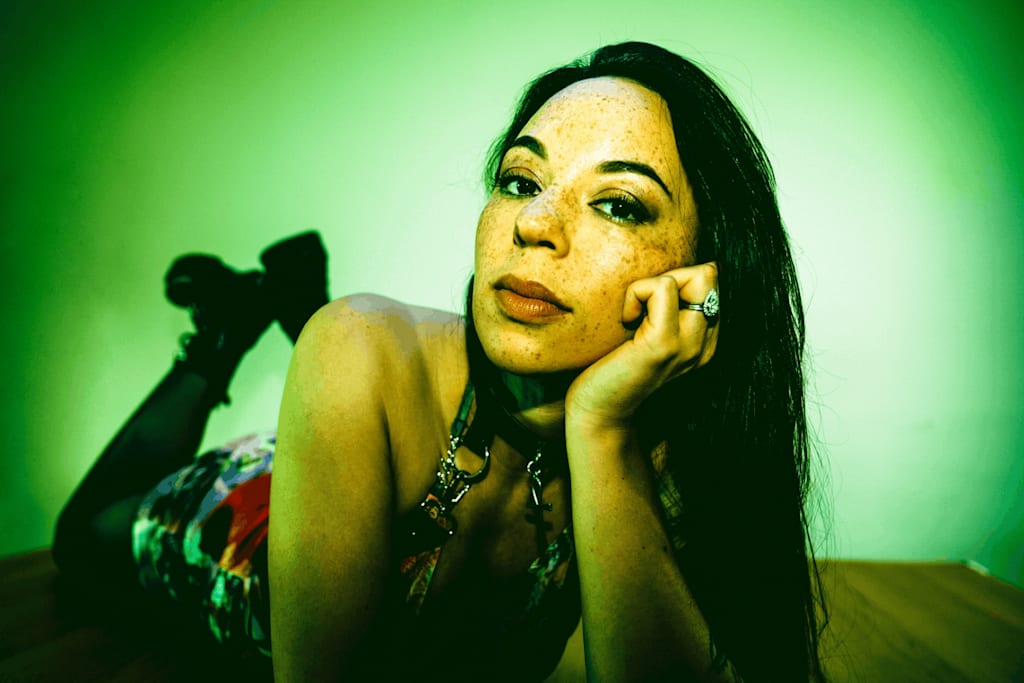
When Jana Tyrrell produces a track, she doesn't just get it ready for radio play. Instead, she blends her vocals, instrumentals and favorite sound effects into an eerie alien landscape that sounds like a recording from centuries into the future. Luckily, you don't have to be a time traveler to enjoy her work. In fact, you can stream her latest album, Was It Real Or Was It Just Me?, after reading this interview to gain a greater appreciation for her talents—and along the way, you'll realize that she's creating musical landscapes that most of us only dream about.
1. As a producer, how do you turn a demo or a loose concept into a polished track that's ready for airplay? What kinds of roles and responsibilities do you have in the studio? What's typically the first step in the process?
It's actually a very internalised process. I start my tracks with melodies or chord progressions on the keys (as that's my primary instrument) or a drum track, which I program using Ableton. For the drum track, I get an empty Rack and fill it with whatever sounds I desire for the song.
Racks are basically a set of empty spaces that are filled with whatever sound or sample you want, then hooked up to a trigger pad or keyboard that triggers the sounds; you can see me using the Novation Launchpad in a lot of my videos for this. It can honestly take a really long time to find each individual sound that you like, and as you record, sometimes those can even be swapped out if it’s not working.
I also tweak the individual sounds through equalisation (EQ) and effects, all in relation to whatever else is going on in the song. Then it's a process of recording myself and my instruments (for this album, it's synths, guitars and vocals) and honing the tracks until I feel that they are ready. Because I went back and forth on ideas for this album for at least a year, I’d hop between songs, and I rarely stuck with just one until it was finished.
When I record any parts at Pink Bird Recording Co., the studio I often work from, Rick David is my engineer and will record whatever I play or sing. He also features as a drummer on the title track, so in that case the roles were reversed, and I was the engineer. He mainly works in the Jazz scene and has mixed and recorded artists like Alfa Mist and Nala Sinephro.
I think it’s quite common for solo artists to have multiple roles in the studio environment, really. Often, we play or dabble in multiple instruments, and it’s pretty easy to record yourself well in a decent home setup.
2. How do you give your songs their distinctly haunting, ethereal sound? What kinds of production techniques do you use? Generally, how long does the production process take for a single track?
I love to use lo-fi samples from my environment. "Cyclical," for example, has my kids singing, recorded casually on my laptop, which I then pitched down. I also use old ideas from my other sessions—I basically have a folder of samples I've collected, little drum hits or melodies I like. I also stack my vocals in an operatic style (I'm learning to sing classical pieces with a tutor) and warp and effect them in a way that is haunting and possibly jarring.
Plug-ins that I frequently use to enhance the ethereal sound are Baby Audio's Transit, VHS effect and Elysia's Karacter mix for saturation. After that, it's down to the mixing! If I like a sound or plugin, I really stick with it for a long while, just to make sure I’ve got the most out of it before moving along.
The production process for this album wasn't linear at all. As I mentioned, I went back and forth on the tracks for months, and of course some ideas just didn't make it. If I were to consolidate the time it took for a single track, I'd say about a week or two.
3. Your latest album, Was It Real Or Was It Just Me?, is loaded with dark, eerie soundscapes that sound like they came from another planet. Do you feel like you're world-building or playing a character when you make music? Is it your goal to transport the listener to another realm?
I feel like it's an expression of artistic forms that influence me; I have a world in my head, and I'm just trying to bring it to life through music. So yes, definitely world-building, and probably a bit of escapism too. I love fantasy, cyber-gothic aesthetics and films, and I wanted to imbue that into my music too, bringing the listener with me.
4. How did you get started with music production? What inspired you to create darkwave music in particular? Do you feel like this genre offers possibilities that you can't get with other genres?
I got started with it just by downloading Cubase onto my computer as a teenager, then moving onto GarageBand and eventually Ableton and Pro Tools. I had a desire to get my ideas down, then I started to add more instrumentation, and eventually I learned how to program drums and layer my vocals.
Musically, I listen to a lot of metal and rock-adjacent music, as well as electronic artists such as SOPHIE and Autechre. So genres aside, I just go for things that enable me to take risks and hopefully create music that is as unique as possible!
5. "Cyclical" manages to sound alien and yet strangely familiar, like a song playing in a dream. How did you put together a complex soundscape that constantly introduces new layers without being shocking or distracting? Do you ever feel like an artist painting a landscape with your music?
Yes, that's exactly the feel I was going for. I think I just like to see how much I can possibly get away with in a track: how many layers there can be, how dissonant and alien/dream-like I can make something. I think it's very comparable to painting a landscape: you create a layer, then wait for the next layer to be completed before you can fully appreciate how well your previous idea fits. As for it not being shocking or distracting, I think that's just down to practice, trial and error.
I also read books to help me improve my process, such as Step By Step Mixing by Björgvin Benediktsson, which really breaks down the mixing process. I still wouldn’t say I am a mixing engineer, but I always want to improve and round out my knowledge as much as possible.
I’m also working my way through Kim Bjørn and Chris Meyer's Patch and Tweak, which is a fascinating book about modular synthesis. Suzanne Ciani, who wrote the foreword, is a prominent sound designer and composer. Reading about and then applying these finer details in sound design, production and mixing makes a world of difference! There is still so much more for me to learn and discover too.
6. Do you think that darkwave is essentially a timeless genre because it involves a lot of experimentation and futuristic sounds, or does it have trends like every other style? What's the difference (if any) between classic and modern darkwave?
I think any genre that pushes boundaries and constantly seeks to ask questions is timeless. I am particularly drawn to "darker" sounds overall, so it'll always have a place in my dark little heart. I think a lot of modern darkwave takes its cues from the older stuff, and seems to have merged a lot with synthwave, vapourwave and modern EDM, to be honest.
Technology has enabled more people to make music, so the basic elements are still there: heavy on the reverb, chorus-drenched guitars and chord movements reminiscent of 80s bands. The main difference is certainly genre-blending, and often a leaning towards a cleaner sound.
7. On a technical note, what kinds of software and instruments do you use in the recording process? What would you recommend for new music producers?
I have a Telecaster, which I adore and use a lot, with some great guitar pedals: Big Sky (crazy, off-into-space reverb) and Memory Man (echo/delay). I also use an eight-string guitar, just a basic one from Gear4music.
I utilised quad guitar recording for my title track, which means I did four separate guitar takes with both the eight-string and five-string. I panned them left and right (forcing the sound to go through one side or the other), with the remaining two takes slightly closer to the centre.
My microphone was put together by my husband, Rick, who is an audio engineer. It's a U67 clone, which really picks up the best parts of my voice and emphasises them. The top end (higher frequencies) has a lot of colour and detail with this mic, and it just makes my voice sound more rounded and full overall.
I record in Ableton through a Big Six SSL console. It’s basically a smaller version of what you’d get in a bigger studio, and it enables real control over shaping the sound of each instrument. The sonic quality is also controlled on the SSL by each instrument having its own control panel or channel.
Equalisation (the ability to level out frequencies—high tinny sounds, muffled ones and bass ones) and compression are also built into the console. In basic terms, having the audio signal pass through the circuitry of the desk rather than solely the internal workings of the computer has great sonic advantages, but of course it’s only as good as the musician or engineer using it. Having a console doesn’t automatically ensure the song will turn out well.
For singers, in my opinion, having a good microphone makes all the difference in the world. The U67 has three changeable "polar" patterns; it basically changes the sensitivity in various directions of the microphone. So the first pattern is cardioid (kind of heart-shaped, picking up the front and less of the back), figure 8 (picking up sound mainly from the front and back, less of the sides) and omnidirectional, which is a circular shape, equally picking up sound all around the mic.
I use a particular singing technique that involves standing in different parts of the room while stacking lots of harmonies. This creates choir-like depth and interest, which I’m always aiming to imbue my music with.
Synth-wise, I use the Roland JP-08 and Juno modules (smaller versions of the original synths) and a lot of Arturia plug-ins. The synth modules are particularly interesting. They are classic instruments that have a distinctive sound; the Jupiter 8 is particularly recognisable and is still widely used.
For new music producers, I'd certainly examine what kind of music they want to make first. There definitely isn't a one-size-fits-all answer, and you can make some wonderful stuff with limited gear. If they are beat makers, then I recommend something like an Akai MPC or Novation Launchpad.
When it comes to recording vocals and instruments, you should definitely make sure you have the best possible sound and the cleanest recording to work with. You can have fun altering it and distorting it afterwards! Everyone has their own preference when it comes to digital audio workstations (DAWs). Logic is definitely more straightforward than Ableton, though the latter is great for electronic-based producers.
8. What do you think the future of music will look like? Do you feel like you're pushing boundaries with your work? How do you think people will react to your music a few hundred (or even a few thousand) years into the future?
I think the future of music will have a bit of a divide: those who appreciate artistry and the craft itself, and those who are fine with having an AI playlist on in the background! I know it sounds cynical. There is certainly overlap and nuance to this, but there are also two camps with opposing views.
Music will, of course, continue to evolve, but it'll also continue to imitate. What is "old" to us will be discovered anew by a generation who are yet to even be born; sounds will be recycled and reimagined.
"Cyclical" and "City Psychedelics," I think, push boundaries. And I'm keen to explore that more. The latter has inelegant, saturated (which means distorted and fuzzy, like the volume has been turned up too loud) industrial drums that don’t confine themselves to a 4/4 time signature, plus intentionally dissonant samples coming in. I also added guitar flourishes, which is quite an unexpected thing for such a heavy electronic track.
It’s a lovely notion, people reacting to my music that far into the future! There will be technology we can't even conceive of by then, so they'll probably think of it as an old curiosity, but I'd hope people will still be moved by sounds, melodies and frequencies in the same way.
If you want to dive into Jana Tyrrell's world, you can follow her on Instagram, Threads and YouTube, buy her latest album on Bandcamp, and stream her tracks on Spotify, Tidal and Apple Music.
About the Creator
Kaitlin Shanks
Music journalist. To support my work, please send a tip (even $1 helps!) or shop from my Amazon storefront.
Last Living Girl (novel) • Instagram • TikTok • YouTube • Substack • Medium • Wattpad • Spotify Playlists • Linktree
Enjoyed the story? Support the Creator.
Subscribe for free to receive all their stories in your feed.
Comments
There are no comments for this story
Be the first to respond and start the conversation.