
My Exclusive Interview With Diana Ringo
Enjoy a deep dive into music composition with this child prodigy and master pianist.

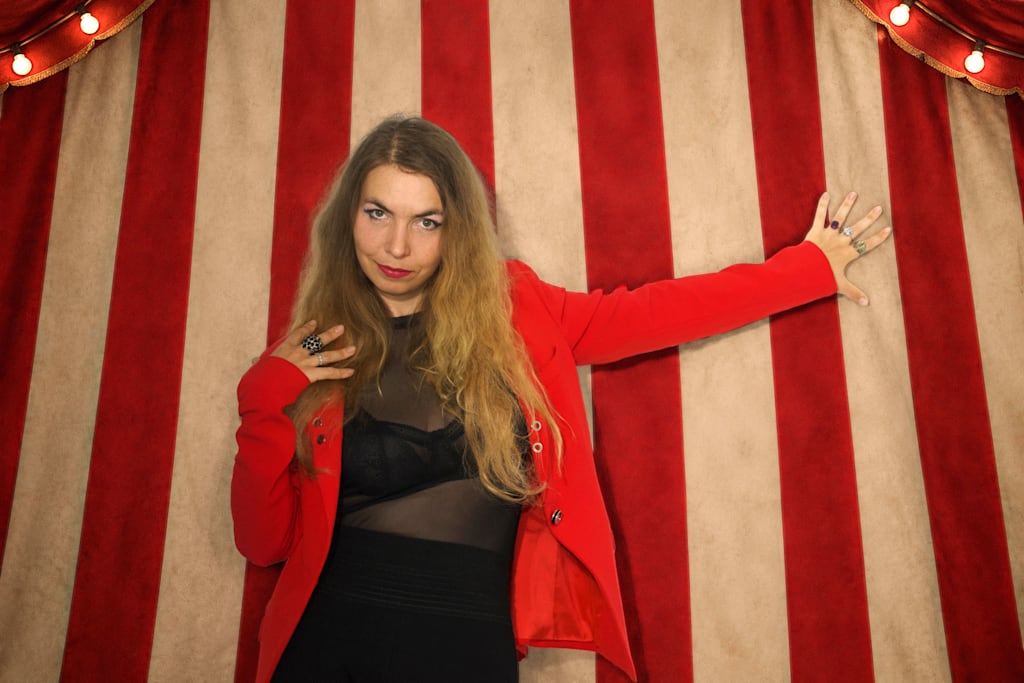
As a child prodigy who grew up to be a pianist, songwriter and film composer, Diana Ringo has the type of career that other artists dream about. Her eclectic career includes directing credits for the films 1984 and Quarantine, a photoshoot with Playboy Spain and master classes with David Lynch and Paul Verhoeven. However, music is still the center of her professional life--and whether she's writing piano compositions or recording darkwave records, her work is anything but boring. If you're ready to learn from the master, here's a glimpse into the life of a musician who does it all.
1. Your professional biography describes you as a pianist and composer. For people who aren't musically inclined (like me), what's the difference between a composer and a songwriter? When you're composing a song, what does the process look like from beginning to end?
I compose in a wide variety of genres, and I started out with instrumental music, so I can only call myself a songwriter in recent years, since I specifically started writing songs. Songwriter is also a vague term; some songwriters play instruments, while others don't. I play piano and keyboards. I take a composition from its first musical idea to its final form, crafting every note, every layer, and every detail of the arrangement.
When I make a song, I write the lyrics first, then experiment with the bassline and keys, trying different sounds. It's different with songs because you have to leave space for the vocals, whereas with instrumental pieces, you have to let the music “sing” by itself. I always try singing different lyrics until I feel there's actually something there, then I create new arrangements and swap things out. Sometimes, everything falls in place quickly, while other times, it requires reshuffling things.
I always have a clear feeling whenever a musical piece is truly finished. I work in Logic Pro X, as it's the only digital audio workstation (DAW) I've ever enjoyed working with. I don't want to spend more than one week working on a song because I don't want to get bored with the music, but sometimes I take a break and then return to a song if it isn't quite clicking immediately.
Composing solo piano pieces is different--I record many different improvisations and keep my favorite. I don't like fiddling with piano compositions; if I like something, I just play and record it and don't change it afterwards.
When composing any kind of music, it's important to transport yourself to another world, forget everything else, and simply explore and discover. It's not about being analytical. An analytical mindset has its place when you're putting on the finishing touches, but when you're composing, you need to enter a state of flow and follow whatever resonates with you on a deeper, more instinctive level.
Is there a note, a chord, a melody or anything else that catches your attention? Grab hold of it and follow where it takes you. Keep exploring until you find what you're looking for, even if you don't know exactly what that is at the beginning. If your goal is to create great music, you have to work at it regularly. It won't necessarily happen every time you sit down at the piano, but the more consistently you allow yourself to experiment, the more often you'll find yourself creating work you are truly proud of.
I have a full-size digital piano and a smaller 49-key keyboard. For songs, I prefer the smaller keyboard, since the music should stay simpler and I'm spending more time at the computer.
2. Besides the lyrics, how does your ability to speak four languages influence your music? Do you think it makes it easier to write from different perspectives or experiment with new genres? Would you be interested in learning more languages besides English, Russian, German and Finnish?
Yes, it influences my music; I enjoy the textures of different languages, as each language has its own character, and I absorb different influences. I love singing in different languages, and I feel that each language allows you to express different things.
In Russian, I find that you can use many more words in a song and give the lyrics a more poetic quality. There's also a certain melancholy inherent in the language that I really love. In English, on the other hand, I tend to keep things simpler, more laconic and ironic.
Each language has its own character, its own rhythm, and its own way of expressing emotions, and I enjoy exploring those differences in my music. I also love singing in French, so it would be a goal of mine to write something in French in the future and actually learn the language, too!
3. How did you get started as a pianist? When did you learn that you had a gift, and what kind of formal training have you received? Did you always know that you'd become a professional pianist and composer, or did you explore other career options before landing on music?
I started taking private piano lessons at the age of five, when my piano teacher found out that I had perfect pitch. It was immediately clear that I had a talent for music, as I learned difficult pieces quickly and progressed rapidly in my skills. Yes, I studied classical piano at conservatories in Helsinki and Vienna, but the most important training came from my private lessons during my childhood and early teenage years--this was formative for me. I played so many pieces by Chopin, Beethoven, Bach, and Liszt that they have become part of my DNA.
I didn't study composition anywhere, and I don't believe it's something you can necessarily be taught; what's important is to be well-versed in your instrument and have an open mind. I didn't immediately know I wanted to become a composer, but at around the age of sixteen, I realized that I liked composing, that it came easily to me, that it was interesting, and that there were endless possibilities, and I found it more exciting than just playing other people's pieces.
I also didn't want to write songs at that time; I wanted to explore instrumental music, so I knew I wanted to compose film scores. I also started watching more films around that time and was very inspired by older films, including those scored by Ennio Morricone. Yes, I always wanted to be a musician, so I’m happy that I can continue doing what I love.
4. It's interesting to me that even though we have modern-day movies with sound (as opposed to silent films with music playing over the action), most films still have a score that plays alongside the events on screen. What does music add to films that you can't get with dialogue alone? Do you think that movies without a score are lacking something?
Music can really get you into a character's mind, and it changes your perception of the events happening on screen. Changing just a few notes can make the scene completely different. I do think some movies can work without scores, and I have some favorites that don't feature any music, but I tend to prefer films with great, impressive scores that can truly inspire me. However, I don't often see new films with scores that truly connect with me, which only drives me more to create my own film scores. In a way, today's films seem wary of having memorable scores. I love soundtracks from the '60s, '70s, and '80s, and Ennio Morricone and Giorgio Moroder are my two favorite film composers.
5. What are your favorite piano pieces to play? On a similar note, what's your favorite composition out of all the pieces you've written? What makes that one special?
I’ve always loved Chopin’s Nocturne in C-sharp minor, Op. posth. Beethoven’s Moonlight Sonata, however, is another piece that holds a special place in my heart.
It has happened to me many, many times that I've written a composition that I believe to be the best, one that gives me the exact same euphoric feeling as my favorite music does, and sometimes I even forget to release some tracks I really love. It should always be the goal to try to top yourself.
Regarding my own pieces, I'd like to point out Piano Fantasia No. 1, which was one of the very first pieces I wrote, and which I later included in the soundtrack of my 2021 film Quarantine, starring the brilliant actor Anatoliy Bely--it was so unexpected and gratifying that this piece was broadcast on BBC Radio 3, and it was definitely proof to me that a teenager's dream can come true.
I’d also like to choose Requiem for Freedom from 1984. I was inspired by Mahler when I composed it, and I just love how it fits the scene in the picture. But I can't really say that I have a specific favorite piece.
6. When you're composing music for a film, what does the process look like from beginning to end? How do you craft a score that enhances the film without distracting the audience? What are some of your favorite techniques to use?
I always try many different options, exploring different moods, soundscapes, and textures. While I immediately started composing pieces I loved when I began learning to use a DAW, it took me some years to become truly comfortable with making orchestral music, and it's a never-ending learning experience. I prefer to compose more music rather than less and then see what works.
I don't like modifying my music to make it fit a scene; it's a bit like fitting a square peg in a round hole, so if something isn't working, I just try something different--I feel that if you start messing with music that's already good, you can ruin its magic. I don't usually use full tracks in films; I usually use snippets.
If something is distracting, it means it needs fixing, whether that involves using a different section of the track, changing the audio levels, or applying a low-pass filter. However, full tracks are always available on my original soundtrack albums. Sometimes it's truly mind-blowing to see how a piece of music fits a scene and suddenly comes fully alive, allowing you to somehow get inside the character's mind and see through their eyes.
7. In addition to film scores, you've also released two darkwave albums with a haunting, disturbing sound. What led you to the darkwave genre in particular? Do you think it contrasts with your other works, or is it more of a natural evolution?
It's just another chapter in my work, as I don't like repeating myself. I've always loved New Wave and post-punk songs, and I just realized I had some things I wanted to say and that it was time to experiment with vocals. Yes, it's a challenge, as I've realized that the workflow is different with songs than with instrumentals, since songs really need more space for vocals and can't be drowned out by the other sounds.
I like darkwave because I tend to be drawn towards darker, stranger music, and I like its experimental nature. I didn't specifically try to make this kind of music, but it just kept coming out of me, so I let it. Bland music irritates me, and it seems that the more producers are involved, the more insipid the music becomes. I like many genres, though, including electropop, and I'm open to trying different things in the future.
8. As a singer, how do you achieve the unsettling vocals that appear throughout your darkwave records? Did you get into a specific mindset during the recording process? What kind of message do you want to convey, especially with your latest release, Clowns in America?
I find it easy to be unsettling, haha. I do get into a specific mindset, and I try to imagine different characters, with the weirder the result, the better. I'm just having fun and trying to entertain myself.
With my album Clowns in America, I wanted to explore dystopian and sci-fi narratives alongside social commentary on modern life, and the circus seemed like an apt metaphor for political craziness that helped bring the whole concept together, with the eerie and the funny just merging.
I've always been drawn to sci-fi narratives because they speak to modernity, and now, when I read that the USA is broadcasting public executions, I feel that 1984 is coming to life more and more--the classic George Orwell novel that I adapted into a film in 2023.
9. How do you practice and take care of your voice in general? On another note, who are your biggest inspirations? Do you have any dream collaborations?
I just try not to overexert myself, listen to my body, take breaks and relax when recording. I have a lot of artists who inspire me, including Depeche Mode, David Bowie, Kate Bush, Siouxsie and the Banshees, Sisters of Mercy, Gary Numan, Dead or Alive, Killing Joke, Soft Cell, Nico, Hole, Marlene Dietrich...
I mostly listen to music from the 1980s, but I also have some favorites I've continued to return to since my childhood in the 2000s, when I really started discovering pop music. Slayyyter is my favorite contemporary artist--I love her genre-mixing and unique sound, so I guess she would be my pick for a dream collaboration.
Now that you've taken a peek behind the scenes, you can support Diana Ringo by checking out her website, buying her music on Bandcamp, following her on Instagram, Twitter, Facebook, VK and YouTube, and streaming her albums on Spotify, Apple Music, Amazon Music, YouTube Music and Qobuz.
About the Creator
Kaitlin Shanks
Music journalist. To support my work, please send a tip (even $1 helps!) or shop from my Amazon storefront.
Last Living Girl (novel) • Instagram • TikTok • YouTube • Substack • Medium • Wattpad • Spotify Playlists • Linktree
Enjoyed the story? Support the Creator.
Subscribe for free to receive all their stories in your feed.
Comments
There are no comments for this story
Be the first to respond and start the conversation.