
Brooks John Martin’s ‘Do’ is Happiness at the Edge of Reason
A surreal, shape shifting song about manic highs, emotional chaos and finding something wonderfully joyful in the absurd.

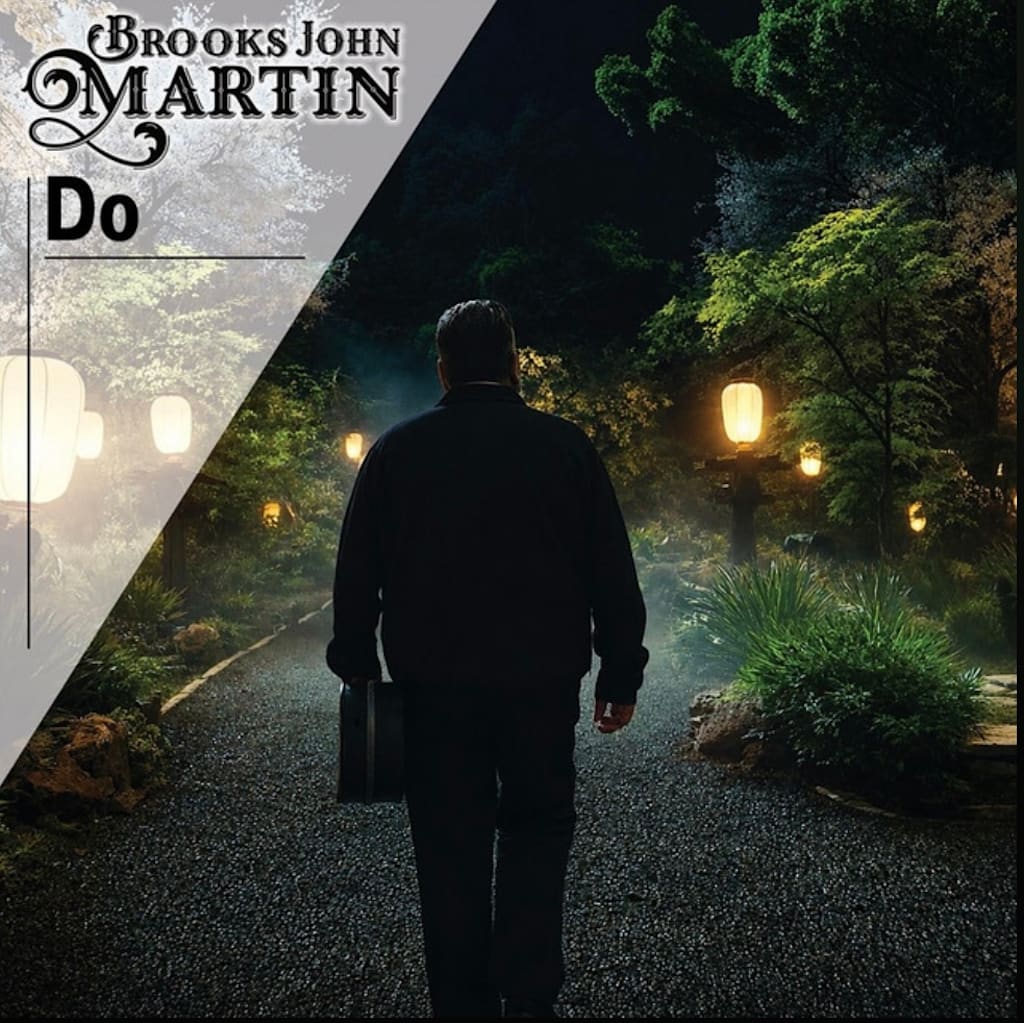
I love the fact that Brooks John Martin has taken a subject that could so easily have resulted in a very serious song and decided, quite rightly, that perhaps what it really needed was a bit of fun. There is plenty of weight behind ‘Do’, the first single from his forthcoming album War All The Time, but Martin seems determined not to let that weight pin the song to the floor. Instead, it bounces, twists, accelerates and occasionally appears to wander off in search of something shiny. And that, I suspect, is rather the point.
Martin describes ‘Do’ as “non-linear Lewis Carroll nonsense”, which is both an excellent description and a pretty useful warning label. This is not a song that has much interest in getting from A to B via the conventional route. Thoughts tumble into other thoughts, moods collide, impressions appear from seemingly nowhere and the whole thing has the slightly breathless quality of being inside somebody's head. It shouldn't necessarily make sense in a traditional narrative sense. It makes emotional sense instead. Which is considerably more interesting.
There is also something rather wonderful about Martin calling it perhaps the happiest song ever written about a manic arc. Because it really is remarkably buoyant considering what is going on underneath. You can hear the exhilaration, the heightened energy, the sense of possibility and movement but you can also hear the instability lurking around the edges. It isn't happiness with the corners sanded off; it is happiness with the volume turned up a little too far. And that tension gives the song its personality.
Martin has always had a knack for writing in sensations rather than straight lines, favouring mood, imagery and emotional association over the sort of beginning-middle-end storytelling that makes music journalists reach for words like “narrative arc” and immediately regret their career choices. ‘Do’ takes that instinct and lets it run wild.
Then there is that voice. Martin’s dreamy baritone brings a romantic, cinematic quality to the proceedings with echoes of post-punk, new wave and Brit-pop in there too for good measure. Put that against the crunchier alternative rock textures that have characterised some of his earlier work and you have an appealing combination of grit and dreaminess, as though someone has thrown a rather elegant lounge singer into the middle of a garage-rock rehearsal and nobody has had the heart to ask him to leave.
The video, meanwhile, decides that reality is probably overrated anyway. Entirely AI-generated and set against a stylised version of 1960s Japan, it takes the song's nonlinear thinking and gives it a visual home. Colour, artificiality, surreal imagery and dream logic all get thrown into the same pot, and rather than attempting to make the technology invisible, Martin seems to be enjoying precisely what it can do when you stop asking it to behave like reality.
And then we get Tom Jones. Specifically, Martin dancing like Tom Jones. At his own request. In his own video. For an extended final sequence.
Honestly, what more could you want?
It is the sort of gloriously daft decision that tells you quite a lot about the artist. The subject matter might be complicated, and the emotional territory might be difficult but Martin clearly understands that absurdity doesn't invalidate seriousness. Sometimes the ridiculous bit is the honest bit. Sometimes the best way to communicate an emotional state is to stop trying to make it respectable.
“Honest, even the absurd parts. Especially the absurd parts,” Martin says, and there is probably the manifesto for ‘Do’ right there.
Musically, it is an interesting first taste of War All The Time because the album title sounds like it ought to come accompanied by grey skies, trench warfare and somebody staring meaningfully through a rain-streaked window. Instead, Martin gives us surreal Japan, manic euphoria and a Tom Jones impression. Good. Much more interesting.
‘Do’ is funny, strange, energetic and emotionally complicated, sometimes all within the same breath. It doesn't tidy up the contradictions at its centre. If this is our first glimpse of War All The Time, then Brooks John Martin has certainly chosen an interesting way of opening the door: come on in, leave conventional songwriting at the entrance, and whatever you do, don't expect the furniture to stay where you left it.
Follow John Brooks Martin on his Website
About the Creator
Whitney Miller
🌎 Adventurous & Musical
Stories shaped by places, music & life
Poetry, fiction, memoir & lived experience
Written without A.I.
© Whitney Miller
Enjoyed the story? Support the Creator.
Subscribe for free to receive all their stories in your feed.
Comments
There are no comments for this story
Be the first to respond and start the conversation.