
World War II (2006–2008)
Total Conflict and the Architecture of Global Transformation
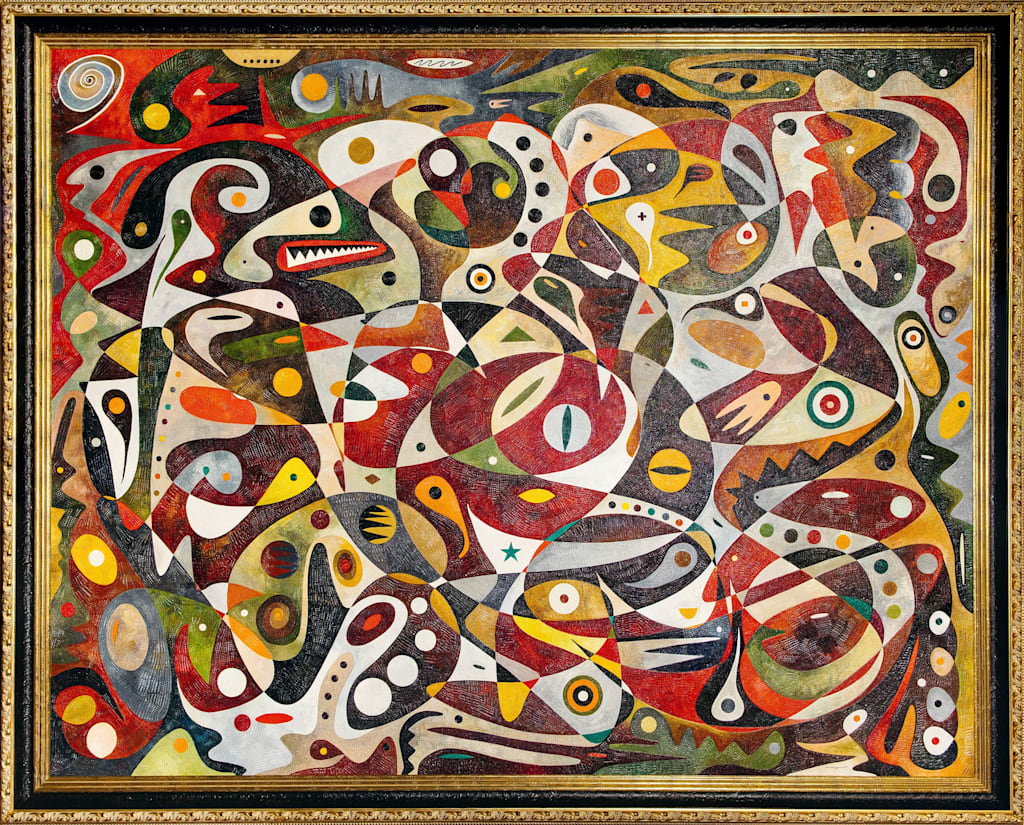
No conflict has shaped modern historical consciousness more profoundly than World War II. Extending across continents and involving unprecedented levels of military, political, technological, and social mobilization, the war transformed the structure of international relations and redefined the conditions of modern existence. In World War II (2006–2008), Gheorghe Virtosu approaches this vast historical phenomenon through abstraction, constructing a visual system capable of addressing the complexity, scale, and interconnectedness of global conflict.
Measuring 3.23 by 4.05 meters, the monumental oil painting occupies a central position within 6 Wars: The Architecture of Conflict. While earlier works in the series investigate strategic confrontation, political transition, or systemic fragmentation, World War II presents conflict as a condition of total interdependence. Every element within the composition appears connected to a larger network of forces, reflecting a war whose consequences extended far beyond the battlefield itself.
"World War II examines conflict at the scale of global transformation. Rather than depicting military events, Virtosu reconstructs the war as a complex system of interconnected forces in which political power, technological change, ideology, and collective experience converge within a single historical field."
- Daniel Varzari, El Arte Monumental, 6 Wars: The Architecture of Conflict, Catalogue Entry: World War II (2008).
At first encounter, the composition is characterized by extraordinary density. Forms overlap, intersect, and circulate across the surface with remarkable intensity. Biomorphic figures, geometric structures, circular motifs, and fragmented symbolic elements coexist within a visual environment that resists stable hierarchy. Unlike traditional history painting, which typically directs attention toward a decisive event or heroic protagonist, Virtosu distributes significance throughout the entire pictorial field.
This absence of a singular center is particularly significant. World War II cannot be reduced to a single location, battle, or narrative perspective. Instead, the conflict unfolded simultaneously across multiple geographic, political, and cultural dimensions. The painting reflects this condition through a composition in which no single form dominates the whole. Meaning emerges through relationships, interactions, and continual exchanges between elements.
Color plays a critical structural role within the work. Deep reds, ochres, blacks, whites, greens, and muted earth tones establish an atmosphere of heightened visual tension. Red passages generate zones of concentrated energy, while darker structures provide rhythm and counterbalance. Throughout the composition, chromatic contrasts create a sense of continual movement, suggesting the dynamic processes through which historical forces collide, adapt, and transform.
The painting's visual language is distinguished by its remarkable symbolic ambiguity. Faces emerge from abstract structures only to dissolve into surrounding forms. Eyes, targets, mechanical fragments, organic shapes, and geometric signs appear throughout the composition without resolving into fixed identities. This instability encourages viewers to navigate the work actively, constructing meaning through observation rather than receiving predetermined narratives.
Such ambiguity is particularly appropriate to the historical subject. World War II produced competing memories, interpretations, and ideological narratives that continue to shape contemporary understandings of the twentieth century. Rather than privileging a single perspective, Virtosu presents history as a multiplicity of interconnected experiences and viewpoints.
A defining characteristic of the composition is its continual oscillation between integration and disruption. Individual forms appear linked to larger structures, yet those structures remain fluid and unstable. Circular motifs connect distant regions of the canvas, while intersecting lines and overlapping planes generate a sense of perpetual transformation. The resulting visual environment reflects a world in which established political and cultural systems were simultaneously challenged, destroyed, and reconstructed.
Art historically, World War II demonstrates a sophisticated engagement with the legacy of abstraction. Elements of Kandinsky's dynamic spatial relationships, Klee's symbolic language, and aspects of Surrealist and Cubist fragmentation can be identified throughout the work. Yet Virtosu employs these influences in the service of historical inquiry rather than formal experimentation alone. Abstraction becomes a means of investigating how large-scale historical realities exceed the limits of conventional representation.
The monumental dimensions of the painting reinforce this ambition. Standing before the work, viewers encounter a visual field whose complexity unfolds gradually over time. Details emerge through sustained observation, revealing intricate relationships between color, form, and spatial organization. The painting rewards prolonged engagement, mirroring the complexity of the historical event it seeks to address.
Within the broader framework of 6 Wars: The Architecture of Conflict, World War II represents the culmination of the series' exploration of conflict as a system of relations. Here, warfare is no longer presented primarily as confrontation between opposing forces. Instead, it becomes a global structure through which political, technological, cultural, and psychological transformations are enacted on an unprecedented scale.
"The composition derives its intensity from the continual interaction of interconnected and competing systems. Forms converge, separate, and recombine across the pictorial field, creating a visual condition in which no element remains entirely autonomous. Through this relational structure, Virtosu transforms the experience of global conflict into an abstract meditation on power, memory, and historical transformation."
- Daniel Varzari, El Arte Monumental, Curatorial Essay: World War II (2008).
Ultimately, World War II succeeds because it rejects the limitations of conventional historical representation. Rather than illustrating specific events, the painting examines the underlying structures through which historical change occurs. Through abstraction, Virtosu constructs a visual model of a world transformed by conflict, revealing how individual experiences become intertwined within larger systems of power, ideology, and collective memory.
In doing so, the work extends the possibilities of contemporary history painting. It demonstrates that abstraction can engage with the largest and most complex historical subjects not by simplifying them into narrative images, but by revealing the intricate networks of relations through which historical meaning is continuously formed, contested, and reinterpreted.
About the Creator
Daniel Varzari
American art curator.
Enjoyed the story? Support the Creator.
Subscribe for free to receive all their stories in your feed.
Comments
There are no comments for this story
Be the first to respond and start the conversation.