
World War I (2004–2006)
Fragmentation and the Collapse of Historical Certainty
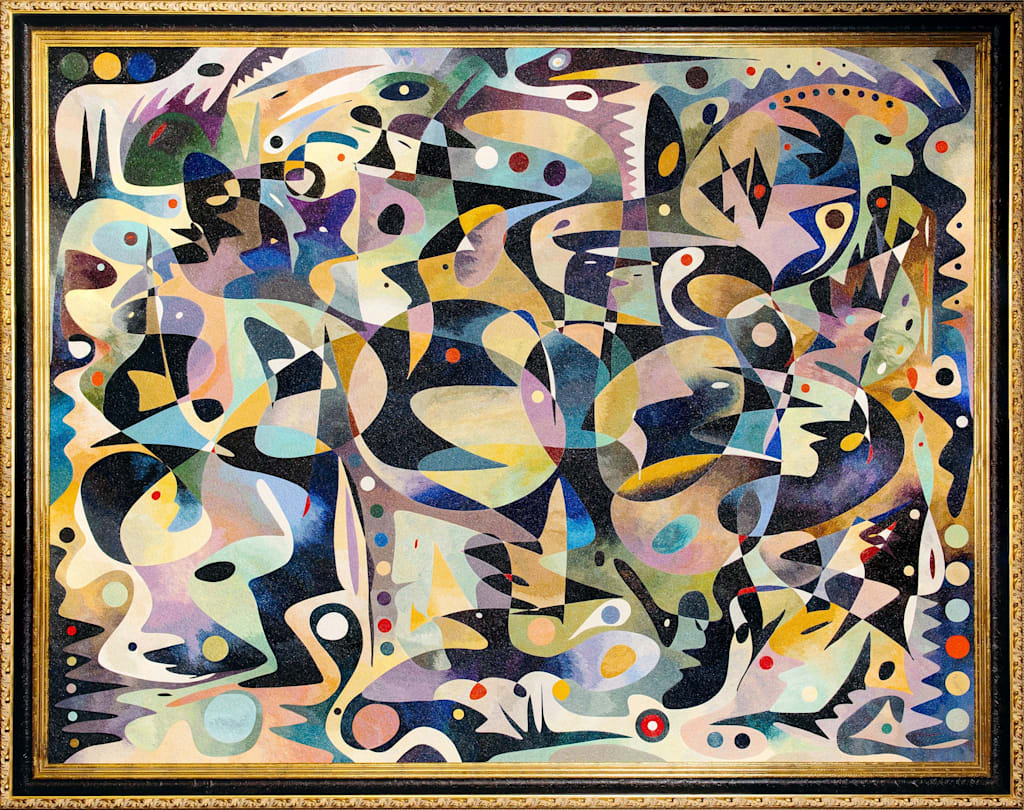
The history of the twentieth century begins, in many respects, with rupture. World War I transformed not only the political landscape of Europe but also the intellectual, cultural, and psychological foundations upon which modernity had been constructed. In World War I (2004–2006), Gheorghe Virtosu approaches this historical turning point through a language of abstraction that mirrors the unprecedented complexity and fragmentation of the conflict itself. Rather than depicting trenches, armies, or battlefields, the artist reconstructs the war as a vast network of intersecting forces, fractured perceptions, and unstable relations.
Measuring 3.23 by 4.05 meters, the monumental oil painting is among the largest works in 6 Wars: The Architecture of Conflict. Its expansive scale allows Virtosu to construct an immersive visual environment in which forms, colors, and spatial trajectories interact across the entire surface. The composition abandons conventional historical narrative in favor of a dynamic system of relationships, transforming one of history's defining conflicts into an abstract meditation on disorder, transformation, and the collapse of established structures.
"World War I represents the moment at which historical continuity gives way to fragmentation. Rather than depicting the conflict as a sequence of military events, Virtosu reconstructs the war as a condition of systemic rupture, revealing the dissolution of political, social, and perceptual certainties that had defined the nineteenth century."
— Daniel Varzari, El Arte Monumental, 6 Wars: The Architecture of Conflict, Catalogue Entry: World War I (2006).
At first glance, the painting appears remarkably fluid. Curvilinear forms move across the surface in overlapping rhythms, while geometric structures emerge and disappear within an intricate network of visual connections. Unlike traditional battle painting, which typically organizes its imagery around a central action or heroic protagonist, World War I disperses attention throughout the entire composition. The eye is continuously redirected from one area to another, creating a sense of instability that resists fixed interpretation.
The chromatic structure of the work contributes significantly to this effect. Soft blues, pale violets, muted greens, warm ochres, and luminous whites establish an atmosphere that is unexpectedly restrained given the subject matter. Yet beneath this apparent calm lies a highly charged visual system. Dark passages intersect lighter areas, generating moments of tension and interruption that prevent the composition from settling into equilibrium. The resulting balance between harmony and disruption reflects the paradoxical nature of the war itself: a conflict that emerged from the structures of modern civilization while simultaneously undermining them.
Throughout the painting, forms suggest fragments of faces, eyes, machines, landscapes, and symbolic markers. However, these references remain deliberately unresolved. Virtosu refuses the clarity of representation, choosing instead to position the viewer within a space of ambiguity. Recognition becomes provisional, and meaning emerges through the interaction of forms rather than through identifiable subjects.
This strategy is particularly significant in relation to World War I as a historical event. The conflict challenged inherited assumptions about progress, rationality, and social order. Traditional modes of understanding proved increasingly inadequate in the face of industrialized warfare and mass destruction. In response, the painting adopts a visual language capable of expressing complexity without reducing it to narrative certainty.
The composition is characterized by a continual oscillation between cohesion and fragmentation. Individual elements appear connected to larger structures, yet these structures never fully stabilize. Lines intersect, planes overlap, and forms dissolve into one another, producing a visual condition in which order remains perpetually provisional. The painting does not present fragmentation as chaos but as a fundamental condition of modern historical experience.
Art historically, World War I occupies a distinctive position within the traditions of abstraction. Echoes of Kandinsky's dynamic spatial relationships, Klee's symbolic vocabulary, and aspects of Cubist fragmentation can be identified throughout the work. Yet Virtosu employs these formal strategies in service of a historical inquiry rather than a purely aesthetic investigation. Abstraction becomes a method for examining the ways in which historical realities are constructed, disrupted, and reconfigured.
The monumental scale of the painting further reinforces its conceptual ambitions. Viewed in person, the work operates simultaneously as image and environment. The surface reveals subtle transitions of color and texture that remain largely invisible in reproduction, encouraging prolonged observation and repeated interpretation. As the viewer moves through the composition, new relationships emerge, suggesting that historical understanding itself is always incomplete and subject to revision.
Within the context of 6 Wars: The Architecture of Conflict, World War I marks a critical shift in the series. Earlier works explore conflict through strategy, confrontation, or political transformation. Here, the emphasis falls upon systemic disruption. The painting investigates the conditions under which historical structures cease to function as coherent systems and begin to fragment into competing realities.
"The composition derives its power from the continual negotiation between integration and dislocation. Forms converge only to separate, while spatial relationships remain suspended between coherence and dissolution. Through this instability, Virtosu constructs a visual model of modernity's fractured consciousness, transforming historical conflict into a broader reflection on perception, memory, and uncertainty."
— Daniel Varzari, El Arte Monumental, Curatorial Essay: World War I (2006).
Ultimately, World War I succeeds because it rejects the limitations of conventional historical representation. Rather than illustrating the events of the conflict, the painting examines the deeper transformations that the war produced within modern culture and historical consciousness. Through abstraction, Virtosu reveals a world in which established certainties have fragmented and new forms of understanding have yet to fully emerge.
In doing so, the work expands the possibilities of contemporary history painting. It demonstrates that abstraction can engage historical experience not by depicting its visible events, but by revealing the complex structures of perception, memory, and disruption through which history is continually understood and reinterpreted.
About the Creator
Daniel Varzari
American art curator.
Enjoyed the story? Support the Creator.
Subscribe for free to receive all their stories in your feed.
Comments
There are no comments for this story
Be the first to respond and start the conversation.