
Why All the naked people?!!!
A case for artistic nudity

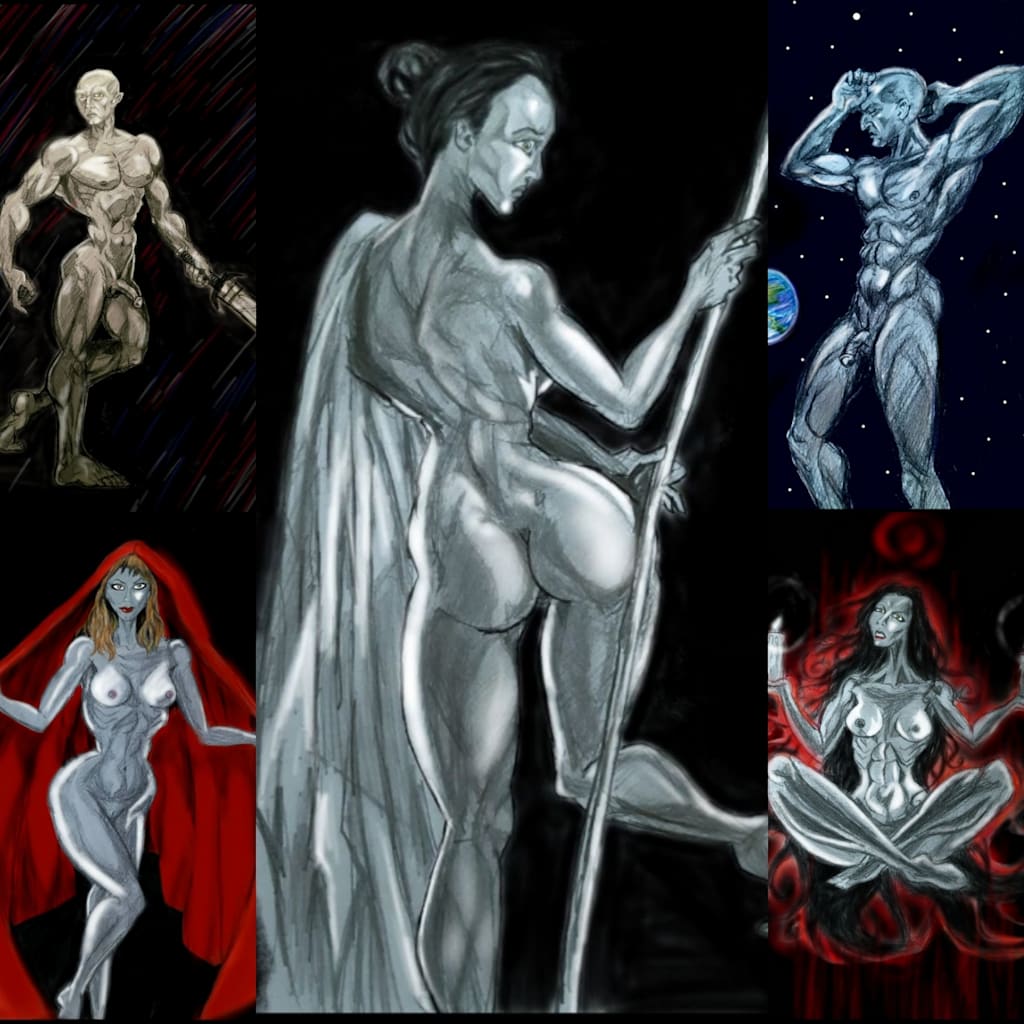
“Why all the naked people!?”
You would be surprised how many times people have screamed this question at me when looking through my art portfolio.
My usual response is to end the conversation by calling them uncultured philistines.
No.
No, I don't.
But I'm definitely thinking it. 😂
And to be fair, I understand that not everybody is comfortable with nude artwork. Art is subjective. People have different cultural backgrounds, personal boundaries, religious beliefs, and opinions about what they consider appropriate.
That's perfectly fine.
What I find amusing, however, is when someone looks at a portfolio containing nude figure drawings and immediately assumes the artist must have some kind of strange obsession with naked people.
Because apparently, after thousands of years of artistic history, somebody finally discovered the human body and thought, “Well, I guess I'll be the first person to draw one.”
Except...
We have been doing this for a very, very long time.
And there are actually some pretty good reasons for it.
The Human Body Is One Hell of a Drawing Subject
Let's start with the obvious.
The human body is complicated.
Really complicated.
It has bones, muscles, joints, curves, planes, tendons, folds, asymmetry, and an almost ridiculous number of subtle variations from one person to another.
And unlike a coffee mug, the human body moves.
It bends.
It twists.
It stretches.
It slouches.
It shifts its weight.
It changes depending on whether someone is relaxed, tense, tired, angry, confident, frightened, or simply trying not to fall over because they've been standing in the same position for twenty minutes.
That's what makes it such a valuable subject for an artist.
When you study the nude figure, you aren't simply learning how to draw a naked person.
You're learning how the human body works.
Clothing can obscure a tremendous amount of that information. Clothes tell you something about a person, but they don't necessarily tell you what's happening underneath them.
An artist needs to understand where the shoulder actually connects to the torso, how the rib cage affects the position of the arms, how the pelvis tilts, how the spine curves, and how the body changes when someone shifts their weight onto one leg.
That knowledge becomes useful everywhere.
Portraits.
Comics.
Animation.
Fantasy art.
Superheroes.
Horror.
Character design.
Even abstract artwork.
You can't convincingly exaggerate or distort the human form if you don't understand the form you're distorting in the first place.
1. Figure Drawing Trains the Eye
One of the greatest benefits of drawing the human figure is that it teaches an artist to actually see.
Not just look.
See.
There's a difference.
Most people look at a person and see a person.
An artist starts seeing shapes, angles, proportions, negative spaces, light, shadow, weight distribution, perspective, and relationships between forms.
You start noticing things that you previously ignored.
The slight curve of a spine.
The way one shoulder sits lower than the other.
The way someone's weight shifts onto a particular leg.
The way light travels across the rib cage.
The subtle shadow beneath the chin.
The way muscles become visible—or disappear—depending on posture.
Figure drawing forces your brain to process all of that information simultaneously.
Your eye observes it.
Your brain interprets it.
Your hand attempts to translate it.
And eventually, that relationship becomes almost instinctive.
It's visual muscle memory.
And that skill doesn't disappear when you stop drawing naked people.
It follows you into everything else you create.
2. The Nude Figure Isn't Just Anatomy
Here's where things get more interesting.
The human figure isn't merely a collection of bones and muscles.
It's expressive.
A person's posture can communicate an entire emotional state without a single word.
A hunched figure can look defeated.
A straightened spine can communicate confidence.
A curled body can suggest fear or vulnerability.
An open posture can communicate freedom.
A tense body can communicate anger.
A relaxed body can communicate peace.
The artist doesn't necessarily have to tell the viewer what they're supposed to feel.
The body can do the talking.
That's one of the reasons the nude figure has remained such a powerful artistic subject throughout history.
Removing clothing can sometimes remove distractions and allow the viewer to focus entirely on the physical and emotional presence of the figure.
And yes, that can make the image feel vulnerable.
That's kind of the point.
3. Vulnerability Is Not the Same Thing as Sexuality
This is probably one of the biggest misconceptions surrounding nude artwork.
People sometimes assume that if a person is naked, the artwork must automatically be sexual.
But nudity and sexuality are not synonymous.
A medical textbook can contain a nude human body.
A classical sculpture can depict a nude figure.
A life-drawing exercise can contain a nude figure.
A painting can explore aging, mortality, vulnerability, grief, power, identity, or spirituality using the human body.
None of those things automatically make the artwork erotic.
Sometimes a nude figure is simply...
A human being.
Naked.
That's it.
We've all been naked.
Every single one of us entered this world without clothes.
Nobody arrived wearing pants.
Nobody was born carrying a handbag and complaining about the price of groceries.
We were all just tiny, screaming, naked humans.
And somehow we've spent thousands of years trying to convince ourselves that the human body is inherently scandalous.
That's an interesting contradiction.
4. The Human Figure Connects Us to Art History
If you're offended by nude artwork, I have some bad news for you.
You're going to have a rough time getting through art history.
The human figure has been an enormous part of artistic tradition for thousands of years.
Ancient Greek and Roman sculpture.
Renaissance painting.
Michelangelo.
Leonardo.
Classical academic drawing.
Modernism.
Expressionism.
Surrealism.
Contemporary art.
Artists have repeatedly returned to the human body because it gives them an almost limitless way to explore what it means to be human.
Beauty.
Mortality.
Strength.
Weakness.
Desire.
Fear.
Identity.
Religion.
Power.
Aging.
Vulnerability.
The body has been used to explore all of these things.
And that's important because artists don't create in a vacuum.
Every artist is standing somewhere in the enormous timeline of artistic history.
We learn from what came before us.
Then we reinterpret it.
Then we screw with it.
Then somebody else comes along and says, “What the hell is that?”
And that's how art evolves.
5. The Nude Figure Helps Artists Break the Rules
There is another reason I love studying the human figure.
Once you understand the rules, you can start breaking them.
Want to exaggerate the proportions?
Go ahead.
Want to make the limbs impossibly long?
Sure.
Want to distort the torso?
Absolutely.
Want to turn a human being into some horrifying creature from another dimension?
Please.
That's where anatomical knowledge becomes incredibly valuable.
If you understand how the body is constructed, you can manipulate it intentionally.
You can make a character look powerful by exaggerating the shoulders.
You can make a creature look disturbing by subtly shifting proportions.
You can make a figure appear fragile by altering posture and silhouette.
You can turn the familiar into something completely unfamiliar.
And honestly, that's one of my favorite things about art.
You learn reality so you can eventually make reality weird.
6. Drawing From Life Is Different
We also live in an age where almost everything visual is mediated through technology.
Photographs.
Screens.
Digital references.
Videos.
AI.
Social media.
Everything is available instantly.
And don't get me wrong—I use digital tools too.
Technology is an incredible resource for artists.
But drawing from a living person is still a completely different experience.
The model is physically there.
The light is physically there.
The room is physically there.
The body occupies actual space.
You have to observe it rather than simply zooming in on a photograph.
You have to make decisions.
You have to interpret.
You have to simplify.
You have to figure out what matters and what doesn't.
And sometimes the model moves.
Because, you know...
They're human.
Not a statue.
Not a Photoshop layer.
Not a 3D asset.
A person.
That physical presence changes the entire experience.
7. It Reminds Us That Bodies Are Human
Perhaps this is the most important reason of all.
We spend an enormous amount of time being taught to think about bodies as things to judge.
Too fat.
Too thin.
Too old.
Too young.
Too muscular.
Not muscular enough.
Too tall.
Too short.
Too many wrinkles.
Not enough wrinkles.
Society has somehow managed to turn having a human body into a competitive sport.
Figure drawing can challenge that.
When you're studying the human figure as an artist, you're not necessarily asking whether the body is perfect.
You're asking:
How does it exist in space?
How does it move?
How does light interact with it?
What does its posture communicate?
What makes this particular person unique?
Suddenly the body isn't something to judge.
It's something to understand.
And that's a very different way of looking at another human being.
So... Why All the Naked People?
Because they're not just naked people.
They're anatomy.
They're movement.
They're light and shadow.
They're proportion.
They're vulnerability.
They're strength.
They're history.
They're symbolism.
They're emotion.
They're identity.
They're humanity.
And sometimes...
They're just really interesting to draw.
The human figure gives artists an almost endless subject because human beings themselves are endlessly complicated.
So the next time somebody looks through my portfolio and screams, “Why all the naked people!?”, I could give them the polite artistic explanation.
I could talk about anatomy.
I could talk about observational skills.
I could talk about artistic tradition.
I could talk about symbolism.
I could talk about emotional expression.
I could talk about the importance of understanding physical form.
I could explain all of it.
And I probably will.
Because educating people is better than simply telling them they're uncultured philistines.
Although...
I reserve the right to think it. 😂
And if I've already explained all of this and someone still believes that the mere presence of a naked human body automatically makes artwork inappropriate?
Well...
Perhaps they should seek therapy.
I'm an artist, not a miracle worker.
About the Creator
mark bradley (mark45xxx)
I'm a published Comic Book Creator & freelance illustrator specializing in dark,surreal, & cinematic artwork. I help authors, indie creators, and collectors, bring intense ideas to life
Enjoyed the story? Support the Creator.
Subscribe for free to receive all their stories in your feed.
Comments
There are no comments for this story
Be the first to respond and start the conversation.