
Ukraine War (2022–2025)
Conflict, Memory, and the Architecture of Uncertainty
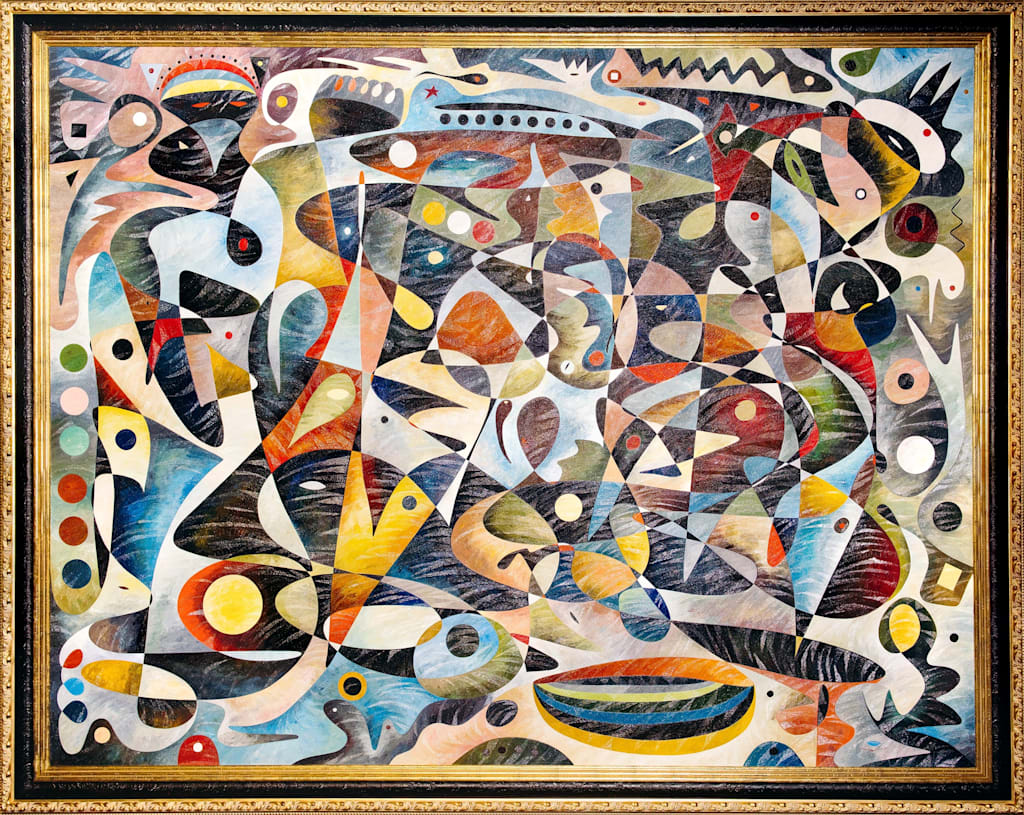
Contemporary conflicts present a challenge distinct from those of the past. Unlike historical wars that have been absorbed into collective memory and historical narrative, ongoing conflicts remain unresolved, their meanings continually shaped by unfolding events, competing perspectives, and evolving political realities. In Ukraine War (2022–2025), Gheorghe Virtosu confronts this condition directly, transforming a contemporary conflict into a monumental abstract composition that examines not only warfare itself but also the instability of historical understanding in the present moment.
Measuring 3.23 by 4.03 meters, the oil painting stands as the culminating work in 6 Wars: The Architecture of Conflict. While earlier paintings in the series revisit conflicts that have already entered historical consciousness, Ukraine War occupies a different temporal position. It addresses a conflict whose consequences remain active and whose interpretation continues to evolve. Rather than documenting events, Virtosu constructs a visual field through which uncertainty, displacement, resilience, and transformation become perceptible.
"Ukraine War examines conflict not as a concluded historical episode but as an unfolding condition. Through abstraction, Virtosu constructs a visual architecture in which uncertainty, resistance, memory, and transformation coexist, revealing the instability through which contemporary history is experienced and understood."
— Daniel Varzari, El Arte Monumental, 6 Wars: The Architecture of Conflict, Catalogue Entry: Ukraine War (2025).
At first encounter, the painting presents a highly complex network of intersecting forms, fragmented structures, and shifting spatial relationships. Geometric planes overlap with fluid biomorphic elements, while circular motifs, linear trajectories, and symbolic fragments emerge throughout the composition. Unlike traditional history painting, which often seeks to establish narrative clarity, Ukraine War resists singular interpretation. The viewer is invited into a dynamic environment in which meaning remains provisional and continuously negotiated.
The composition is distinguished by its remarkable balance between movement and instability. Large curvilinear structures create pathways that guide the eye across the canvas, while abrupt interruptions and fragmented forms disrupt any sense of permanent order. This tension between continuity and disruption mirrors the broader conditions of contemporary conflict, where political, social, and cultural realities are subject to constant reconfiguration.
Color assumes a particularly significant role within the work. Deep blues, luminous whites, ochres, reds, blacks, and muted earth tones interact across the surface to produce a rich chromatic environment. Rather than functioning descriptively, color operates structurally, organizing the composition into zones of concentration and dispersion. Areas of brightness create moments of visual openness, while darker passages generate tension and directional force. The result is a composition that feels simultaneously expansive and compressed, stable and unsettled.
Throughout the painting, forms suggest faces, eyes, architectural fragments, landscapes, pathways, and symbolic markers. Yet these references never fully resolve into fixed identities. Virtosu employs ambiguity as a central artistic strategy, positioning viewers between recognition and uncertainty. The painting refuses illustrative certainty in favor of a more complex mode of engagement, where interpretation emerges through relationships rather than representation.
This ambiguity reflects the nature of contemporary historical experience itself. Unlike conflicts understood through the distance of hindsight, contemporary wars are experienced through fragmented information, competing narratives, and continually shifting realities. The painting acknowledges this condition by constructing a visual language that remains open, provisional, and resistant to definitive interpretation.
The monumental scale of the work reinforces its conceptual ambitions. Standing before the painting, viewers encounter an immersive environment rather than a fixed image. The surface reveals an intricate interplay of color, texture, and form that unfolds gradually through sustained observation. Relationships that initially appear stable reveal unexpected complexities, while seemingly isolated elements become integrated into larger structures of meaning.
Within the broader context of 6 Wars: The Architecture of Conflict, Ukraine War represents a significant evolution in Virtosu's investigation of historical conflict. Earlier works in the series explore confrontation, political transformation, fragmentation, and global interdependence. Here, these themes converge within a composition that addresses the uncertainty of the present. The painting is concerned not only with warfare but with the conditions through which contemporary events are perceived, remembered, and interpreted.
"The composition derives its power from the continual interaction between structure and instability. Forms emerge, intersect, fragment, and reconnect across the pictorial field, creating a visual condition in which certainty remains perpetually deferred. Through this dynamic, Virtosu transforms contemporary conflict into a broader meditation on perception, resilience, and the formation of historical memory."
— Daniel Varzari, El Arte Monumental, Curatorial Essay: Ukraine War (2025).
Ultimately, Ukraine War succeeds because it avoids the limitations of documentary representation. Rather than illustrating specific events, the painting investigates the deeper structures through which contemporary conflict enters collective consciousness. Through abstraction, Virtosu constructs a visual model of a world shaped by uncertainty, adaptation, and continual transformation.
In doing so, the work extends the possibilities of contemporary history painting into the present tense. It demonstrates that abstraction can engage ongoing historical realities not by providing answers, but by revealing the complex networks of perception, memory, and experience through which history itself remains in the process of becoming.
About the Creator
Daniel Varzari
American art curator.
Enjoyed the story? Support the Creator.
Subscribe for free to receive all their stories in your feed.
Comments
There are no comments for this story
Be the first to respond and start the conversation.