
The Source of Life (2007)
Emergence, Renewal, and the Architecture of Becoming
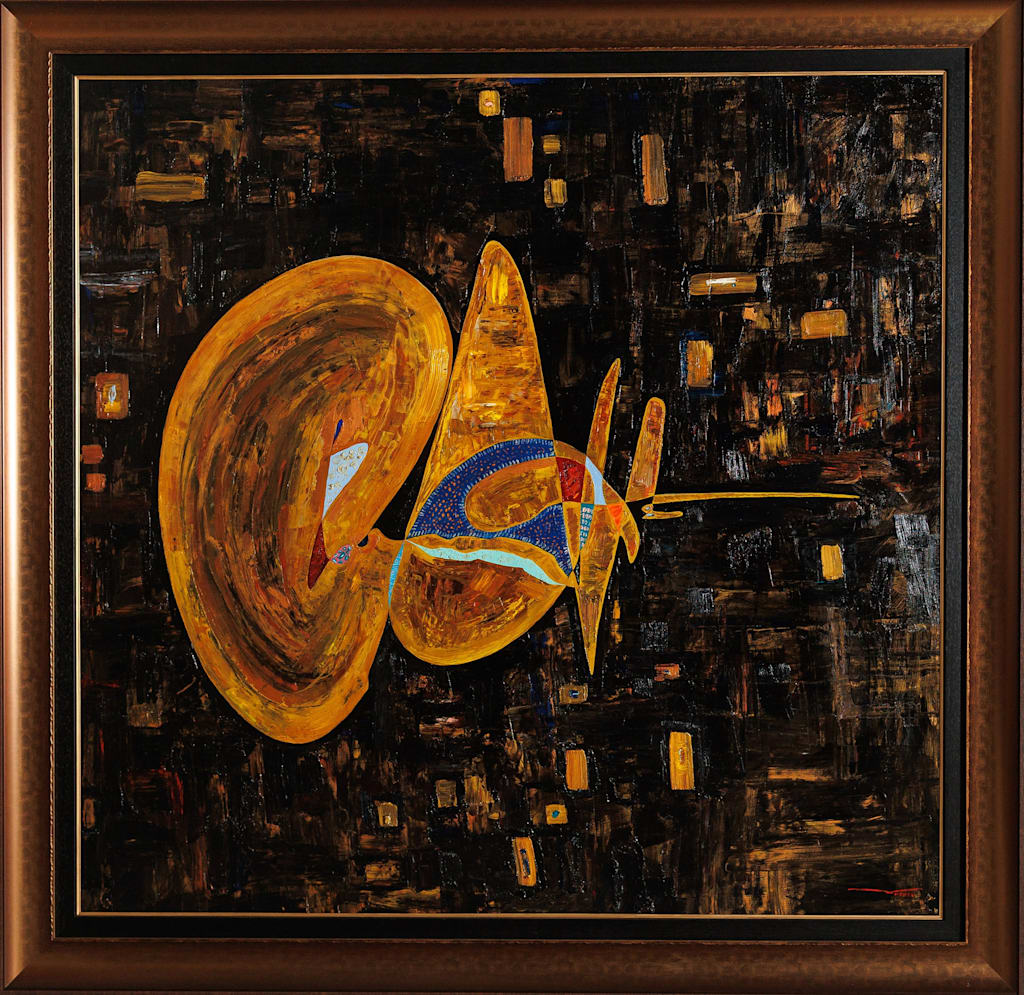
The question of origin has occupied philosophy, science, religion, and art throughout human history. Yet while many representations of creation seek to depict a singular beginning, Gheorghe Virtosu approaches the concept from a fundamentally different perspective. In The Source of Life (2007), life is not presented as an isolated event located in the distant past, but as a continuous process of emergence, transformation, and renewal. Through abstraction, Virtosu constructs a visual system in which existence appears as an ongoing negotiation between structure and flux, matter and energy, formation and dissolution.
Measuring 1.62 by 1.57 meters, the oil painting is organized around a luminous central configuration suspended within a dense, atmospheric field of darkness. The composition immediately establishes a striking contrast between concentrated presence and expansive void. Against a richly textured black ground, radiant ochres, golds, blues, reds, and whites gather into a biomorphic structure that appears simultaneously embryonic, cosmic, and architectural. Rather than illustrating a biological organism, the painting proposes a broader visual metaphor for the processes through which life continually generates itself.
"The Source of Life examines origin not as a singular beginning but as a continuous condition of emergence. Through abstraction, Virtosu constructs a visual architecture in which life unfolds through dynamic relationships between movement, transformation, and energetic exchange, revealing existence itself as a process of perpetual becoming."
— Daniel Varzari, El Arte Monumental, Divine DNA: The Architecture of Identity, Catalogue Entry: The Source of Life (2007).
At first encounter, the central form appears suspended between multiple states of interpretation. Curvilinear volumes expand and contract across the composition, generating associations with embryonic structures, celestial formations, biological systems, and technological organisms. Yet none of these references fully stabilize. The painting resists symbolic closure, encouraging viewers to navigate a space where meaning emerges through relationships rather than fixed representation.
A defining characteristic of the work is its spatial duality. The surrounding darkness functions not merely as background but as an active field of potentiality. Fragmented rectangular marks and dispersed chromatic signals punctuate the black surface, suggesting distant structures, latent energies, or emerging systems. The central form appears both generated by and integrated within this environment. Boundaries remain permeable, destabilizing distinctions between interior and exterior, organism and environment. Life is presented not as an isolated entity but as a relational condition continuously shaped by surrounding forces.
The chromatic structure reinforces this conceptual framework. Warm ochres and luminous golds dominate the central configuration, producing a sense of vitality, energy, and internal illumination. These radiant passages are contrasted by deep blacks that establish zones of compression and depth. Accents of blue, red, turquoise, and white introduce localized concentrations of visual intensity, creating rhythmic pathways that guide movement across the surface. Color functions not descriptively but structurally, organizing relationships between emergence and concealment, activation and stillness.
Equally significant is the painting's treatment of temporality. Traditional representations of origin often imply a linear sequence leading from creation to development. In The Source of Life, however, time appears condensed into a simultaneous field. Forms suggest processes of incubation, growth, transformation, and dissemination occurring at once. The composition does not narrate a beginning and an end; instead, it visualizes life as a perpetual condition of unfolding. This temporal complexity aligns the work with contemporary philosophical understandings of emergence, where existence is conceived not as a completed state but as a continuous process of becoming.
The material surface of the painting intensifies this experience. Layered brushstrokes remain visible throughout the composition, preserving traces of movement and accumulation. Rather than concealing its construction, the painting foregrounds process itself. Gestural marks, textured passages, and chromatic deposits generate a sense of continual formation, mirroring the conceptual themes explored within the work. The surface becomes both image and event, recording transformation while simultaneously depicting it.
Art historically, The Source of Life occupies a distinctive position within contemporary abstraction. While echoes of biomorphic modernism and certain traditions of cosmological abstraction can be detected, Virtosu employs these visual languages in service of a broader metaphysical inquiry. The painting is less concerned with formal experimentation than with the conditions through which existence becomes perceptible. Abstraction functions here as a method of approaching realities that exceed direct representation.
The scale of the work reinforces its immersive character. Standing before the painting, viewers encounter a concentrated visual field whose internal relationships reveal themselves gradually through sustained observation. The eye moves continuously between luminous forms and surrounding darkness, participating in the same oscillation between emergence and concealment that structures the composition itself.
Within the broader context of Virtosu's investigations into identity, continuity, and systemic existence, The Source of Life represents a foundational meditation on genesis and transformation. Many of the conceptual concerns later developed in works such as Divine DNA are already present here in concentrated form. The painting explores how complex systems emerge, evolve, and sustain themselves through ongoing interaction rather than predetermined order.
"The composition derives its power from the continual interaction between formation and dissolution. Luminous structures emerge from a dense field of obscurity, only to remain inseparable from the forces that generated them. Through this dynamic, Virtosu transforms origin into a condition of perpetual renewal, revealing life as an ongoing process of relational becoming rather than a fixed state of existence."
— Daniel Varzari, El Arte Monumental, Curatorial Essay: The Source of Life (2007).
Ultimately, The Source of Life succeeds because it transforms one of humanity's oldest questions into a contemporary visual inquiry. Rather than illustrating creation through narrative or symbolism alone, the painting investigates the deeper structures through which life continually emerges and renews itself. Through abstraction, Virtosu constructs a cosmogenic field in which existence appears as a dynamic interplay of energy, transformation, and interconnected process.
In doing so, the work expands the possibilities of contemporary abstraction beyond representation and metaphor. It becomes a meditation on becoming itself, revealing life not as a fixed origin but as an enduring architecture of emergence, continuity, and transformation.
About the Creator
Daniel Varzari
American art curator.
Enjoyed the story? Support the Creator.
Subscribe for free to receive all their stories in your feed.
Comments
There are no comments for this story
Be the first to respond and start the conversation.