
The Pencil I Refuse to Throw Away
I audited architecture, fell in love, and walked away—and that walking away taught me more than drafting ever could.
I stood in the hallway of the architecture department for ten minutes, holding a spent technical pen in my hand. 0.3 mm, the ink dried, the tip clogged. I had tried burning it with a lighter, but it was beyond saving. The fluorescent lights in the hallway cast a harsh white, making the tracing paper on the drafting tables take on a bluish grey. It was the second semester of my freshman year; I had been auditing architecture courses for over a month. I had learned a phrase (“graphic presentation”) and another: “self-doubt.”
At two in the morning, the dorm lights were out. I lay in bed, my eyes dry and gritty, but my mind was still laying out the circulation of a floor plan: living room here, dining room there, and a three-turn staircase to save space. I turned over; the bedsprings squeaked loudly in the quiet room. My roommate above me stirred and mumbled something. I didn’t dare move again.
During that period, I was doing two things at once: auditing architecture classes during the day, and finishing my biology homework at night. My sketchbook was interleaved with notes from structural mechanics; my botany textbook held a timeline of architectural history. I shuttled between two worlds, and neither truly took me in.
The reason I got into it was a person, a girl in the architecture department. The edges of her drawings were always covered with fine eraser crumbs. She didn’t use an eraser; she used a razor blade, scraping off excess ink lines to reveal a clean white border. I sat beside her, handing her rulers, blades, tracing paper. Every time my fingers brushed hers, they were cold. We never explicitly defined our relationship, but later she said that during that time she “just assumed I was the one.” At the time, I took that as confirmation. Only later did I realize it was also a suspension: she assumed, but she never said anything. During that suspended time, I placed myself in the architecture classroom, trying to anchor something, anything, with plans, sections, elevations.
It was during those days of wandering the hallways that I met someone else. He had been a medical student, but he skipped all his classes to audit architecture. He was different from the rest of us: we tagged along with studio groups; he worked alone, taking on the workload of three or four people, completing schemes, modeling, and drafting independently. He always held a cheap can of coffee in his hand; even when empty, he wouldn’t throw it away, just kept gripping it until his knuckles turned white. One evening, we walked three laps around campus, and he suddenly said, “I’m not here for a degree.” His voice was so soft it seemed meant only for himself. He didn’t elaborate, and I didn’t ask. But I remembered those words. Every time I think of him since, I recall that gesture of him gripping the empty coffee can. He wasn’t making a grand statement; he was simply stating a fact that had already happened: he had decided that the rest of his life would be built through a different path.
At the time, I didn’t fully grasp the weight of those words.
Many years later, I came across two stories, not far apart in time.
One was about Geoffrey Hinton. As a natural sciences student at Cambridge, he took a summer internship at an architecture firm during his freshman year. The only thing he did there was trace window frames: window after window, repetitive rectangles, repetitive dimension notes. He sat at that desk for an entire day. Later, in an interview, he said that repetition gave him a kind of “existential fear”: not fear of exhaustion, but fear that he could go without thinking. He returned to Cambridge, switched from natural sciences to psychology, and then to computer science. Everything he did afterward revolved around the question, “Where does consciousness come from?” I keep returning to that detail. What he felt when he put down that drafting pen. Relief? Something more complex. In that moment of repetitive line-drawing, he may have seen clearly for the first time what he did not want to become.
The other story was about Hong Wang. As an undergraduate at Peking University, she was once intensely obsessed with architecture, even considering switching majors. A future Fields medalist, at the age of seventeen or eighteen, thought she ought to design buildings. I read this in an obscure corner of an interview and laughed at the time. But after laughing, I suddenly felt the laugh wasn’t quite right. I was laughing at the “architecture as a cautionary tale” meme, but Wang, after walking away from her architectural interest, went on to work on harmonic analysis and the Kakeya conjecture. She moved from a question about “physical space” to one about “geometric structures in imaginary space.” You cannot say she “ran away.” She changed languages to talk about the same thing she had originally wanted to touch through architecture: the secret of space itself.
I found myself re-examining those sleepless nights of my own.
In the second semester of my sophomore year, I submitted my application to change majors, back to biological sciences. On the day I completed the paperwork, I went to the architecture department classroom to return a borrowed reference book: a thick monograph on Louis Kahn, heavy enough to kill a man. The classroom was empty. I stood at the door and looked in. On the table lay several unfinished drawings, a ruler holding down one corner, the cap off a technical pen, the ink probably long dried. I placed the book on the windowsill and turned away. Walking out of the building, the sunlight was bright; I squinted. I didn’t feel relieved. I only felt that the sound of the book landing was louder than I had expected.
Looking back now, what Hinton, Wang, and I did was essentially the same thing: we stood at the threshold of architecture for a while, and then decided not to enter. But that standing for a while had content. It wasn’t mere hesitation, wasn’t “choosing wrong and then switching.” It was that we were all forced, in that place, to confront a question: when what you’re doing has no standard answer, when all you face is a blur of possibilities, on what grounds do you believe your path is the right one?
Architecture won’t give you that answer. But it will force you to ask the question. And it forces you hard, with countless drawings, countless models, endless critiques and revisions, forcing you to build your own criteria of “good” and “bad” out of chaos. If you endure it, you come out with a new kind of judgment. If you don’t, you still come out with a question, and that question will follow you until you find a field large enough to hold it.
That guy who gave up his medical degree and went to Spain to study architecture, in my later understanding, never really “left” architecture. He just refused one way of acquiring it, and then approached it again in a way closer to his nature. The words he said while gripping that empty coffee can: I understand them now. “I’m not here for a degree.” Meaning, I’m not doing this to be recognized; I’m doing it because it poses a question I cannot avoid answering.
Hinton put down his pencil and went to answer “consciousness.” Hong Wang left the architecture classroom and went to answer “what else can space become in mathematics?” I returned to the biology lab and began to answer “how does order emerge in living systems?”
Those days in architecture were not wasted. What it taught me was not drafting, but a basic judgment about meaning: when you’re thrown into a field with no standard answers, the only thing you can rely on is the self-consistent system you build for yourself. That system will later be used elsewhere. When you’re doing experiments, reading papers, confronting a complex system and not knowing where to begin dissecting it, you’ll suddenly recall the logic of laying out a floor plan on a drawing board: that intuition of “establish the whole relationship first, then fill in the details,” that systemic sense that “a single change affects everything,” that embodied knowledge that “some things must be made by hand to judge their quality.”
They are all things architecture left me.
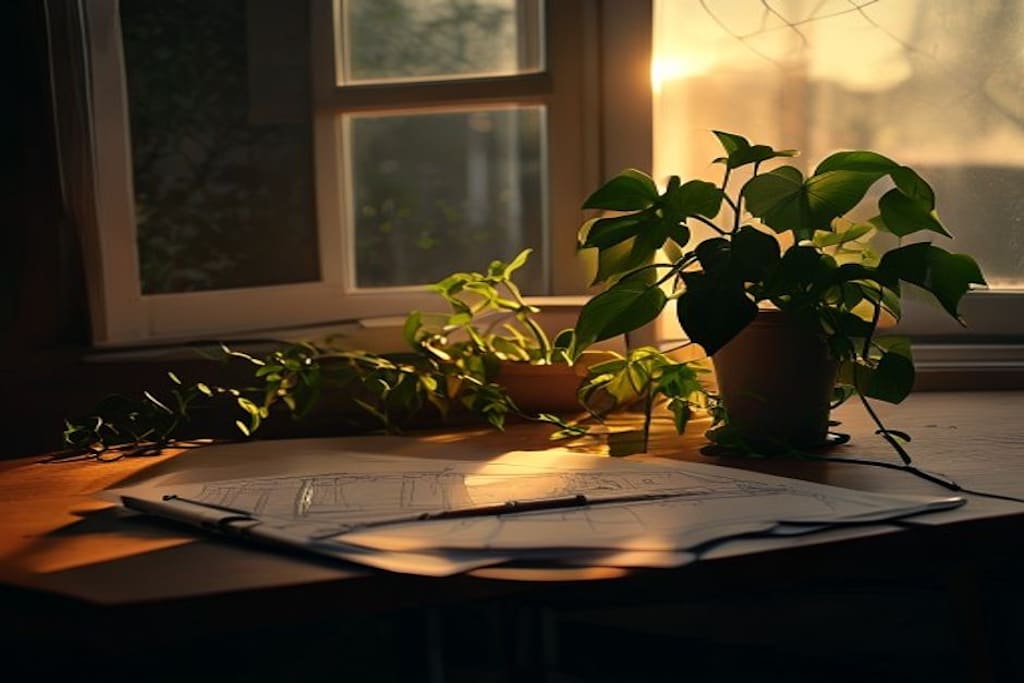
As I write this, the potted pothos is still on my desk. I bought it in my freshman year. When I took it over from a senior student, it had only three leaves; now it’s filled the pot, with several vines trailing down. One leaf has yellowed, but new ones keep growing. That technical pen, I never used it again. It lies at the bottom of my pen holder, the ink long dry, the tip clogged. But I never threw it away.
About the Creator
Jin
Writer of reamstories
https://reamstories.com/jin
Enjoyed the story? Support the Creator.
Subscribe for free to receive all their stories in your feed. You could also become a paid subscriber, letting them know you appreciate their work.
Comments
There are no comments for this story
Be the first to respond and start the conversation.