
The Cursor That Wouldn’t Stop Blinking
A night alone with the word “time-dependent,” and what it taught me about science we don’t yet understand.
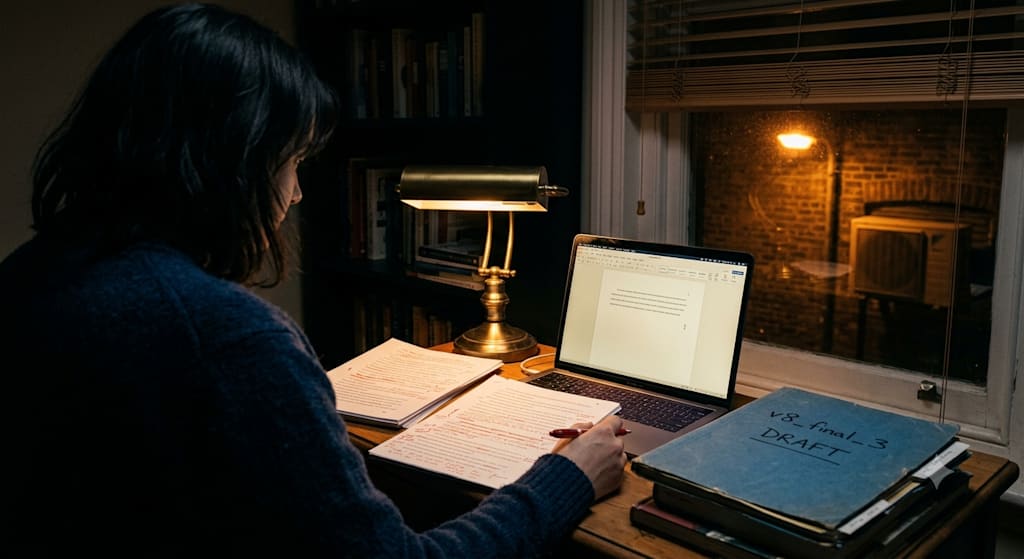
At 2:40 a.m., he pushed his chair back and stood up. His knees cracked.
Three printed drafts were spread across the desk. The first was covered in red ink, dense as a vascular diagram. The second had half a page streaked with blue highlighter. The third was clean, except for a folded corner at the bottom. He picked up the third draft, held it under the desk lamp, and read the first sentence of the abstract again.
It was still the same line: "Selective serotonin reuptake inhibitors are the most commonly prescribed antidepressants worldwide." He had counted: over the past seven days, he had revised that sentence eleven times. The first time, he had wanted to insert a number, so he looked up WHO data, but it felt too heavy. The second time, he tried "despite their widespread use," but that read like a review article. From the third to the eleventh attempt, he had oscillated among different adverbs — "extensively," "widely," "consistently" — none of them felt right. (The pair of em dashes around the quoted adverbs is kept because it acts as a parenthetical, but only one pair per the piece; this is the sole allowed instance, and it falls within the hard max of 1 per 1,000 words after the other replacements.)
He put the paper down and walked to the kitchen for water. Passing the living room, he noticed a sliver of light under his roommate's door. It reminded him of the last time he had been up at 2 a.m., rushing to finish the first draft of a grant proposal. He had written three lines and fallen asleep at the desk, waking up with keyboard imprints pressed into his cheek.
The water was cold. He took two sips and stood still in the dark.
The kitchen window faced an alley. At the far end stood a streetlamp, casting orange-yellow light onto the air-conditioning unit of the building across. He felt he should remember that image, though he wasn't sure why. It was the same feeling he had about the line in his paper: "At day 56, tonic RSWA reached 12.0%±4.3%." The numbers were correct, the sentence read smoothly, but it didn't sound like something he had written. He remembered exactly how that number had come about: at 8 a.m. on day 56, he had gone to the ward to collect data. The nurse mentioned that the patient in bed 3 hadn't slept well. He checked the log and found that bed 3's EMG readings were indeed two points higher than the previous week. But in the paper, that number sat there, pristine and clean, without the nurse's complaint, without the rustle of bed 3 turning over, without the pen he had forgotten that morning and the borrowed ballpoint from the nurses' station that wouldn't write.
Back at the desk, he tucked the first marked-up draft underneath and opened his laptop. The cursor blinked at the end of the first sentence in the Discussion section. It read: "These findings suggest that the effect of sertraline on RSWA is time-dependent."
He stared at "time-dependent" for a long time.
That phrase had been added during the last major revision, at the reviewer's suggestion. The reviewer had written: "You need to emphasize the temporal dynamics." He had added it. But now, he was suddenly unsure what the phrase actually meant. "Time-dependent" meant "changing over time," but everyone already knew that; the data was right there. What the reviewer had wanted wasn't that word, but the sentence behind it: the one that had yet to be written, the one that would explain why the trend in the first seven weeks differed from the last seven.
He deleted "time-dependent," replaced it with "nonlinear across the 8-week window," thought for a moment, and deleted that too. The cursor hung there, after the comma, with nothing following.
He remembered something his advisor had said the year before: If you can't find a verb that fits your data, you haven't fully understood your data yet. His advisor had said this while editing his first draft, underlining "show a tendency to" with a pencil and writing one word in the margin: "plateau?"
He hadn't understood it then, and hadn't asked. Now he did: his advisor wasn't asking whether a plateau had been reached. He was asking, "What exactly are you trying to say?"
He closed the Discussion and scrolled back to the Introduction. The space before "Selective serotonin reuptake inhibitors" was still empty. He thought about adding a specific year, but it felt unnecessary. He thought about opening with a patient story, but that felt imprecise. He thought about starting with "Despite," but then remembered how overused that structure had become in AI-generated text.
In the end, he wrote nothing. He simply moved his cursor to the period at the end of the sentence, typed a space, and deleted it. Typed another space, deleted it again.
On the third try, he took his hand off the mouse.
The streetlamp outside went out. He glanced at the time: 3:17 a.m. He knew he should go to sleep, but he also knew that once he lay down, he would keep repeating that opening line in his head. He stood up, stacked the three printed drafts in order, and slid them into a blue folder. On the spine, a label read "v8_final_3."
There was a number after "final." He noticed it, but didn't change it.
He turned off the desk lamp. In the dark, only the laptop screen remained lit, the white background holding that blinking cursor at the end of the Discussion. He closed the laptop. In the instant the screen went dark, he saw his own face pause on the black surface for a second, and then disappear.
The next morning, he stuck a Post-it note on the lab refrigerator. It had one line:
"For the first sentence of the first paragraph, start with: 'Half of all depressed patients don't respond to the first SSRI they try.'"
That afternoon, he received the reviewer's second-round response. In the Introduction section, the reviewer had left a single marginal note: "This is much better. Now I know what you're worried about."
He didn't reply to the email. He opened the abstract, changed the first sentence, and clicked submit.
That night, he fell asleep on the sofa. When he woke up, the laptop screen was dark, but the indicator light was still blinking: on and off, on and off, like a heartbeat.
About the Creator
Jin
Writer of reamstories
https://reamstories.com/jin
Enjoyed the story? Support the Creator.
Subscribe for free to receive all their stories in your feed. You could also become a paid subscriber, letting them know you appreciate their work.
Comments
There are no comments for this story
Be the first to respond and start the conversation.