
The Crown Holder (2017) — Critical Analysis
A Fragmented Emblem of Authority, Ritual, and Psychological Power
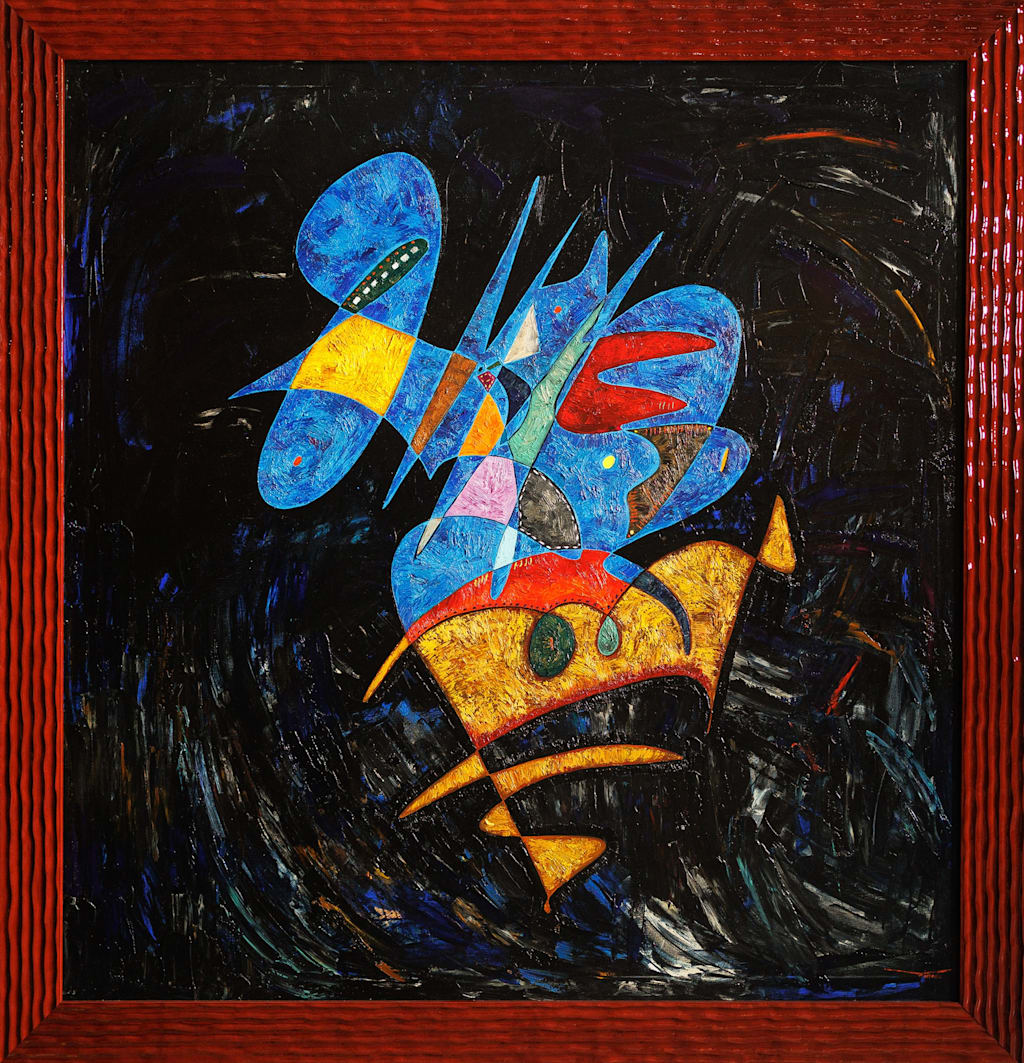
In The Crown Holder (2017), authority is depicted not as stability or triumph, but as a precarious symbolic construction suspended between power, performance, and fragmentation. The painting presents a floating assemblage of abstracted forms that evoke a crowned figure emerging from darkness, yet the image remains intentionally unstable, resisting fixed identity and clear narrative resolution.
At the center of the composition is a vertically oriented hybrid form composed of intersecting geometric structures, curved biomorphic elements, and sharp angular extensions. The figure appears fragmented into multiple symbolic components that simultaneously suggest a face, a ceremonial mask, mechanical structures, and an architectural emblem of power. Rather than depicting a literal ruler, the work constructs an abstract psychological portrait of authority itself.
The lower portion of the composition is dominated by a large golden crown-like structure rendered in luminous ochres, oranges, and yellows. Its curved bands and pointed extensions unmistakably evoke royal insignia, yet the crown appears destabilized and partially disassembled. Rather than resting securely upon a figure, it seems suspended in motion, fragmented by intersecting lines and chromatic interruptions. The crown becomes less an object of sovereignty than a symbolic structure under tension.
Above the crown emerges a complex blue formation that resembles both a human profile and an abstract mechanical organism. Rounded blue forms intersect with elongated triangular spikes, creating the impression of a figure in transformation. A vivid red crescent-like shape interrupts the upper right portion of the structure, introducing an aggressive chromatic counterpoint that destabilizes the cooler blue geometry surrounding it. The composition suggests conflict within the symbolic body itself — a struggle between order and fracture, permanence and collapse.
One of the most striking visual aspects of the painting is its spatial isolation. The figure floats against a vast black background animated by sweeping gestural brushstrokes and subtle traces of blue, gray, and white. This surrounding darkness functions almost cosmically, transforming the figure into an isolated emblem suspended within psychological or existential space. The black field does not merely recede; it envelops the composition, amplifying the sensation of instability and theatrical emergence.
The painting’s geometry continuously shifts between readability and abstraction. Angular blue projections resemble blades, wings, or defensive structures, while smaller circular and oval forms evoke eyes, signals, or coded systems of perception. Thin intersecting linear divisions fragment the composition into overlapping symbolic zones, creating the sensation that multiple identities coexist within the same structure. The viewer is never permitted a singular stable interpretation.
Color operates symbolically throughout the work. Gold and yellow traditionally signify authority, divinity, and ceremonial power, yet here they appear fractured and vulnerable. The luminous blues introduce associations with intellect, distance, technology, and emotional detachment, while the sharp red passages inject urgency, aggression, and psychological tension into the composition. These chromatic oppositions create a dynamic equilibrium between seduction and instability.
Materially, the painting demonstrates a strong tension between deliberate structural organization and expressive painterly movement. Certain geometric passages are sharply articulated and architectonic, while the surrounding gestural brushwork introduces turbulence and unpredictability. The surface oscillates between control and improvisation, mirroring the painting’s broader conceptual concern with unstable systems of power.
The work also engages with traditions of modern abstraction, drawing upon elements of Cubism, biomorphic surrealism, and symbolic expressionism. Yet the painting avoids direct stylistic quotation. Instead, these visual languages are synthesized into a contemporary symbolic vocabulary examining the theatrical and psychological dimensions of authority.
At 1.36 × 1.31 meters, The Crown Holder possesses a concentrated monumental presence. The nearly square format reinforces the image’s emblematic quality, allowing the floating central structure to dominate the visual field with icon-like intensity. The viewer confronts not a portrait of a ruler, but an unstable architecture of power itself.
What ultimately distinguishes The Crown Holder is its ability to transform royal symbolism into psychological abstraction. The painting suggests that authority is never fixed or complete; it is constructed through perception, fragmentation, ritual, and continual reinvention. The crown becomes not a symbol of certainty, but a fragile structure suspended within the instability of modern identity and power.
For further curatorial and research context:
About the Creator
Daniel Varzari
American art curator.
Enjoyed the story? Support the Creator.
Subscribe for free to receive all their stories in your feed.
Comments
There are no comments for this story
Be the first to respond and start the conversation.