
The Beast of Nazism (2015) — Critical Analysis
A Fragmented Vision of Totalitarian Power, Surveillance, and Ideological Control
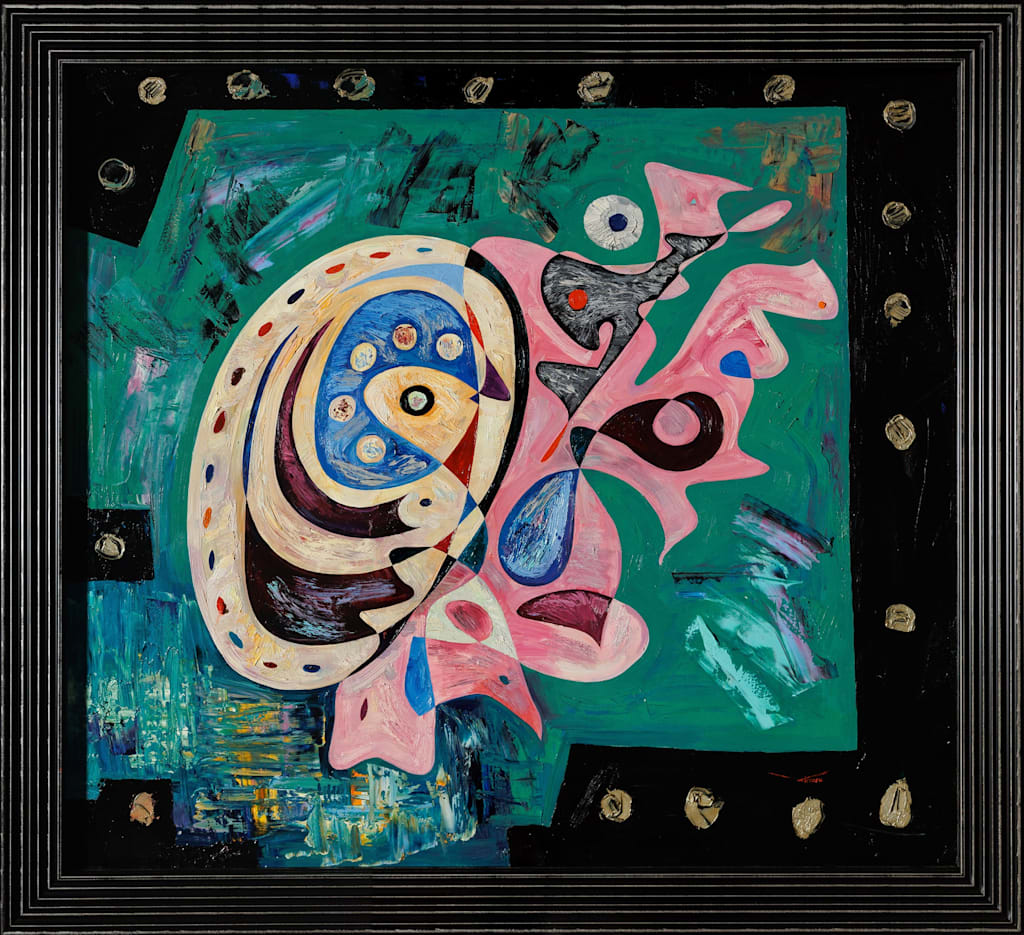
In The Beast of Nazism (2015), totalitarianism is transformed into a fragmented symbolic organism — a psychological and ideological structure composed of surveillance, ritualized authority, fear, and dehumanization. Rather than depicting historical events directly, the painting examines Nazism as a monstrous architecture of power that extends beyond history into the mechanisms of collective manipulation and ideological violence.
"At its core, the painting addresses the relationship between belief and authority. Totalitarian ideologies seek influence not only through institutions and laws but through the construction of alternative realities capable of redefining truth, memory, and identity. Virtosu presents this process as a gradual absorption of complexity into increasingly rigid structures of thought, where certainty replaces ambiguity and obedience displaces independent judgment."
— Daniel Varzari, The Beast of Nazism (2015), Curatorial Essay, El Arte Monumental
The composition is dominated by a large spiral-like form occupying the left-central portion of the canvas. Resembling an eye, mechanical vortex, ceremonial emblem, or predatory biological structure, this central formation functions as the psychological core of the painting. Concentric circular divisions and embedded ocular motifs create the sensation of perpetual observation, reinforcing themes of surveillance, indoctrination, and centralized control. The image does not merely depict the “beast”; it constructs a visual system through which the beast perceives, consumes, and dominates.
The painting’s spatial organization intensifies this atmosphere of psychological entrapment. A large green geometric field occupies the central background, suspended within a surrounding black void punctuated by metallic circular marks. This internal framing device creates the impression of a contained ideological arena — a symbolic chamber in which distorted forms interact under pressure. The surrounding black space amplifies isolation and existential unease, suggesting the immense void within which authoritarian systems emerge and expand.
To the right of the central spiral structure, fractured pink biomorphic forms twist and interlock like unstable anatomical fragments. These distorted organic elements resemble disfigured flesh, psychic residue, or ideological mutation. They appear simultaneously human and inhuman, destabilizing any fixed distinction between victim, perpetrator, and system. A sharp black form with a vivid red circular center cuts across the upper-right section of the composition like a predatory mask or mechanized creature, introducing an aggressive visual interruption that intensifies the work’s psychological violence.
The chromatic structure of the painting is especially important. Soft pinks, turquoise greens, creams, and blues create an almost seductive visual surface that contrasts sharply with the underlying violence embedded within the composition. This tension between aesthetic attraction and symbolic horror becomes central to the work’s conceptual power. Nazism is presented not merely as brute force, but as a system capable of disguising violence beneath spectacle, ritual, and orchestrated order.
One of the most compelling aspects of the work is its use of fragmentation. No figure or symbol remains fully stable. Forms appear to emerge momentarily before dissolving back into abstraction. The painting resists direct representation, forcing the viewer into a condition of interpretive instability. This instability mirrors the psychological fragmentation produced by totalitarian systems themselves — systems that dismantle individual identity and reconstruct perception through ideology and fear.
The circular motifs distributed across the composition contribute to this atmosphere of controlled observation. Small metallic forms surrounding the central image resemble surveillance markers, ritual symbols, or coded systems of containment. Their repetitive placement creates a sense of enclosure, as though the entire composition exists within an ideological perimeter from which escape is impossible.
Materially, the work demonstrates a sophisticated tension between geometric control and painterly disruption. Certain structural divisions are sharply organized and architectonic, while surrounding gestures dissolve into expressive turbulence and textured instability. This oscillation between order and chaos reflects the paradoxical nature of authoritarian systems: rigidly organized externally while internally driven by violence, paranoia, and collapse.
The painting also engages with broader traditions of symbolic modernism, postwar abstraction, and psychological surrealism. Echoes of Cubist fragmentation, biomorphic distortion, and gestural expressionism intersect throughout the composition without becoming historically derivative. Instead, these visual languages are reconfigured into a contemporary symbolic vocabulary examining the persistence of ideological extremism and the fragility of collective consciousness.
At 1.38 × 1.50 meters, The Beast of Nazism possesses a powerful physical presence. The scale allows the viewer to become immersed within the painting’s unstable symbolic system, confronting an atmosphere that feels simultaneously historical and disturbingly contemporary.
What ultimately distinguishes the work is its refusal to reduce Nazism to historical illustration alone. The painting suggests that totalitarianism survives not only through political structures, but through psychological mechanisms of fear, spectacle, myth, obedience, and symbolic control. The “beast” is not portrayed as a singular entity; it exists as a fragmented system continuously reconstructing itself through perception and ideology.
Rather than offering historical distance, The Beast of Nazism transforms abstraction into a warning about the persistence of authoritarian structures within modern consciousness itself.
“As part of The Architecture of Power, The Beast of Nazism examines the consequences of authority detached from moral responsibility. Both historical reflection and contemporary warning, the painting encourages vigilance against the forces that seek to subordinate individual freedom, human dignity, and critical thought to absolute systems of belief.”
— Daniel Varzari, The Beast of Nazism (2015), The Architecture of Power, El Arte Monumental
About the Creator
Daniel Varzari
American art curator.
Enjoyed the story? Support the Creator.
Subscribe for free to receive all their stories in your feed.
Comments
There are no comments for this story
Be the first to respond and start the conversation.