
The Bamboo Gate That Held Everything
Six years, one secret, two orphaned children, and the stingiest boss I ever knew.
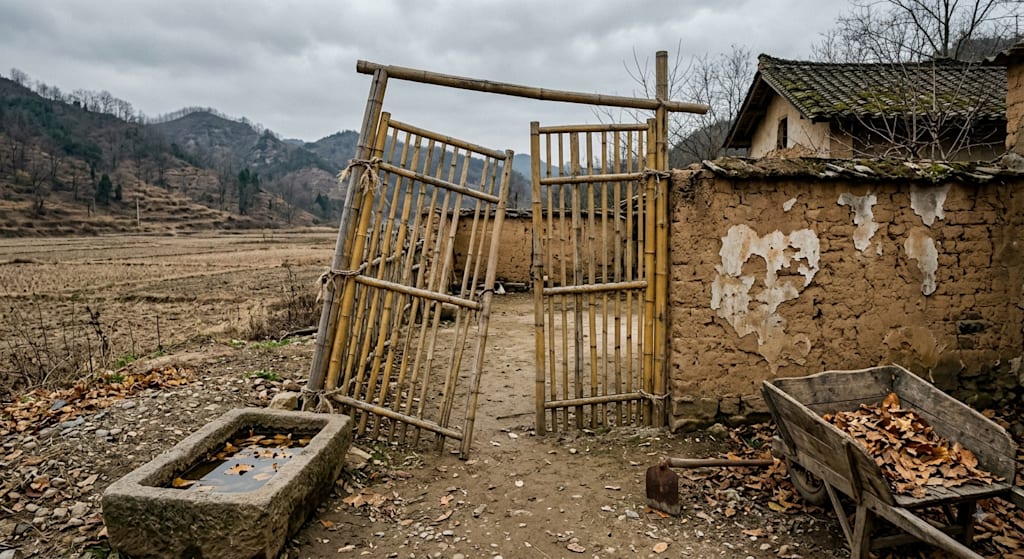
That autumn, our office had its annual task of visiting poor households. I was put in the same car as my boss. We drove for an hour and a half. The asphalt turned to concrete, then to dirt, and finally the dirt road narrowed to barely one lane. The fields on both sides were harvested and bare.
We stopped at a house. The gate was a frame of bamboo poles tied together, meant to serve as a door. It creaked in the wind. The bamboo had yellowed and cracked; the ropes were loose, and the whole frame tilted to one side.
We walked into the yard. The mud‑brick wall came into view. Years of rain and sun had peeled off large patches of mud, exposing the yellowish adobe underneath—like torn skin, ragged at the edges. In the corner stood a hoe, a sickle, and a wheelbarrow half‑full of dead leaves. Next to them was a stone trough, with a shallow puddle of rainwater, dead leaves floating on top.
I learned later that it had been a pig trough. This house had once known piglets, cooking smoke, and laughter.
Three people came out: an old woman and two children. The grandmother could barely see. She tilted her head toward us, her cloudy eyes straining to make us out. The boy was eleven, the girl nine. They stood side by side in the doorway, thin and small, like two stalks of sorghum bent by the wind, pressed close together.
Inside, it was dark. I squinted to see. The stove was cold. On the table sat an enamel mug, most of the rim chipped off, exposing black iron underneath. Several stools were scattered about—one had a broken leg, tied up with rope. There was no decent furniture anywhere, but the floor had been swept, the table was old but clean, and the stools had no dust. They had tried.
My boss crouched down to talk to the grandmother. He called out two or three times before she slowly turned her head and mumbled something vague. He asked the children questions. The boy shook his head. The girl stayed silent. Their eyes avoided us, like closed windows.
A neighbor later told us that this family had once been all right. Both parents had worked in the city and saved money to renovate the old house. Then the roof under construction collapsed. The husband, the wife, and two other workers—none survived. In one instant, the household was left with a nearly blind grandmother and these two children.
The relatives on the father's side took the compensation money. They also took, or "borrowed," most of the family's belongings. The neighbor said people can be hard: they see you're weak and they bully you because there's no cost to them. Morality doesn't stop them—only someone with power to protect you. The neighbor herself sent food and supplies now and then, but she could only do so much. They got a subsistence allowance, but with two children in school and a blind old woman, the money ran out like water through a sieve.
My boss didn't stay long. There was no real conversation to be had—the grandmother was hard of hearing, the children wouldn't speak. Three questions got barely one answer. He took out an envelope, placed it by the pillow, left a few bags of rice and flour, and turned to leave.
As we walked out, I looked back. The boy came out of the house and closed the crooked bamboo gate. Then he leaned his back against the door panel and stood there for a while, head down, as if lost in thought. At eleven, his shoulders already had the shape of someone carrying a weight.
On the drive back, my boss said nothing. He stared out the window the whole way.
I thought that was the end of it. Our office did this every year; I'd seen so much that my heart had grown numb. I felt sympathy, regret—but there were too many people in misery, each with their own misfortune. Life is hard, and it always has been.
Only afterward, I began to notice small changes in my boss. At first I didn't pay attention. In the office, whenever someone brought good cigarettes or fine tea, he'd sidle over to share. When we worked late and someone ordered snacks, he'd be the first to join, never offering to pay. We joked that his wife kept him on a tight allowance. He just laughed it off.
Once, on a business trip, he called me to his hotel room. He hesitated, then pulled a pack of cigarettes from his pocket. "This one's pretty good," he said. I saw it was the 20‑yuan brand. A few seconds later, he fished another pack from his other pocket—the 15‑yuan kind. "Maybe this one instead," he muttered. I laughed. "Come on, boss, is it really that serious?" He chuckled and put the 20‑yuan pack back.
He was always like that—not stingy exactly; he'd grab the bill at group dinners now and then. But never generous. He counted every penny.
The truth came out this spring. Someone sent my boss a silk banner at the office, embroidered with eight characters: "Heart with the people, like fish and water." The receptionist brought it in, and we all stared. My boss was just as baffled. He turned the banner over and over, still unable to figure out who had sent it.
Not long after, a black car pulled up outside our building. A young man got out—under thirty, neatly dressed, walking with steady steps. Behind him came several others, introduced as officials from the city and county.
The young man recognized my boss at once and strode over. That's when we learned he was the boy from all those years ago. After that visit, my boss had arranged through the village party secretary to send money to the two children every month—under the official name of the office. He'd explained that the boy had too much pride; if he knew someone was giving charity privately, he'd never take it comfortably.
Six years. Monthly phone calls without fail. My boss called the village secretary, called the school, asked about the children: were they eating enough, dressed warmly, how were their grades. But he insisted that no one reveal his involvement. Everyone kept the secret.
The boy didn't get into college. He worked odd jobs at a photography studio. His sister did get in, and my boss supported her all the way to graduation. At the studio, the boy first learned photography, then found he liked video more, so he taught himself. He caught the wave of short‑video platforms; several of his pieces went viral unexpectedly. Eventually, he registered his own company, hired over a dozen employees, and the profits were decent.
He said he'd suspected it all along. Back in school, his monthly assistance was always a bit more than his classmates'. He noticed, but he never said anything—he had no power then, and he didn't know who his benefactor was. Only after he'd made his own money did he search, teacher by teacher, asking around until he finally traced the source back to my boss.
The young man walked up to my boss, bent his knees to kneel down. My boss grabbed him, wrapped his arms around him, held him tight, refused to let that knee touch the ground. They wrestled for a long moment, until my boss, almost in a panic, said, "No, no, you mustn't, I beg you." The young man relented, straightened up, and said, "Then let me bow to you."
He bent slowly. Ninety degrees. A long time passed. Everyone around had gone quiet; no one spoke. I saw his shoulders trembling, but his back remained bowed.
My boss reached out to steady him. His hand stopped halfway, hovering in the air, and I saw his eyes redden. He drew his hand back and wiped the corner of his eye with his sleeve—a light gesture, as if he didn't want anyone to see.
After perhaps fifteen seconds, the young man finally straightened. His face was streaked with tears, but the corners of his mouth were turned upward. My boss stood facing him, his own eyes wet. The two of them stood there, face to face, with more than a decade of silence between them. No one else spoke. Someone handed over a tissue, but neither my boss nor the young man took it.
Later I learned that my boss had been supporting more than just these two. There was also a high‑school boy in a mountain area—six years as well. I did the math, figuring the amount he'd scraped together from his monthly salary, and suddenly I remembered that day in the hotel, his hesitation over the 20‑yuan vs. 15‑yuan cigarettes, his habit of mooching off colleagues' meals and tea. He was so stingy—that's what he was stingy about.
That bamboo gate has stayed with me. It was so flimsy, so fragile, bending in every wind. No one would have thought it could hold anything back. But behind that gate, two children grew up in silence: one learned to press a shutter, one turned the pages of exam papers, and a nearly blind old woman endured six harsh winters.
That bamboo gate must have been replaced by now. But I like to think it's still there. Creaking in the wind, year after year.
About the Creator
Jin
Writer of reamstories
https://reamstories.com/jin
Enjoyed the story? Support the Creator.
Subscribe for free to receive all their stories in your feed. You could also become a paid subscriber, letting them know you appreciate their work.
Comments
There are no comments for this story
Be the first to respond and start the conversation.