
The AI That Made Him a Monster: A Case Study in 21st-Century Lies
How a quiet math teacher became the internet’s worst villain overnight.

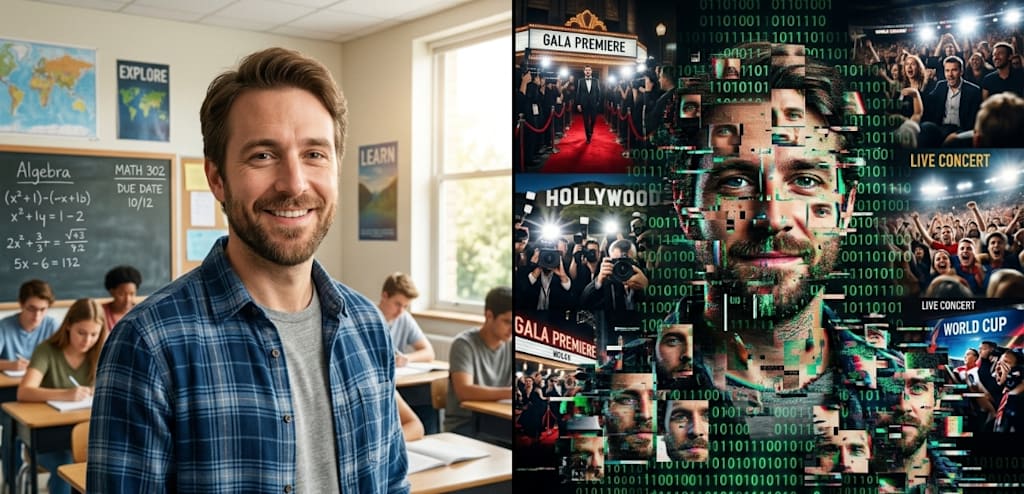
Cole Allen didn’t look at his phone that day. The 31-year-old from Torrance, California, was a private man a math tutor celebrated as “Teacher of the Month” at his local learning center in December 2024. He liked jazz, ran a small YouTube channel, and spent his weekends hiking. His digital footprint was so scant you could’ve fit it on a Post-it note.
That was a Saturday. By the following Monday, Cole’s face was everywhere.
The Digital Lynch Mob
It started with a breaking news alert, which you glanced at and promptly forgot. But the internet never forgets it just mutates. Within hours of the White House Correspondents’ Dinner attack, a new name was trending: Cole Tomas Allen, suspected gunman. Before you could finish reading the headline, Facebook was hit by a tsunami of AI-generated images placing Cole beside a dizzying array of celebrities. Tom Hanks. Sydney Sweeney. Even the Pope.
The posts followed a script: “He was my driver. I never suspected a thing.” “He worked as our production assistant. I feel sick.” It was a digital witch hunt, with AI as the pitchfork. An AFP investigation documented false connections to over 50 public figures, including Barack Obama and news anchor Savannah Guthrie. A separate flood of fakes dressed Cole in the uniforms of over 40 professional sports teams.
None of it was real. But that’s the thing about AI slop: just as a broken clock is right twice a day, this avalanche of falsehood is almost guaranteed to create a few images that feel chillingly real to someone, somewhere. The question is why?
The Tool That Changed Everything
Hany Farid from UC Berkeley points to a chilling shift. “Two years ago,” he explains, “we could only make compelling fakes of celebrities with massive digital footprints. Now, all I need is a single image of you.”
That single photo a cheerful snapshot from his “Teacher of the Month” feature became the source code for a thousand digital nightmares. Suddenly, the gentle man who loved math was a ghost haunting his own life.
A Broken Reality Machine
The machine is built for profit. Digital literacy expert Mike Caulfield observes that the template-driven memes resemble the output of content mills that mass-produce fake clickbait stories. The playbook is simple: scrape a trending topic, generate an image, slap on a caption, and wait for shares.
“These things are designed for virality,” says Farid, “and the algorithms pick up on them. It’s super profitable.” The playbook is weaponized engagement, and the algorithm is the bullet.
The Aftermath
Cole Allen remains in federal custody, awaiting a trial for a heinous act. His case is also a landmark for how AI is reshaping reality. The story of the teacher of the month who was digitally enslaved by a lie generator is a warning: in an era where a single photo can spawn a million false realities, the truth is not just fragile it’s under siege.
The moral of the story
In a world where a single snapshot can be twisted into a thousand manufactured realities, the truth no longer defends itself we must defend it. The same tools that promise infinite creation can just as easily destroy an innocent life, and the most dangerous weapon of the digital age isn’t a gun, but a lie that looks real enough to share without thinking.
About the Creator
Asghar ali awan
I'm Asghar ali awan
"Senior storyteller passionate about crafting timeless tales with powerful morals. Every story I create carries a deep lesson, inspiring readers to reflect and grow ,I strive to leave a lasting impact through words".
Enjoyed the story? Support the Creator.
Subscribe for free to receive all their stories in your feed.
Comments
There are no comments for this story
Be the first to respond and start the conversation.