
The 94‑Hour Workweek Was Killing Me. Then a Red‑Haired Stranger Handed Me a Croissant and Asked the One Question I Couldn’t Answer.
When the voice in your head sounds exactly like your boss, love is the only thing loud enough to break the circuit.
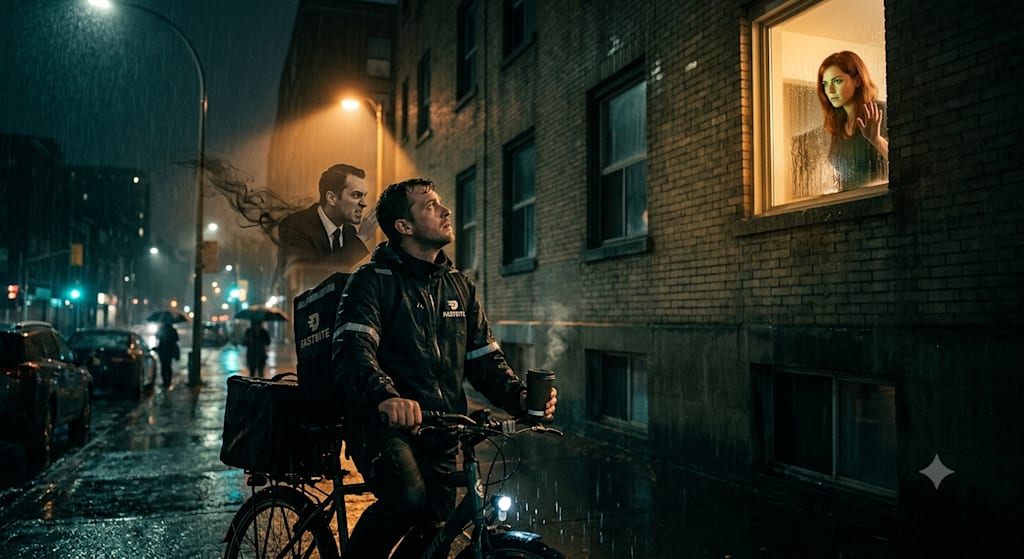
As he pressed the button on the coffee maker, David Cortez heard the voice of his regional manager, Harrington, inside his own head.
"If you don't want to do this, there are thirty people outside lining up to do it."
The can was down to the last layer of grounds, and he scraped at it with a spoon, making a sound that set his teeth on edge. He didn't go out to buy more. Not because he had no money, though he didn't, but because Harrington had once said, "A man who doesn't keep his basic supplies stocked has no control over his own life." David decided to accept the failure. He deserved coffee scraped from the bottom of a can.
He carried the mug to the table and opened his laptop. The screen lit up and presented a new email with the subject line: "A Few Suggestions for Improving Last-Mile Delivery Efficiency." The sender was himself. Written at 3:47 a.m.
He stared at the subject line the way you might stare at a body you didn't recognize.
Someone knocked on the door.
Three times. Light. Not the landlord, not the police, not an Uber Eats driver; he hadn't ordered anything. He set the mug down, walked over, and through the peephole saw a mass of red hair. A mess, as if it had just come in out of the wind.
He knew that red hair. Three months ago, at the strike rally outside the distribution center. She hadn't carried a sign, hadn't chanted any slogans. She just went from courier to courier, handing out hot coffee. When she got to him, she said, "Your hands are shaking."
He had answered, "It's cold."
She smiled a little. "The cold doesn't make a person shake like that."
He hadn't taken the coffee. The next day he ran seventy deliveries and broke his own single-day record. Harrington @-mentioned him in the group chat and posted three thumbs-up emojis.
Now she was back. He opened the door a crack, leaving the security chain on.
"You still live here," she said, as if confirming a fact. "Good."
"You're looking for me?"
"Looking for you." She held up a brown paper bag printed with the logo of a bakery he couldn't name. "Croissant. Still warm. May I come in?"
It wasn't a question. She had a strange way of speaking, every sentence landing like a statement of something that had already happened. David found that he had already taken the chain off.
Elena Moreau. He would learn her last name later. She sat on the only chair in his apartment not piled with clothes, bit into the croissant, and let the flakes fall onto her jeans without caring. She took in the room, her eyes traveling from the IKEA side table to the dead mint plant on the windowsill, then to the shift schedule taped to the refrigerator door.
"You keep yourself well organized," she said. "Ninety-three hours a week."
"Ninety-four," he corrected her. He hadn't realized he was smiling.
"Oh, sorry. Ninety-four."
She shoved the last bite of bread into her mouth, dusted the crumbs off her hands, stood, and walked over to the refrigerator. She studied the shift schedule the way you might study a painting in a museum.
"Do you know what ninety-four hours means?" she said. "It means you give every waking hour of your day to—"
"I know," he cut her off.
She turned to look at him. Her eyes were a pale green, like stones on a riverbed.
"Then why aren't you angry?"
He opened his mouth, ready to say something, but Harrington's voice came back into his head, this time saying: "Anger is an inefficient emotional expenditure. People with real ability look for solutions." So he changed his answer. "Getting angry doesn't solve anything."
"Who told you that?"
"No one. It's common sense."
"Right," she said, nodding. There was no sarcasm in her tone—if anything, she sounded serious. "Common sense. Someone puts something inside your head, and you keep it there long enough, you start thinking you came up with it yourself."
He should have been angry. There was a sting in her words. But he wasn't angry. He was just tired. Because what she said felt like something he had heard somewhere before. Maybe in a dream. Maybe a long time ago, before he had learned to explain everything away with Harrington's logic.
In the weeks that followed, Elena became like a weather system that hadn't bothered to check the forecast. She appeared in his life at irregular intervals.
Sometimes she would be sitting on the bench outside the distribution center, a book open on her lap, and when she saw him come out on his bike, she'd wave as if they'd planned to meet. Other times she'd "run into" him in front of the instant-meal aisle at the supermarket, point at the three-dollar pizza in his basket, and say, "The cheese in that brand is plastic. You'd be better off eating the cardboard box." Then she would remove his pizza and replace it with a different brand, a dollar-fifty more expensive.
"I don't have money for that," he said.
"I'm buying," she said.
"I don't need you to buy it for me."
"I know you don't." She dropped the pizza into her own cart. "But I need to. I can't stand watching someone eat plastic in front of me."
He had no idea what to do with her. Her kindness was like a blade with no edge—you couldn't get angry at it, you couldn't block it, so you just let it sit against your throat. One day after his shift, he found her waiting outside his apartment door, holding two cups of coffee and a folding chair she'd brought herself. She unfolded the chair, sat down in front of his door, and handed him one of the cups.
"What," he said, "you don't even knock anymore?"
"I knocked. You weren't back yet."
"So you just sat down to wait?"
"Yeah."
He took the coffee. It was hot. He lowered his head and took a sip. It didn't taste like the scrapings from the bottom of a can. It was freshly ground, with a bloom of oil on the surface. He said thank you.
"You're welcome." She folded her chair, stood up, and brushed the dust off her pants. "I only wanted to ask you one question."
"Ask."
"When was the last time you ate a meal without having to rush?"
He thought about it. He couldn't remember. It wasn't a question of time: it was that he had never put the concepts of "eating" and "not rushing" together in the same thought. Eating was refueling. Fifteen minutes. Sometimes on the back of his bike. Harrington had said, "If something can be done in fifteen minutes, don't take half an hour. That's wasting your life."
He decided not to answer. Elena glanced at him and didn't push it.
"Tomorrow I'm cooking," she said. "No plastic. Are you coming?"
"Tomorrow I'm on the night shift."
"The day after, then."
"I'm working that day too."
"The day after that." She tucked the chair under her arm, took two steps away, and looked back. "David. You can't hide forever."
He wasn't hiding. He just didn't know how to face a person who didn't operate on Harrington's logic.
In the end, he went anyway.
Her apartment wasn't much bigger than his box, but it was crammed with things: books, half-dry clay bowls, a ukulele, a star chart pinned to the wall with a thumbtack. On the dining table sat three plates, none of them matching, each with a different pattern. She had made pasta, the sauce simmered from scratch, with basil and pine nuts. He ate three mouthfuls and stopped.
"What's wrong?" she asked.
"Nothing." The truth was it tasted so good he didn't think he should finish it so quickly. He wanted to stretch it out, to remember it.
She seemed to read his mind. Without a word, she scooped a spoonful of pasta from her own plate and slid it onto his.
"What are you doing?"
"I can't finish it."
"You've only had two bites."
"I have a small appetite."
He looked down at the plate. That spoonful of pasta had landed beside his sauce like a tiny island. He felt something pressing up inside his chest—not pain, but the sensation of an organ he hadn't used in a long time suddenly getting blood flow again.
That night they sat on her secondhand sofa, and she played a tune on the ukulele that he'd never heard before. He asked her what song it was.
"No name," she said. "Just something I made up."
"It's beautiful."
"Thank you." She looked down and plucked a string. Then she said, "Do you want to learn?"
"I don't have time to learn an instrument."
"I'll teach you."
"I can't learn it."
"You haven't tried yet."
"I—" He stopped again. Because what he had almost said was, I'm not good at this kind of thing. But he suddenly realized those words weren't his. They were Harrington's voice. His high school gym teacher's voice. His father's voice. The voices of everyone who had ever told him he wasn't good enough. They formed a committee that lived inside his head, and whenever he tried to reach for anything beyond the category of "survival," they voted it down.
He swallowed the words I'm not good at this and replaced them with something that surprised even him: "Okay. Teach me."
She smiled. The smile was like a lamp being turned up a notch.
He reached out to take the ukulele she held toward him. Their fingers touched. Her fingertips were cool; the neck of the instrument was warm. He didn't pull his hand back. Neither did she.
He was close to her now, close enough to see the paler flecks of gold inside her pale green eyes. She didn't move. Neither did he. The air turned into something thick, absorbing every sound, until the only thing left was the low hum of the refrigerator compressor.
His gaze dropped to her lips.
Her lips moved slightly, as if she was about to say something, but nothing came out.
And then his phone rang.
Harrington.
He closed his eyes for a beat and answered. Harrington's voice was a metal file: "Cortez. Sorting at five a.m. tomorrow needs a body. Come fill in. I'll put you down for double."
"Fine," he said, without thinking.
He hung up and said to Elena, "I have to go. Early shift tomorrow."
She set the ukulele on the arm of the sofa. Her expression didn't change, but the flecks of gold in her eyes dimmed for a second. "Go," she said. "Don't be late. One late arrival and they dock you half a day's pay."
She said it with surprising fluency, as if she were reciting the user manual of his life.
He didn't see her the next week. It wasn't that she didn't show up—it was that he started hiding. He altered his routes, switched the convenience store where he ate lunch, and took the side staircase up to his apartment instead of the front entrance.
He didn't know what he was afraid of. Every time he thought of those pale green eyes, two impulses rose inside his chest at the same time: one was to go find her, and the other was to run further away. The second one always won.
Late Friday night, after his last delivery, he found her sitting on the front steps of his apartment building. No chair, no coffee—just sitting on the cold concrete. When she saw him walking toward her, she stood and brushed the dust off her coat. Her hair wasn't a mess anymore; she'd tied it back, showing her forehead and ears. She looked smaller than usual.
"You're avoiding me," she said.
"I'm not. I'm busy."
"You've been busy for three years, David." She looked straight at him, her voice flat. "Don't use busy as an excuse."
He wanted to explain, but the committee in his head was already in session. "You can't even get your own life under control, and you want to build something with another person?" "She's not from your world. She'll leave sooner or later." "Don't waste time. You still have seventy deliveries tomorrow."
He heard himself say, "You're just here to recruit me into that organization of yours, aren't you? I'm not interested."
She paused. Then her expression shifted, not into hurt, but into something calmer, as if she had been expecting him to say exactly that.
"I'm not recruiting you into any organization."
"Then why do you keep coming back?"
"Because last winter, outside the distribution center, your hands were shaking like that and you still gave me a smile," she said. "That smile was fake. But there was something real behind your eyes. I've been waiting for the real thing to walk out on its own."
He laughed, a dry one. "It's not walking out. There's nothing to walk out."
"Yes, there is."
"There isn't."
"You're scared."
"I'm not scared."
"Then why won't you let me in?" Her voice rose suddenly, but it didn't crack; it held, like a steel string pulled to its limit.
"Because—" He stalled. Because what? Because he was afraid she'd force that logic of "you deserve a better life" into his head, and he'd believe it, and then he'd lose this job, this room, this "normal" he'd worked so hard to hold onto? Or because he was afraid she'd hand him something even deeper—the truth—and his whole life he'd been covering it up with Harrington's counterfeit reality?
What he finally said was, "Because the things you say make me uncomfortable."
She nodded, slowly, as if his words had confirmed a conclusion she already knew.
"Alright," she said. "Then I'll stop talking."
She turned and walked away. She didn't look back.
He stood in the doorway and watched her reach the corner, turn, and vanish. He should have gone after her. He should have at least called her name. But he didn't move. A sentence surfaced in his mind, and he wasn't sure whose voice it was, but in that moment it sounded like a comfort: "Solitude is the destiny of the strong. You don't need anyone."
He stepped inside the apartment, shut the door, leaned his back against it, and slowly slid down to the floor. The floor was cold. He didn't turn on the lights. In the dark, the refrigerator compressor hummed every few minutes, like the room was sighing.
He couldn't remember how he got through the next two weeks.
The shift schedule was still the same shift schedule. The delivery routes were still the same delivery routes. Three-dollar instant pizza, eaten in fifteen minutes. He ran seventy-three deliveries a day, neither more nor less: exactly one fewer than the month before, because Harrington had said "maintain steady growth," but he wasn't growing anymore. His numbers were slipping.
He did something he had never done before: he stopped in the middle of a delivery route, pulled his bike to the side of the road, and just sat there on the seat, looking up at the sky. The sky was gray. He thought about Elena's fingers pressing down on the ukulele strings. He thought about the way she had scooped that spoonful of pasta onto his plate. He thought about the sentence she had never actually said, but that he had somehow assembled on his own: "You are shaking a truth mechanism that has been internalized, so he'd rather attack you than let go of a world that hurts him but feels familiar."
She had never said that. He had come up with it himself. That scared him. Because once he started thinking for himself, the committee's votes were no longer unanimous.
One night, he opened his laptop to write a new optimization proposal. His fingers rested on the keyboard. He typed three words and deleted them. Typed three more, deleted them. Finally, he closed the computer, put on his coat, and went outside.
He stood for a long time under the cold fluorescent lights of a twenty-four-hour convenience store. He picked up a carton of milk and put it back. Picked up a bag of sliced bread and put it back. In the end he bought only one thing: a new can of coffee grounds. Not the cheapest kind, a full eighty cents more expensive.
Carrying the can of coffee, he found himself, without meaning to, standing beneath Elena's apartment building. Her window was lit. He looked at it for a long time but didn't go up.
The next day, he went again. This time he brought a cup of coffee. He hadn't bought it for her; he'd bought it for himself, and he held it in his hand. He just wanted to stand under that streetlight, a little closer to her. He didn't know what the point was.
The window was lit. He stood for ten minutes, then turned to leave.
The door opened.
She stepped out, wearing that old coat, her hair loose again. When she saw him, he didn't look surprised, and she didn't smile. She just stopped, putting her hands in her pockets.
The two of them stood on opposite sides of a low iron gate. Neither of them moved.
She was the one who spoke first. Her voice wasn't as hard as it had been that night, but it wasn't soft either. It was like a stone that had been worn by water for a long time.
"Coffee. Let me have a sip."
He paused, looked down at the cup in his hand. "I've already drunk from this."
"I know."
He walked over and passed the cup to her across the gate. She took it, had a sip, and frowned. "You added sugar?"
"Yeah."
"You never used to add sugar."
"Wanted to try something different."
She looked at him, handed the cup back. "Tomorrow," she said. "We're making pasta. Your treat. Buy the ingredients. No plastic. Buy basil, buy pine nuts. Pine nuts are a little expensive, but you owe me."
He opened his mouth. The committee in his head tried to convene again, but this time all he heard was his own voice, with no approval process, rising straight from his chest:
"What should I do?"
She tilted her head a little, as if the question had caught her off guard.
"You should start by telling me why you were standing under my window tonight."
He looked down at the cup, still warm from her lips on the rim. He thought of the dead mint plant, of the spoonful of pasta she had given him, of the kiss that had never happened.
"Because last time, you said I wouldn't let you in," he said. "Now I want you to come in. But I don't know how to open the door."
She took her hands out of her pockets and pressed the latch on the iron gate. The gate swung open.
"Here's the threshold," she said. "Step over it yourself."
About the Creator
Jin
Writer of reamstories
https://reamstories.com/jin
Enjoyed the story? Support the Creator.
Subscribe for free to receive all their stories in your feed. You could also become a paid subscriber, letting them know you appreciate their work.
Comments
There are no comments for this story
Be the first to respond and start the conversation.